
What is your wind tolerance for boat based hunts???

Have hunted way more than my share of really shitty weather days. Marsh hunting is for sure the way to go when the weather is really bad, extra points if the marsh is such that you can walk home or protected enough to paddle home in an emergency.

Additionally... I don't ever seem to get the gunning that I expect on really windy days. I've had many windy days that I thought that I was going to slay them sitting in a little lee where they like to hang out and the birds hunkered down elsewhere while I sat in the cold waiting for them to abandon caution and join the decoys. Although it goes against conventional wisdom, the brant and black ducks along the rocky coasts in CT I've hunted the past couple decades seemed to fly poorly in the wind (the mergansers, however, they like to fly in the wind) - they were probably headed to some comfortable marsh on long island leaving me in the cold. :)

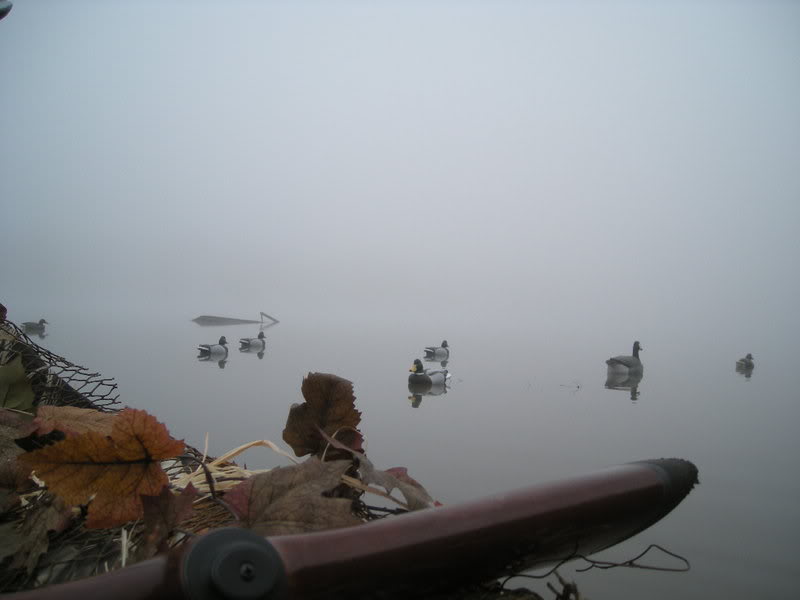
Coated entirely with a sheet of salt ice – I think “rime” is the correct term – I presented a sight to remember. As the coating discouraged any sort of movement, my loyal partner could not help but utter the immortal words of the badly-rusted Tin Man – in The Wizard of Oz: “Oil can!”

Probably looked a bit like this, luckily I had a stout cameraman:
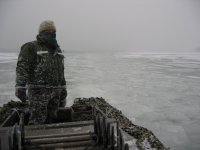
1765050265241.jpeg
 
Last edited:
Growing up a pothole hunter it was more of a ride to and from the islands that we had to run. When I was young it was nothing to jump in the boat and head into the wind pushing 30+ mph. Where I live is where the river runs East to West and our typical winds on the Mississippi River where I live used to come from the north/northwest. Today they mainly come from the west/southwest. Then I hunted with a group of 3 and sometimes 4 partners. You're invincible in your 20s and 30s when you hunt with a group of like minded hunters. The day I was hunting alone and a freak snow storm with wind came up and I couldn't get the boat started and the waves were blowing back against the storm I stayed on the island where our duck blind was. I had some extra clothes in a boat box, a coleman heater in the blind and some canned Hormel stew and a flashlight. The dog and I headed to the blind. Back in those days nobody ever bothered another hunters blinds so I knew I'd be fine. Those old bowl type heaters were always hard to light but finally it kicked off. The winds finally died around midnight. It wasn't bad at all then. Between the heater and the dog I was quit warm. The next morning I had the best hunt I ever had. A limit of Mallards in 30 minutes. I had a lot of time to think about things and the thing that stuck with me was my dad's insisting of being prepared and having emergency plans. Today I carry a small coleman heater, 2, 1 lb propane, a change of clothes, varies gloves, fire starters, some trail mix, energy bars, water, head lamp, small medical kit and a cell phone. I don't go out when the forecast winds are expected to be more than 10 to 15mph out of the west or 20 to 25mph out of the north as I'm protected by the islands when headed to a boat ramp. Today all my hunting partners have stopped hunting or are no longer earth bound. Yes, Im a wuss!
 
There is really nothing that I can add that hasn't been already said. Over the years I pay a lot more attention to the wind and weather. Really depends on where I am going to hunt for the day.
I too hunt long Island Sound, when hunting the big water 10-15 is my cut off. When hunting the Marsh 15-20.

Like most of us I have gotten into some hairy situations, I chalk them up as a learning experience.

Tod- I love the picture you posted,it reminds me of the days when we had the bonus season for Scaup!!
 
I just hunt a salt marsh today, and like Mike-SID, over 15 MPH and gusts I just don't go anymore. Mostly that is because, at least where I hunt, I find the birds sit tight in that wind and don't move around much. That's just my own experience hunting that marsh. I will hunt a field or a land based blind on small water, typically private, in higher winds, but not much higher than 20. I just don't really enjoy anymore, too hard to do everything. The other thing is that on day 2 of a hard nor'wester the water gets blown out of the marsh and Delaware Bay to the point that high tide is not very high and low tide can make creeks that typically hold water at any tide go dry even before low tide. You get stuck on a blow out tide and it can be 8 hours until you can get out, definitely no fun.
I would not hunt high wind on bigger water anymore because I don't want the risk, even if the weather is mild.
 
I just hunt a salt marsh today, and like Mike-SID, over 15 MPH and gusts I just don't go anymore. Mostly that is because, at least where I hunt, I find the birds sit tight in that wind and don't move around much. That's just my own experience hunting that marsh. I will hunt a field or a land based blind on small water, typically private, in higher winds, but not much higher than 20. I just don't really enjoy anymore, too hard to do everything. The other thing is that on day 2 of a hard nor'wester the water gets blown out of the marsh and Delaware Bay to the point that high tide is not very high and low tide can make creeks that typically hold water at any tide go dry even before low tide. You get stuck on a blow out tide and it can be 8 hours until you can get out, definitely no fun.
I would not hunt high wind on bigger water anymore because I don't want the risk, even if the weather is mild.

More wind intolerance than I would have thought, so I'm not the wuss I thought I was!!!! I'll call it wisdom. Thanks all for sharing.

I hunted yesterday from shore and the wind started at 10-15 at sunrise and was up over 30 when I left. Was getting windy enough that I was glad I didn't get the boat. Birds were way down in number and very stale. I think I'd have done better without decoys, but I'm also battling the complete lack of any cover near the water. I was on the "X" and birds were headed for it, but as soon as they were 80 yards out they bailed like I was dancing a jig on the shore.
 
Last edited:
I've been reading this thread all along, but I didn't really have a good answer. The equipment I have now is light years ahead of what we had 50 years ago, at which time I would have said 15 knots offshore, 25 in the marsh. Now I can't really say I get put off by wind because I have great clothes, big boats, equipment to stay warm if we get stuck and the ability to call home.

It's become what the dog can stand, I don't want to leave him home. Today is a perfect example, I planned to go this afternoon. It's in the teens right now, warming to around freezing by noon which is marginal for him but ok. The problem is the ice, there's a lot now and I won't put a dog on or around ice if it can be avoided. There are a few exceptions in really shallow water, but not many. To the original question regarding wind, if I think the dog will struggle in the waves where we plan to hunt we're not going. The bottom line sentiment, which I believe is shared by others on here, is that if the dog gets in trouble I go for him. Even if it means neither of us go home. Better to avoid having to make that choice.
 
Question on life jacket use. I confess to being a lot braver on water than I ought to be. I was competitive swimmer in high school, swam and played water polo in college, and grew up with a free pass to my grandfather's fleet of small boats that was open to me as soon as I could demonstrate that I could swim across the pond and back with no help, which was about age 9 or 10. Nobody ever cautioned me to wear a lifejacket as a kid, adolescent, or adult, and I virtually never wore them, with the exception of whitewater paddling in water above Class 2. But cold water is a different story, and somewhere in my 40's I took to a general rule of wearing a life jacket any time that the water temp was below 55 degrees. That means that for all practical purposes, all of my spring fishing and almost all of my duck hunting have me wearing a life jacket when in the boat or otherwise at risk of a dunk (for example, perched on an icy salt marsh bank and retrieving by wading). Where are other members' thresholds for life jacket use?
 
Question on life jacket use. I confess to being a lot braver on water than I ought to be. I was competitive swimmer in high school, swam and played water polo in college, and grew up with a free pass to my grandfather's fleet of small boats that was open to me as soon as I could demonstrate that I could swim across the pond and back with no help, which was about age 9 or 10. Nobody ever cautioned me to wear a lifejacket as a kid, adolescent, or adult, and I virtually never wore them, with the exception of whitewater paddling in water above Class 2. But cold water is a different story, and somewhere in my 40's I took to a general rule of wearing a life jacket any time that the water temp was below 55 degrees. That means that for all practical purposes, all of my spring fishing and almost all of my duck hunting have me wearing a life jacket when in the boat or otherwise at risk of a dunk (for example, perched on an icy salt marsh bank and retrieving by wading). Where are other members' thresholds for life jacket use?

I never wear a life jacket, but whenever the water is deadly cold I always wear a float coat. I've told this story a bunch of times, but in the incident where the boat drifted off and I had to swim for it, I just jumped in and swam out to the boat. Under the conditions (very cold air temperature, late season cold water and on an island in the ocean) there is no way that could have been accomplished without a float coat since we were a fairly long ways from the launch. When I got into the boat, I was basically dry under my waders and coat (there were dribbles here and there inside). I have float coats for everyone in the family and somehow I have 3 for myself (that danged ebay). I personally feel that a life jacket is nearly worthless for a lot of the conditions we experience during late season. I always have it on and even on a nice day over cold water I have it partially zipped to that if I end up in water I can get it fully zipped.
 
Most of the time, if I am in the boat, my lifejacket, either an inflatable or mesh top shooting PFD, is on.
If am in a blind in shallow water (less than 2'), I will take it off. Unless I have to run the motor, then its going back on.
This is especially true when I am fishing. There are times I am in 10-20' of water with a strong current, no way I could swim to safety without a life jacket on, in any season or water temp in those conditions.
 
Most of the time, if I am in the boat, my lifejacket, either an inflatable or mesh top shooting PFD, is on.
If am in a blind in shallow water (less than 2'), I will take it off. Unless I have to run the motor, then its going back on.
This is especially true when I am fishing. There are times I am in 10-20' of water with a strong current, no way I could swim to safety without a life jacket on, in any season or water temp in those conditions.

Don't forget sunscreen too . :)
 
As I got older I became more cautious. Now everyone in the boat wears a PFD when underway. And the kill switch lanyard is always attached to myself. I think the kill switch is most important, especially when running in the dark. Hit something in the dark while on plane, inadvertantly let go of the tiller, motor snaps over, boat tilts drastically to one side, hunters get thrown out, boat keeps running in circles unattended. Frightening!
 
Question on life jacket use. I confess to being a lot braver on water than I ought to be. I was competitive swimmer in high school, swam and played water polo in college, and grew up with a free pass to my grandfather's fleet of small boats that was open to me as soon as I could demonstrate that I could swim across the pond and back with no help, which was about age 9 or 10. Nobody ever cautioned me to wear a lifejacket as a kid, adolescent, or adult, and I virtually never wore them, with the exception of whitewater paddling in water above Class 2. But cold water is a different story, and somewhere in my 40's I took to a general rule of wearing a life jacket any time that the water temp was below 55 degrees. That means that for all practical purposes, all of my spring fishing and almost all of my duck hunting have me wearing a life jacket when in the boat or otherwise at risk of a dunk (for example, perched on an icy salt marsh bank and retrieving by wading). Where are other members' thresholds for life jacket use?
I'm pretty much like you, been in and around the water my whole life and probably not as fearful of being dumped as I should as a result. When the water is cold I wear one, but otherwise I don't... whether inshore or offshore.
 
I'm pretty much like you, been in and around the water my whole life and probably not as fearful of being dumped as I should as a result. When the water is cold I wear one, but otherwise I don't... whether inshore or offshore.

What do they say about life jackets in cold water???? something like at least your wife has a body to mourn...
 
What do they say about life jackets in cold water???? something like at least your wife has a body to mourn...
Yeah, I know. You've about convinced me on the float jacket alternative, I agree that's a better solution. But since my duck boat isnt likely to see cold water anytime soon, I'll defer the investment a little longer.
 
Yeah, I know. You've about convinced me on the float jacket alternative, I agree that's a better solution. But since my duck boat isnt likely to see cold water anytime soon, I'll defer the investment a little longer.

Get one with neoprene sleeve cuffs, not knitted. The knitted (reference my pic above) always gets wet even if you are being careful. The neoprene on my mustangs is not a tight cuff, just a regular cuff like on a winter jacket, but neoprene. Jacket is plenty warm too.
 
In the summer I wear on inflatable and when the water temps drop into lower 50s I wear a life vest. I never was a strong swimmer and now at 70 I question the ability to save myself. A gentleman that sold use our pontoon boat was an avid fisherman. One September a few years ago his rope slipped and his boat started floating from the dock while parking his truck. His life jacket was in the boat. He dove in. He made it to the boat but could not enter the boat. Slipped under the water and drowned. Very said.
 
Back
Top