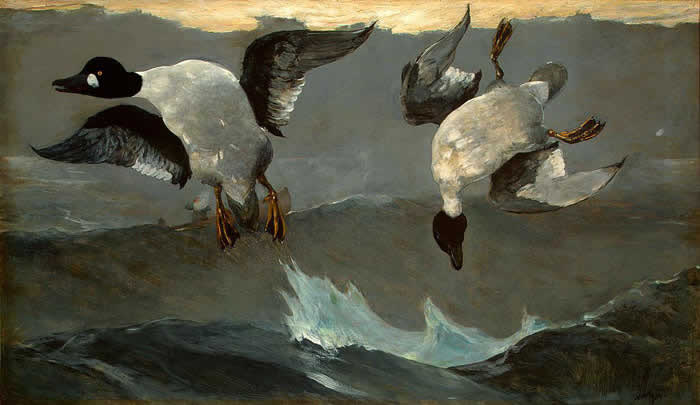
Harlis

SJ, your point is pretty fairly well taken. Back in the day of our local New Jersey duck forums a young hunter posted up a bunch of Bufflehead. Along with the question

"I can't figure out why this one hen is so much bigger than the rest ?"

As you probably guessed he had killed a hen Harlequin.

He was quickly warned of his mis step, but not before one of the local Warden's saw the post. While they didn't throw the book at him, the bird was confiscated and he was fined.

It is really unreasonable to expect on the wing ID in these cases.
 
SJ, your point is pretty fairly well taken. Back in the day of our local New Jersey duck forums a young hunter posted up a bunch of Bufflehead. Along with the question

"I can't figure out why this one hen is so much bigger than the rest ?"

As you probably guessed he had killed a hen Harlequin.

He was quickly warned of his mis step, but not before one of the local Warden's saw the post. While they didn't throw the book at him, the bird was confiscated and he was fined.
Sad to see, but I have to think it's common based on the ones I've seen over the years. Glad to hear they treated him reasonably, considering it was an honest mistake. If somebody has a drake, no mercy for that.
 
It is really unreasonable to expect on the wing ID in these cases.
Agree for newbies, although they stick out once you see a couple. They're a little squatter than a coot (if that's possible) with a slightly faster wingbeat. What concerns me is if enough mis-ID's happen, the mere presence of harlequins in an area might be an excuse to shut the area down.
 
Agree for newbies, although they stick out once you see a couple. They're a little squatter than a coot (if that's possible) with a slightly faster wingbeat. What concerns me is if enough mis-ID's happen, the mere presence of harlequins in an area might be an excuse to shut the area down.

I just don't think it is reasonable for 90% of people out there with a gun, people suck at duck ID. The way Maine deals with Barrow's is reasonable.
 
A

Agreed, that's a good policy. Problem is many of that 90% don't know what it is in their hand, I suspect same with the Barrows.
I'd like to see info from Maine on how many incorrectly IDed Barrows GE's are reported--which is what our law requires. I'd be willing to bet that almost all of them are drakes. I've twice been in parties that have mis-IDed and downed drake Barrows. After the second, where I was the shooter, I stopped setting up for GE's and I haven't shot any, common or Barrows, since. I suspect most hunters couldn't reliably ID a hen Barrows from a hen Common with the bird in hand, and I suspect that few if any are reported.
 
Agree for newbies, although they stick out once you see a couple. They're a little squatter than a coot (if that's possible) with a slightly faster wingbeat. What concerns me is if enough mis-ID's happen, the mere presence of harlequins in an area might be an excuse to shut the area down.
That is a great point. Also about three years ago a hen Harlequin was found in a trashcan at the closest boat ramp to this area.

As far my understanding, they've now put in effect a sort of "safety zone" in the area, where these birds most frequently are found.

It's not an extensive area, but it does encompass the rocks and the immediate shoreline. Though you could easily set up a layout boat outside of that area and still have them buzz your spread.

I don't know that it was entirely to protect the Harlequins, but they wanted to stop guys drifting that channel in the strong current, picking out trophy sea ducks within feet of rocks, Tourists, and birdwatchers.

Up until 2023 it was legal way to bag, trophy eiders, old squaw, scoters etc.
 
I'd like to see info from Maine on how many incorrectly IDed Barrows GE's are reported--which is what our law requires. I'd be willing to bet that almost all of them are drakes. I've twice been in parties that have mis-IDed and downed drake Barrows. After the second, where I was the shooter, I stopped setting up for GE's and I haven't shot any, common or Barrows, since. I suspect most hunters couldn't reliably ID a hen Barrows from a hen Common with the bird in hand, and I suspect that few if any are reported.
I'm curious as well, but I suspect they don't publish it to suppress any outcry from anti's. The don't arm the enemy theory. Not being judgemental, but I've rarely shot whistlers. It's a leftover from my youth, when whistlers, butterballs, boobies and poulle deau were on the Do Not Shoot list. We rarely shot Old Squaw either, I love hearing them when there's a large group.
 
That is a great point. Also about three years ago a hen Harlequin was found in a trashcan at the closest boat ramp to this area.

As far my understanding, they've now put in effect a sort of "safety zone" in the area, where these birds most frequently are found.

It's not an extensive area, but it does encompass the rocks and the immediate shoreline. Though you could easily set up a layout boat outside of that area and still have them buzz your spread.

I don't know that it was entirely to protect the Harlequins, but they wanted to stop guys drifting that channel in the strong current, picking out trophy sea ducks within feet of rocks, Tourists, and birdwatchers.

Up until 2023 it was legal way to bag, trophy eiders, old squaw, scoters etc.
I'm guessing it won't be long before more restricted areas pop up. I'm sorry to say there are jerks who will intentionally shoot one for a trophy mount rather than travel to the west coast.
 
I'm curious as well, but I suspect they don't publish it to suppress any outcry from anti's. The don't arm the enemy theory. Not being judgemental, but I've rarely shot whistlers. It's a leftover from my youth, when whistlers, butterballs, boobies and poulle deau were on the Do Not Shoot list. We rarely shot Old Squaw either, I love hearing them when there's a large group.
You mentioned the sound they make, thanks for reminding me of that. Unfortunately I haven't heard any this year but that's probably just a function of not spending enough time on or near the water where they normally are than anything, but yes love to hear that distant bugling sort of sound.
 
A local birder advocated for some restricted areas in Maine some years ago. There are 4 or 5 well known areas where Barrows are frequently seen. He proposed closing them to all waterfowling, which would have been excessive. He believed--without much evidence that I ever saw--that there were parties deliberately targeting Barrow's. But closing those areas just to hunting over diver decoys would probably be equally effective in protecting the Barrows as a closure to all waterfowling. I used to hunt with some people who targeted whistlers. They were a fun hunt--decoyed well, and they were mostly present late in the season and active mid-day when the puddle ducks were not. But with the (ethical, even if not legal) risk of taking a protected species, and the considerable prep involved in making them good to eat, I just decided not to target them any more. Neither of the Barrow's killed by parties I was with were in the traditionally-known spots that would likely be closed.
 
All~
Harlequins are predictable in similar situations along the South Shore of Long Island - I have seen them at Montauk point and at Shinnecock, Moriches and Jones Inlets. They are probably at Fire Island Inlet, too - have not been there in winters, however. The inlets usually have Purple Sandpipers, too - as well as Surf Scoters.

James: Do not hesitate to recommend good sites that provide good information for gunners as well as birders. I commonly get "bird ID" questions from both gunners and birders. I always give them a link along with my answer. The first one is from Cornell (my alma mater) Lab of Ornithology and home to eBird:

https://www.allaboutbirds.org/guide/Harlequin_Duck/id
https://www.audubon.org/field-guide/bird/harlequin-duck

I believe that the season on Harlequins was closed back when I was the DEC duck biologist on Long Island - 1980s.

I have never shot one, but.... When I 15 or 16 my Dad and I had one fly over us - in range. Neither raised our guns because he taught me to "always be sure of your target". Neither of us was certain of the species - so we watched it carefully. It was about the same size and shape as a hen Oldsquaw (Long-tailed Duck) but with a dark belly. I could see the whitish head markings - but not those of a Butterball (Bufflehead) or Whistler (Goldeneye).

View attachment 73451

Once we got home, we consulted the Audubon Water Bird Guide - with paintings by Don Eckleberry - a well-worn volume in our house. It was printed in 1946 - long after the Labrador Duck - which even I am not old enough to have seen.


View attachment 73449

Earle L. Poole did the wonderful line drawings of birds in flight.

View attachment 73450

It continually amazes me how this 72-yearold brain can still see that Hen Harlequin vividly - a belly shot against a grey afternoon sky at the mouth of the Connetquot River in light winds. This grand sport of ours fills us with experiences and images we can enjoy forever.

Which brings me to my final thought. I have always encouraged duck hunters - and anyone interested in the natural world - to learn as much as you can about anything related. Whether it is boats or decoys or the birds themselves, go beyond the narrow confines of the sport itself and learn about history, the natural world, art, et cetera. Any endeavor gives back more if you put more into it.

All the best,

SJS

Re. your final thought. Well said!

Best regards,

Bryce
 
Back
Top