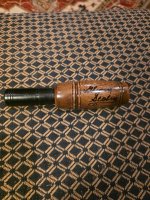
Can you help me tune a long reed goose call?

MIKE-SID

Well-known member
Supporter
I have a Glynn Scobey 400 goose call that's a little off. Does anyone have insight on how to tune a long reed goose call? Maybe I need a new reed, but no clue where to get one. There are many YouTube videos about tuning short reed calls, but I can't find anything on long reed calls. Thanks
 

Attachments

  • 17701727175838232729824594304649.jpg
    17701727175838232729824594304649.jpg
    367.6 KB · Views: 5
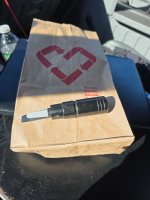
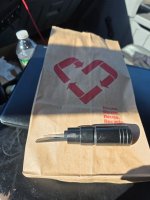
Never played with one. is the long reed still the same mylar thickness as a short reed goose call? it cant be that hard, but pictures of it taken apart might help a ton. Is the glynn scobey like your typical wedge style goose call? If you can, take the call apart, post pics of the reed in how it sits, post pics of the reed close up, then if you can get a good pic of the distance between the reed and the gap of the toneboard. It might be as simple as loosening the wedge, manipulating the reed, and wedging back down tight. Again, not even sure where to start without pics of the toneboard and how the reed sits in the call.
 
Just the normal set up that I'm used to seeing 👀

Maybe I have it set up good, it's just taking more back pressure than im used to
 

Attachments

  • 17702195408854490702971101686324.jpg
    17702195408854490702971101686324.jpg
    157.5 KB · Views: 13
  • 17702195527484414738585930466280.jpg
    17702195527484414738585930466280.jpg
    165.5 KB · Views: 13
That looks like a lot of reed past the end of the channel but I don’t have a call to reference. That would explain the back pressure.
Yes, it's way past the end, almost an inch, but I think, don't know, but think that's how old school long reed calls are.
 
Yes, it's way past the end, almost an inch, but I think, don't know, but think that's how old school long reed calls are.
Reed looks ok and not delam, so like mentioned above, mark where wedge and reed are at this time, loosen and move just ever so much til you find the right noise. If you move the reed toward the wedge, the less pressure to break over and the lighter sounding it should get. The more you reed away from the wedge, the more air pressure it takes to break over the reed and deeper tone you get. Go light and easy, remember big geese decoy to little geese but little geese dont decoy to big geese. All mine run just a touch on the higher pitch side. Dont go too light that spit and quick spit notes sounds wonky, but dont go too deep and make the call hard to run.

 
Google how to tune a resonant chamber goose call. That may help. Pull the insert out the the barrel and mark all the parts with pencil before disassembly. Mark top of Reed on sound board, top of wedge on Reed, where the Reed and tone board sit in the insert. Then disassemble and make slight adjustments if needed.
 
If the pitch is where you want it, reed length from the front of the wedge should be about right. I’d mark the reed and try to move the tone board out a little at a time to shorten up how far past the channel the reed goes.

Looks like there’s a break on the tone board about 1/8” in front of the end of the channel
 
Reed looks ok and not delam, so like mentioned above, mark where wedge and reed are at this time, loosen and move just ever so much til you find the right noise. If you move the reed toward the wedge, the less pressure to break over and the lighter sounding it should get. The more you reed away from the wedge, the more air pressure it takes to break over the reed and deeper tone you get. Go light and easy, remember big geese decoy to little geese but little geese dont decoy to big geese. All mine run just a touch on the higher pitch side. Dont go too light that spit and quick spit notes sounds wonky, but dont go too deep and make the call hard to run.
Thanks for all the help, looks like I'm on my way.
@William Reinicke we don't see anything but Canada geese here, except for rare sightings, so I guess I'm good keeping mine deep.
Very interesting fact that I was totally unaware of.
 
I have a Glynn Scobey 400 goose call that's a little off. Does anyone have insight on how to tune a long reed goose call? Maybe I need a new reed, but no clue where to get one. There are many YouTube videos about tuning short reed calls, but I can't find anything on long reed calls. Thanks

Mike I

I own and used Glynn Scobey duck and goose calls for many years. The Old Guide and LL Bean sold them. His Snow Goose call (with the painted barrel) is a favorite of mine.

The instruction booklet that came with each Scobey call under Call Care states, "This call is such that it will last for years, with the exception of the REED which will have to be replaced occasionally." New reeds could be purchased from Mr. Scobey, Route 3, Newbern, TN 38059.

I have more than my share of duck and goose calls, many being wooden calls. The what used to be termed "inexpensive calls" I will replace the reeds and retune the call myself with satisfactory results. The better high end, and custom calls I always send back to the maker for new reed and whatever else needs to be done to get the call to function properly. Unfortunately you cannot do that with the Scobey.

If you have checked the auction prices for his calls you shall see the prices have gone up considerably. If the call were mine I'd find a Tennessee style wooden call maker that is willing to do the work on your call as it most likely may need reed holder work as well since the call is now vintage. Somewhere there are reeds for your call, most likely in TN. I hope that you can get that call back into working order and use ASAP.

Best regards
Vince
 
Thanks for all the help, looks like I'm on my way.
@William Reinicke we don't see anything but Canada geese here, except for rare sightings, so I guess I'm good keeping mine deep.
Very interesting fact that I was totally unaware of.
When I say big geese and little geese, Im referring to canada geese. We get all species here. Some time I hunt, im shooting cacks the size of mallard and sometimes Im targeting big family groups of giant canadas. If your call is tuned deep and low and sound like a big giant canada, those cacks are weary and dont lock up as easy. You hit a higher pitch note on small group of big giant geese, they lock up just the same as if you were hitting them with a deeper toned goose call. Sometimes better, because they know those little geese are no match for them on the ground. Ive watched big geese pick on little geese in a field and completely move them out of an area if they want that food source on the ground. Small canada geese dont like big canada geese. Thats for sure.

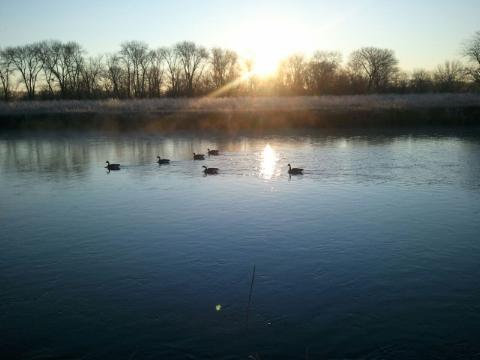
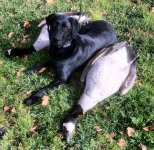
We shoot some bigs for sure. This is an old pic of my 85lb lab laying next to geese. Pic is deceiving because they make my dog look so small.
 

Attachments

  • IMG_5786.jpeg
    IMG_5786.jpeg
    881.7 KB · Views: 4
When I say big geese and little geese, Im referring to canada geese. We get all species here. Some time I hunt, im shooting cacks the size of mallard and sometimes Im targeting big family groups of giant canadas. If your call is tuned deep and low and sound like a big giant canada, those cacks are weary and dont lock up as easy. You hit a higher pitch note on small group of big giant geese, they lock up just the same as if you were hitting them with a deeper toned goose call. Sometimes better, because they know those little geese are no match for them on the ground. Ive watched big geese pick on little geese in a field and completely move them out of an area if they want that food source on the ground. Small canada geese dont like big canada geese. Thats for sure.

We shoot some bigs for sure. This is an old pic of my 85lb lab laying next to geese. Pic is deceiving because they make my dog look so small.
Very interesting indeed! Good advice.
Most all of the Canada geese I see at my regular spots are larger ones, but I know of smaller ones, probably lesser in some areas close by. I'll blow a higher pitched short reed when I see the little guys.
Thanks
 
Back
Top