Canada Goose Chinstraps

Steve Sanford

Well-known member
Good morning, All~

At the LIDCA Show this past Saturday, Dave Diefenderfer showed me some "unbreakable" heads he has begun making - from silicone. His engineer's (he's the real kind - not my seat-of-the-pants version) mind is forever working through production processes - for both decoys and boats. He had heads for both Brant and Canada Goose - the latter being the Show's theme this year.

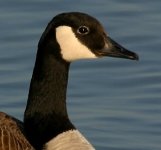
Ever the critic-at-large, I brought my Admiral Nitpicker Fussbudget painting brain to bear on the Canada - the white chinstrap in particular. So, I just e-mailed him some photos as a follow-up - and thought I might as well share them here.

Of course, any chinstrap will do for gunning purposes, but....as long as one is going to the trouble to paint/re-paint....might as well pay attention to the details. These are my notes:


Canada Goose Chinstrap - NOTES.JPG

Another live specimen...

CanadaGoose Chinstrap 2.jpg

One more....a strong "hook" at the top....


Canada Goose Chinstrap 3.jpg

One last live bird...

Canada-Goose Chinstrap 4.jpg

From the 150 Years - Hunting the Canada Goose on Long Island exhibit. The "stuffer" is from Duane Arnister (East End guide). The wooden head is my paint on an Al McCormick feeder I just restored. I did not put the hook on the chinstrap - opting for traditional instead.

sm 7 Stuffer, McCormick, Johnson.jpg

I do not know if Dave has customers in the Southern Hemisphere, but gave him this reference material just in case.

Chinstrap penguin - Canva - ValerieVS.jpeg

BTW: Just about to hit the "post thread" button when Coyotes started howling outside.

All the best,

SJS
 
Are there large differences in the size and configuration between the various subspecies of Branta canadensis and Branta hutchinsii??

I havent looked too closely at Branta penguini chinstrapus yet...... ;)
 
Good morning, Carl~

My experience has been restricted to Canadas and Cacklers here on the East Coast. When I chased them with airboats at Horicon NWR in the mid-70s I was observing in flocks of hundreds or thousands - but never in hand. And the Canadas I have seen in England and Germany did not call my attention to their chinstraps.

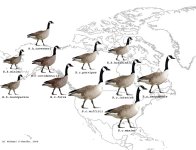
In learning about the other subspecies (which were called "races" in the earlier literature), the variation I noticed the most was the chest - right up to the black-stocking neck.

Subspecies Map.jpg
When painting decoys I want the sides to grade into a markedly paler chest and then become almost pure white when it meets the black.

NOTE: On closer inspection, some of the chinstraps below reminded me that I had "help" from a couple of 8-year-olds on some of these birds.


Goose Rig 3- small.jpg

Regarding the Penguin subspecies - as far as I can tell they are all exactly the same.

All the best,

SJS
 
Good morning, All~

At the LIDCA Show this past Saturday, Dave Diefenderfer showed me some "unbreakable" heads he has begun making - from silicone. His engineer's (he's the real kind - not my seat-of-the-pants version) mind is forever working through production processes - for both decoys and boats. He had heads for both Brant and Canada Goose - the latter being the Show's theme this year.

Ever the critic-at-large, I brought my Admiral Nitpicker Fussbudget painting brain to bear on the Canada - the white chinstrap in particular. So, I just e-mailed him some photos as a follow-up - and thought I might as well share them here.

Of course, any chinstrap will do for gunning purposes, but....as long as one is going to the trouble to paint/re-paint....might as well pay attention to the details. These are my notes:


View attachment 74426
Steve, always appreciate the corrections..... I remember teaching my daughter her letters with flash cards. I would get so frustrated that she routinely got R and P wrong. I finally pointed out the line on the R, and she never got it wrong again. I know that until some specific detail is pointed out, we sometimes don't even see it.
 
Decoy Carving and Decoy Making are not Taxidermy. Taxidermy is it's own craft. Decoy Carving and Decoy Making are Artistic Endeavour as well as personal expression. Hence the different styles from many areas and many Carvers and Makers. Clone decoys have very little to no personality nor personal artistic expression. Many of the greatest decoys of all time for hunting and collecting are as far from taxidermy work as can be. Feathers painted backward, "chinestraps" on all sizes of Canada geese painted where ever the carver and maker wanted them. This is personal style on behalf of the carver and maker. You can call it incorrect, clunky and junky yet it is their style. Style counts Big Time.

In my world decoys have descended into the taxidermy/clone category that lacks all types of artistic personal style by the carver/maker. The birds are the inspiration that is for certain. Where and how the carvers and makers take that inspiration and make it their own elevates the work. For several years I did my best to mimic the Real Bird like so many others. Then Thank God I woke up and developed my style that some can ID without checking for a brand or a signature.

" I paint the way I like to." - Raphael Soyer

my 2 cents
 
Decoy Carving and Decoy Making are not Taxidermy. Taxidermy is it's own craft. Decoy Carving and Decoy Making are Artistic Endeavour as well as personal expression. Hence the different styles from many areas and many Carvers and Makers. Clone decoys have very little to no personality nor personal artistic expression. Many of the greatest decoys of all time for hunting and collecting are as far from taxidermy work as can be. Feathers painted backward, "chinestraps" on all sizes of Canada geese painted where ever the carver and maker wanted them. This is personal style on behalf of the carver and maker. You can call it incorrect, clunky and junky yet it is their style. Style counts Big Time.

In my world decoys have descended into the taxidermy/clone category that lacks all types of artistic personal style by the carver/maker. The birds are the inspiration that is for certain. Where and how the carvers and makers take that inspiration and make it their own elevates the work. For several years I did my best to mimic the Real Bird like so many others. Then Thank God I woke up and developed my style that some can ID without checking for a brand or a signature.

" I paint the way I like to." - Raphael Soyer

my 2 cents
Good morning, Vince~

I believe you and I share very similar views re style v. realism. You should note that while Dave used the word "correction", I did not. I like his example of his daughter not "seeing" the leg on the R. It evokes the challenge all artists feel when drawing something from life . It can be a duck or a human or a boat - or anything at all. We begin the process by looking but striving to truly see what is before us. As we attempt to put it down on paper (or whatever) we struggle to study and then reproduce it accurately. That is the first step.

For me, it has always been important to get the personality of the species down in 2 dimensions. Growing up, my heroes were:

Audubon

Audubon - Canada.jpeg

Eckleberry

Don Eckleberry Geese and Swans - Plate 3.jpg

Fuertes

Fuertes - 4 geese CROPPED.jpg
I found Wilson much later.

A Wilson BxW Sepia warm.jpg

These painters were all field ornithologists - working from the bird-in-hand and observing them live in the wild. Accuracy was crucial because they were recording for science. Fortunately for the world each also had the soul of an artist.

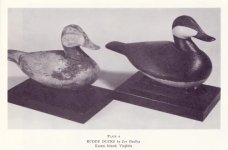
It was decoys that led me toward abstracting what my eye could see in the live birds. I first saw Lee Dudley's Ruddies in Wild-Fowl Decoys when I was about 12. The genius caught me immediately.

Barber - Dudley ruddies-wild-fowl-decoys-plate-2.jpeg


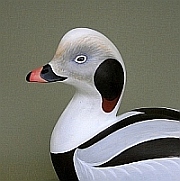
Later, Joseph Lincoln exerted a strong influence.

277A-Lincoln-oldsquaw-2.jpg


So, without going too far afield, my approach has always been: The personality - The Look - of the bird is paramount. Then, elements of practicality, whimsy and artistry can guide the development of style. I will use just one example - this Blue-wing:

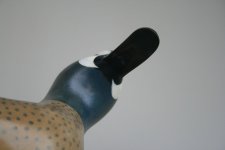
The 2 White crescents are intended to complement each other. The Powder Blue wing coverts enjoy an organic shape bounded by fair curves - the boatbuilder in me.

sm - Preening BWT Drake - 2008.jpg

The facial crescents trail aft in life. However, I was inspired by the Minnesota Vikings helmets to end them as horns beneath his chin.

sm BWT chinstraps.JPG

With the Al McCormick goose shown earlier in this post, it came to me needing some rehabilitation. I am not sure how much of the paint was from Al's hand - or from owner/co-carver Gary Andrews. Al always worked with each new carver, guiding (directing, really!) them through the whole process.

1 McC Goose.jpg

I decided to honor Al with a "no-hook" chinstrap - but to get the overall shape and placement such that it has The Look of a Canada Goose - at least to my eye.

sm Andrews 3.jpg

We could have a long and enjoyable discussion - in its own post - about the development and value of style. I collected a bunch of images for that purpose. I included some of early Duck Stamps as well as other premier antique decoys. Maybe another time.... (I will be posting about the about McCormick-Andrews-Sanford goose.)

All the best,

SJS
 
Back
Top