

Steve Sanford
Well-known member
Good morning, All~
TA Smith asked me if I had posted on the care and feeding of the cast iron ballast keels in Herter's foam-bodied decoys - as in Model 63 and 72 (ducks) and 81 and 92 (brant and geese). These ballast keels were inside the bodies, encased in Herter's Durlon foam. Over a long life - and especially around salt water - the iron would rust - and bubble and flake - and work its way out of the bodies. First signs were rust staining, then cracking, then "hatching".....
I cover this a bit in my Tutorial on painting Model 72 Broadbill:
https://stevenjaysanford.com/re-painting-broadbill-decoys/
In the early stages, any cracks should be filled - with either a paintable caulk or thickened epoxy. Note that these are the earlier flat-bottom/flat keel versions.
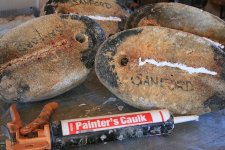
Here I filled with thickened epoxy (epoxy + fairing compound) - then protected it with a light (6-ounce 'glass cloth). I do this all in one operation so I avoid having to sand the cured filler. Whereas the flat-bottomed decoys were introduced around 1955, I think the "extruded" keel was sold in the mid-60s.
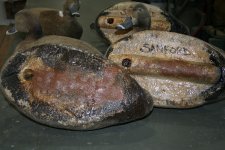
I always paint bottoms a medium tone - either grey or duckboat color - so I can use a felt marker for the owner's name.
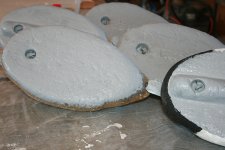
Here is a friend's Model 63 where the entire cast iron keel was falling out - but had not yet escaped to the bay bottom....
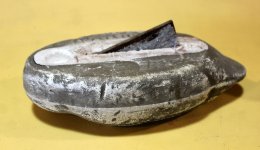
The rust was not bad. I have seen others that have progressed (regressed?) to the crumbly stage.
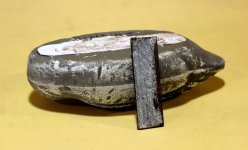
The slot was cleaned out and the keel set in caulk (not shown here) - for both adhesion and encapsulation from moisture. Thickened epoxy could be used as an alternative. This body later got the full epoxy+sawdust (or crushed walnut shell) coating.
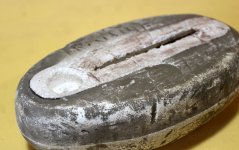
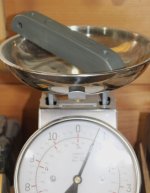
If the ballast is missing, a new one needs to be heavy enough to do its job - of keeping the bird trimmed properly and upright. This is an exterior keel (Pine with lead poured in) for a hollow wooden decoy. Notice it is about 12 ounces total.
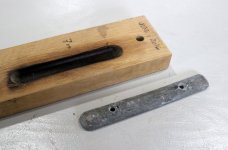
A replacement keel can be made from flat (bar) stock from your hardware store - or you can pour a lead one. The latter can be smaller because lead is so much denser (44% more) than iron. I made this mold from White Oak - and routed the slots with a core box bit. I rub some beeswax in before my first pour. The other side of this mold has a longer slot - for a 9-ounce weight. These are intended as external ballast keels - but could be put into the slot of a foam body - then sealed in.
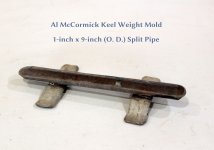
Al McCormick made his keel mold from split pipe.
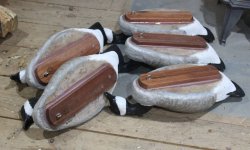
Another approach: This owner - another friend - wanted the "Full McCormick" - with the Mahogany providing the weight and the flat keel orientation so the birds would sit upright even once the tide ran out on a mud flat.
Hope this helps!
SJS
TA Smith asked me if I had posted on the care and feeding of the cast iron ballast keels in Herter's foam-bodied decoys - as in Model 63 and 72 (ducks) and 81 and 92 (brant and geese). These ballast keels were inside the bodies, encased in Herter's Durlon foam. Over a long life - and especially around salt water - the iron would rust - and bubble and flake - and work its way out of the bodies. First signs were rust staining, then cracking, then "hatching".....
I cover this a bit in my Tutorial on painting Model 72 Broadbill:
https://stevenjaysanford.com/re-painting-broadbill-decoys/
In the early stages, any cracks should be filled - with either a paintable caulk or thickened epoxy. Note that these are the earlier flat-bottom/flat keel versions.
Here I filled with thickened epoxy (epoxy + fairing compound) - then protected it with a light (6-ounce 'glass cloth). I do this all in one operation so I avoid having to sand the cured filler. Whereas the flat-bottomed decoys were introduced around 1955, I think the "extruded" keel was sold in the mid-60s.
I always paint bottoms a medium tone - either grey or duckboat color - so I can use a felt marker for the owner's name.
Here is a friend's Model 63 where the entire cast iron keel was falling out - but had not yet escaped to the bay bottom....
The rust was not bad. I have seen others that have progressed (regressed?) to the crumbly stage.
The slot was cleaned out and the keel set in caulk (not shown here) - for both adhesion and encapsulation from moisture. Thickened epoxy could be used as an alternative. This body later got the full epoxy+sawdust (or crushed walnut shell) coating.
If the ballast is missing, a new one needs to be heavy enough to do its job - of keeping the bird trimmed properly and upright. This is an exterior keel (Pine with lead poured in) for a hollow wooden decoy. Notice it is about 12 ounces total.
A replacement keel can be made from flat (bar) stock from your hardware store - or you can pour a lead one. The latter can be smaller because lead is so much denser (44% more) than iron. I made this mold from White Oak - and routed the slots with a core box bit. I rub some beeswax in before my first pour. The other side of this mold has a longer slot - for a 9-ounce weight. These are intended as external ballast keels - but could be put into the slot of a foam body - then sealed in.
Al McCormick made his keel mold from split pipe.
Another approach: This owner - another friend - wanted the "Full McCormick" - with the Mahogany providing the weight and the flat keel orientation so the birds would sit upright even once the tide ran out on a mud flat.
Hope this helps!
SJS