Herters - keel less?

craig shire

Member
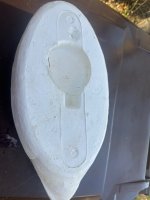
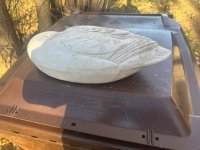
So I bought these like 20 years ago. Was a project son and I were going to do - restless coat, paint etc.

Never really got to it, he turned into a teenager - girls, school, work turned into work, wife, and babies

Now he is back to hunting a lot and now he is the hard driving lead and I am the tag along

Dug these out of the back of the garage and now will be a father, son, grandkids project

Anyway. I seem to remember something about trex decking screwed into bottom to make a keel? Can somebody guide me on how that works? Pics are good cuz I’m a slow learner sometimes
 

Attachments

  • IMG_3445.jpeg
    IMG_3445.jpeg
    379.3 KB · Views: 15
  • IMG_3446.jpeg
    IMG_3446.jpeg
    279.8 KB · Views: 15
Craig~

Nice project! I have not seen these particular Herter's models before. They are Herter's Model 72 Mallard/Black Duck bodies - but with no molded keel and a cavity to receive a vibrating "puck" to make ripples.

I have also not used Trex for keels - but it makes perfect sense: rot-proof, waterproof, dense (for ballast) - and easy to work. I have used it on duckboats.

My suggestions:

1. Use the keel as a base through which you can attach the head. I would a use a 4-inch deck screw.

2. Bed the keel in an adhesive caulk. 3M 5200 is the ultimate - but more $$$ than you need to spend for this project. Look for a weatherproof tube adhesive - maybe PL 300 (?) or a Loctite. Make sure whatever product you use does not dissolve the foam!

The screw holding the head on is probably all the "clamping" you will need. The Durlon (Herter's name for styrofoam) has no strength - so screwing into it would be futile. IF you need to clamp the aft end of the keel during cure, use either a bungee or duct tape.

3. Bed the base of the head in a caulk when you fasten it. It protects the body beneath the head and prevents the anchor line from wedging in a gap 'twixt the neck and body. Mix up the head positions, left and right - rarely straight ahead. I always put at least a bit of turn in each head - and usually do not go beyond 45 degrees off center.

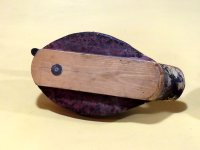
4. Apply a flat keel - not one that is taller than it is wide. This has 2 benefits: If you hunt tidal waters, the decoy will stay upright when the tide runs out. In any event, such keels take up less room in the boat or bag. The keel does not need to be the 3-inch width shown here - but I would go at least 2 inches wide.

sm Andrews McCormick Can - bottom - clamped with screw.JPG

5. For attaching the anchor line, bore a 5/16'" or 3/8" hole across the forward end of the keel - about an inch back and ahead of the head screw. No need for hardware for this job, in my experience. Bore the holes on the bench before you fasten the keels. Note that I round and bevel both ends of the keels to match the bode shapes.

6. Not sure if you and your son with be turning these bodies into Mallards or Blacks - or something else. Here's a tutorial on painting Homer Mallards (foam-bodies similar to Herter's):

https://stevenjaysanford.com/tutorial-painting-homer-mallards/

I coat my foam birds with epoxy resin + fine sawdust on the heads and ground walnuts shells on the bodies. I have never tried ground corn cobs (as per Restle) - because they are unavailable hereabouts (eastern NYS).

Hope this helps!

SJS
 
Last edited:
Awesome resource of info Steve, thanks very much!

I bought these at the end of Herters producing their decoys as I recall. These were the oddballs that were left at some dealer once production stopped.

As a side note, both corn cob media and walnut shell media are available on Amazon - for anybody else looking to do this type of coating. Watch the prices, as they seem to vary widely. I have 7 lbs at $12 coming my way.
 
Do you need keels where you are hunting? If you are not on big water and are not tossing decoys, you can use the keel-less decoys. You can press the down in the water, tip them to the side and burp some of the air out of the hollow body. Then let them up and they stick to the water really well. Just a thought, I have foam decoys with a hollow bottom and they stick to the water really well once you burp some air out of them.
 
Back
Top