
U-bolt installation for Bow Eye - Your thoughts?

Steve Sanford

Well-known member
All~

I just installed a s/s U-bolt to serve as the bow eye on my latest project. Over the years I have installed many on various vessels. They have varied in small details - and some have kept me wondrin'... Hence, I am seeking your thoughts.
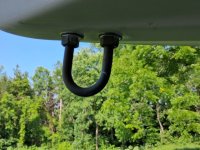
sm U-bolt - below.jpg

Here is the process I just completed over the last couple of days:

1) I reinforced the 'glass hull inside of the "nose" so that it was now about 3/8" thick. I used a couple of layers of 1708 biaxial with mat set in epoxy.

2) I made a backer from 1/2-inch AC plywood - which I coated with epoxy. I have long used these plywood backers for any hardware/features that might need to support the weight of the boat, e.g., cleats, eye-bolts.

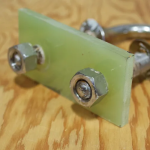
3) As I am trying to keep the finished weight of this vessel to an absolute minimum, I am tracking the weights of everything I add or subtract. The U-bolt is 5/16" in diameter; is 316 stainless; and is rated for 3500 pounds. It and the backer weigh a bit over 6 ounces. Although this will be a very light vessel, it may need a bow eye for towing, dragging and anchoring at various times. It will likely NOT be winched onto a trailer as I plan to transport it on my roof rack.
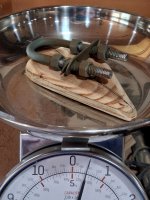
sm Bow Eye and Backer - 6 ounces.jpg

4) As I do with any s/s hardware that will show, I sanded the U-bolt with 400-grit, washed it with acetone, then sprayed it with Rustoleum Self-Etching Primer.

5) I bored the holes in the hull and the plywood backer at 3/8-inch - to leave some room for the 3M 5200 bedding (adhesive caulk).

6) After perusing several YouTubes - which varied the placement of the s/s backing plate that comes with the U-bolt (and some come with 2 backers), I decided to locate the backer inside the hull and use the 2 flat washers between the outer nuts and the hull - with plenty of 5200 coating the entire length of the U-bolt threads. I see no advantage to putting the backing plate on the outside of the hull. My seat-of-the-pants engineering tells this old brain that the fundamental need is to prevent the U-bolt from pulling through the hull.
Other opinions?


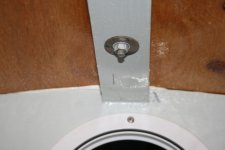
7) I put LOTS of 5200 'twixt the hull and the plywood backer because the hull was not perfectly flat and I wanted any potential void to be filled with cured 5200 when all was said and done. There was LOTS of squeeze out to prove I had filled to void - and I was not concerned about "working clean" - as I would on the deck or the outside of the hull. I faired it onto - and into - the surrounding 'glass. All will be painted once I have completed framing the interior of the vessel.
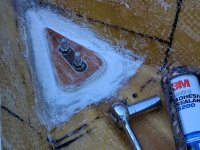
sm U-bolt with AC backer bedded in 5200.jpg

8) I cleaned around the hardware with a paint thinner-soaked rag - so that I could put a wrench on the nuts - inside and out - if I ever needed to in the distant future.
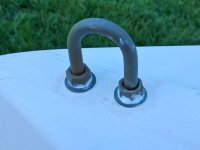
sm U-bolt - outside - bedded in 5200.jpg

Just let me know if you have some other insights into this common task.

All the best,

SJS
 
Steven,

Will you be mounting a handle on the topside to assist with car top loading? One regret I have is using a eye bolt instead of a grab handle at the bow to make moving the sneak box easier.
 
Rick~

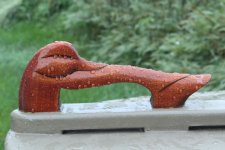
As this project is currently Top Secret...I cannot yet reveal all of my design particulars - and some are still TBD (not to be confused with TDB...). However, history would suggest a better-than-even likelihood ("The odds are 50:50 - and only a 10 percent chance of that." - see Naked Gun) that something like this might appear on the foredeck....

sm Bow Handle in rain.JPG

And, another "secret" feature will make this vessel very easy to manhandle. All will be revealed in good time.

All the best,

SJS
 
Steve

I can't think of any improvements to your bow eye install. I have never used a backing plate on the outside. Typically the keel has a metal strip on it and that works just fine for a backer. As long as the fiberglass strands or wood fibers aren't crushing you should be fine. Even a little crunch wouldn't bother me much as long as water can't get in there.
 
Steve, I can't think of anything I would do differently with installing that U-bolt. Would a spring loaded D-ring be of interest to use in some instances? I don't think there would be any issue with it bouncing when hitting waves but your insight into it might confirm or deny otherwise.

 
Steve

I replaced my bow eye in my 1987 14' TDB Classic last summer
7 layers of 1708 with epoxy resin inside nose and 2 outside nose - probably overkill on the 1708
I used G-10 which is a compressed fiberglass and epoxy resin backer board inside bow nose instead of any wood
Cheers
1782966771557.png
 
You guys are doing it the best way I know of assuming you can access the nuts after final assembly. On the fiberglassed BBSB style hulls, it's nearly impossible to get at nuts years down the road. My BBSB's get a through hull eye bolt for that reason, and usually a cleat (with a backer) just forward of the cockpit to affix the painter. Using the eye as a fairlead reduces stress on the bow. Deck support for the eye bolt (not really a backer in this case) in the form of a plate of wood or a thickened epoxy pour is installed where possible. Don't want that pretty bow damaged.
 
Steve, I don't like to use plywood for backers. Wood gets compressed over time. I use stainless, never tried compressed glass as Eric suggested. You said there will be no load on the eyes, should be ok.
 
Steve, I don't like to use plywood for backers. Wood gets compressed over time. I use stainless, never tried compressed glass as Eric suggested. You said there will be no load on the eyes, should be ok.
Rich
G-10 - super high compression strength - is a composite that is being used more and more in salt water boat building to back cleats or bow eyes
I put the the stainless steel flat metal bracket on top of the G-10 , lock washers and then the nuts
EJ
 
Rich and Eric~

I have not yet used G-10 but have often used thick 'glass layups - either my own or salvaged from scraps decks, etc. It certain makes sense that modern 'glass boats - with their "no wood" wisdom - would opt for an inert material.

All the best,

SJS
 
Steve, I don't like to use plywood for backers. Wood gets compressed over time. I use stainless, never tried compressed glass as Eric suggested. You said there will be no load on the eyes, should be ok.
Rich~

Of course, one must sometimes fasten through just wood. As I did with this deck cleat, I almost always use s/s fender washers:

sm Fender Washer - RED-LEG - C Rail 4.jpg

All the best,

SJS
 
I have a question that needs answered before I can offer an opinion. What torque value did you apply when tightening the nuts holding the bow eye?
Dave~

I'm pretty sure torque wrenches only work on automotive projects.....

I tightened the nuts until my wood backer just barely showed signs of deflection. How can anyone put a value on that????

All the best,

SJS
 
Dave~

I'm pretty sure torque wrenches only work on automotive projects.....

I tightened the nuts until my wood backer just barely showed signs of deflection. How can anyone put a value on that????

All the best,

SJS
Steve,
No offense meant when I asked my question. You detailed the specs of the U-bolt and your process, yet failed to mention this detail.

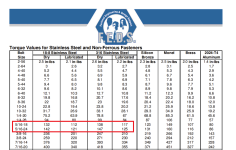
The reason I asked about the torque applied, is because the specs you gave for load capacity, are only achieved when the U-bolt is installed under the proper torque and against a solid surface

You put a value on the force, by using a torque wrench. When the wood "squishes" to your satisfaction, you read the torque value displayed. A torque value is much more easily quantified by another individual. Your perception of tight may not be the same to everyone.

I see no advantage to putting the backing plate on the outside of the hull.
Obviously this is determined on a case by case basis. Having a baseplate for the U-bolt to bear against my or may not be critical to it's performance, in a particular application. In a low stress application, a baseplate under the U-bolt may not be entirely needed. Having a properly bedded baseplate does however allow the maximum load capabilities to be achieved.
Folks may take your statement on the need or lack there of for a baseplate on the outside, as a blanket statement to be applied to any installation of a bow eye.
Having a baseplate that is itself properly bedded, is the best case scenario.
You probably noticed I have used the term "baseplate" for the plate on the outside of the hull. The term "backing plate", would be reserved for the plate inside the hull.

Again, the rated strength of any bolt or U-bolt is only achieved when installed against a flat surface and within the specified torque range.
Using a baseplate versus washers allows for more support area for the U-bolt to bear against. Yes, side load pull probably contributes to more failures, than straight line pull failures.
1783091719521.png
 
Dave~

Thanks for the information. If I were at home....

I am on LI at my Mom's - who turned 97 yesterday. Were I in my shop I would take a photo of my torque wrench - which is lodged between the back of its drawer and the frame of my rolling toolbox. Still not sure how to extract it (without damage to tool or toolbox). When I do, curiosity will have me putting it on the nuts for a reading.

My design target for this vessel is 75 pounds (aka total displacement). Not sure how the 3500 pound limit applies.

I bought the torque wrench (had always borrowed one previously) when I installed the towing package (from e-Trailer) on my 2018 Forester. I do not recall the values required (maybe 130 foot-pounds?) but I was astounded at how much force these nuts and bolts needed. It was far beyond what I had believed to be "good and tight".

In that same vein, I am taking the time to weigh everything that goes onto or into my latest project - to help me answer: "Where did all that weight come from?"

Always happy to learn!

SJS
 
All~

I just installed a s/s U-bolt to serve as the bow eye on my latest project. Over the years I have installed many on various vessels. They have varied in small details - and some have kept me wondrin'... Hence, I am seeking your thoughts.

View attachment 77196

Here is the process I just completed over the last couple of days:

1) I reinforced the 'glass hull inside of the "nose" so that it was now about 3/8" thick. I used a couple of layers of 1708 biaxial with mat set in epoxy.

2) I made a backer from 1/2-inch AC plywood - which I coated with epoxy. I have long used these plywood backers for any hardware/features that might need to support the weight of the boat, e.g., cleats, eye-bolts.

3) As I am trying to keep the finished weight of this vessel to an absolute minimum, I am tracking the weights of everything I add or subtract. The U-bolt is 5/16" in diameter; is 316 stainless; and is rated for 3500 pounds. It and the backer weigh a bit over 6 ounces. Although this will be a very light vessel, it may need a bow eye for towing, dragging and anchoring at various times. It will likely NOT be winched onto a trailer as I plan to transport it on my roof rack.

View attachment 77193

4) As I do with any s/s hardware that will show, I sanded the U-bolt with 400-grit, washed it with acetone, then sprayed it with Rustoleum Self-Etching Primer.

5) I bored the holes in the hull and the plywood backer at 3/8-inch - to leave some room for the 3M 5200 bedding (adhesive caulk).

6) After perusing several YouTubes - which varied the placement of the s/s backing plate that comes with the U-bolt (and some come with 2 backers), I decided to locate the backer inside the hull and use the 2 flat washers between the outer nuts and the hull - with plenty of 5200 coating the entire length of the U-bolt threads. I see no advantage to putting the backing plate on the outside of the hull. My seat-of-the-pants engineering tells this old brain that the fundamental need is to prevent the U-bolt from pulling through the hull.
Other opinions?


7) I put LOTS of 5200 'twixt the hull and the plywood backer because the hull was not perfectly flat and I wanted any potential void to be filled with cured 5200 when all was said and done. There was LOTS of squeeze out to prove I had filled to void - and I was not concerned about "working clean" - as I would on the deck or the outside of the hull. I faired it onto - and into - the surrounding 'glass. All will be painted once I have completed framing the interior of the vessel.

View attachment 77194

8) I cleaned around the hardware with a paint thinner-soaked rag - so that I could put a wrench on the nuts - inside and out - if I ever needed to in the distant future.

View attachment 77195

Just let me know if you have some other insights into this common task.

All the best,

SJS

Do you allow sufficient time for the 5200 to cure? It is a moisture curing urethane that cures from moisture in the air. Some even spray water onto it to speed up curing. Have you considered using the fast cure version of the 5200? Never have to worry about the sealant being fully cured.

Mark
 
Do you allow sufficient time for the 5200 to cure? It is a moisture curing urethane that cures from moisture in the air. Some even spray water onto it to speed up curing. Have you considered using the fast cure version of the 5200? Never have to worry about the sealant being fully cured.

Mark
Mark~

Although I have sprayed the 5200 with water when time was pressing, I did not do so on this installation. I knew I would be away for several days - and this project is in S-L-O-W mode.

I tried the Fast Cure once - way too fast for my needs. It was skinning over before I could wipe and fillet the exposed areas.

All the best,

SJS
 
My design target for this vessel is 75 pounds (aka total displacement). Not sure how the 3500 pound limit applies.
Only because you felt it needed mentioning in your original post?
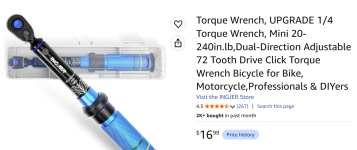
As to the torque wrench you used to install your towing package. I doubt it would be of the torque range needed for the U-bolt application. (may not register a low enough reading)
It is actually more common for fasteners to be over torqued than to be under torqued.
Notice the range is listed in "inch pounds" whereas I am certain the wrench you used previously is rated in "foot pounds".
1783111973211.png
it may need a bow eye for towing,
There is no doubt that towing the hull across the surface of the water has the most potential, for the greatest load spike. Catch a wave that results in a nosedive, will test both the tow rope as well as the bow eye connection.
 

Attachments

  • 1783110696649.png
    1783110696649.png
    275.7 KB · Views: 2
Only because you felt it needed mentioning in your original post?
As to the torque wrench you used to install your towing package. I doubt it would be of the torque range needed for the U-bolt application. (may not register a low enough reading)
It is actually more common for fasteners to be over torqued than to be under torqued.
Notice the range is listed in "inch pounds" whereas I am certain the wrench you used previously is rated in "foot pounds".
View attachment 77285

There is no doubt that towing the hull across the surface of the water has the most potential, for the greatest load spike. Catch a wave that results in a nosedive, will test both the tow rope as well as the bow eye connection.
Dave~

Now I will simply borrow a smaller wrench from my mechanic neighbor!

Stay tuned (still on Long Island....),

SJS
 
Mark~

Although I have sprayed the 5200 with water when time was pressing, I did not do so on this installation. I knew I would be away for several days - and this project is in S-L-O-W mode.

I tried the Fast Cure once - way too fast for my needs. It was skinning over before I could wipe and fillet the exposed areas.

All the best,

SJS
Back when I worked in the Marine Division for 3M, went on more than one customer call who had issues with 5200. I remember one in particular who was trying to biond several layers of marine plywood together using 5200 to make a sturdy transom board. Right after adhering the pieces together, he sealed the whole thing in epoxy and fiberglass. No moisture could get to the 5200 and it didn't cure for a very long time. This was on a multi million dollar fishing yacht. Boat owner wasn't happy, boat builder wasnt happy and we sure as heck werent happy either.

Mark
 
Back
Top