
What is your most recent discovery in technique?

Kevin Puls

Well-known member
Supporter
I was working on a hen canvasback body today and when I picked up the bow sander I started thinking about all of the “ah ha” moments I’ve had over time.

I was going to try to decide what my biggest discovery in making decoys has been. Is it Don Mintz introducing me to epoxy sculpt and 10cent glass eyes? Or Steve Sanfords paint colors and schemes? Maybe Pat Gregory’s carve from the center line out. Or Tom Christie’s cork cut out methods.

I could go on and on and on.

Today I’m going to go with my most recent, which is a homemade bow sander based on Pat Gregory’s design.

What is everyone’s most recent discovery? I bet we could all learn something from you!
 
Post pictures of the bow sander. I need to made a couple more.


I don't know if you'd call it an "ah ha" moment or exactly recent but I really like the way I've been doing vermiculation the last couple years. I started doing it a long time ago using a fan brush and this is talking acrylics. I paint the base coat, say dark gray like on a greenwing or pintail drake. Then I use the fan brush and black over the whole base coat and then go back over it with a lighter shade of the base coat to tone down the black and give it some depth. On some birds I will go back with another lighter color like white on the back of the blackhead I just posted in the workbench thread. It's not the fastest of the easiest I'm sure but it's something I feel like I made my own style if you will.

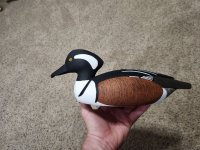
Here is a hooded merganser I just finished where I used that technique on the sidepockets.

1000019745.jpg
 
I don’t even know if I could count all the techniques I’ve learned from others on forums or online. Bowl calipers, contour gauges, soldering iron for bills, brad nails or sandpaper sand to keep things from slipping during glue up and a bunch more have all been nice quality of life improvements when Im carving.
The single biggest changes to my decoys though, have probably been tube oils I started using after picking up Keith Muellers book. Understanding tube oils is full of little ah-ha moments in itself.
The other one, isn’t really a technique, so much as a fear that I had to get over.
ALL of my first decoys looked awkward because I was worried about taking off too much material and ruining them. I still leave things thicker and flatter than they need to be, but not nearly to the extent I did.
 
Post pictures of the bow sander. I need to made a couple more.


I don't know if you'd call it an "ah ha" moment or exactly recent but I really like the way I've been doing vermiculation the last couple years. I started doing it a long time ago using a fan brush and this is talking acrylics. I paint the base coat, say dark gray like on a greenwing or pintail drake. Then I use the fan brush and black over the whole base coat and then go back over it with a lighter shade of the base coat to tone down the black and give it some depth. On some birds I will go back with another lighter color like white on the back of the blackhead I just posted in the workbench thread. It's not the fastest of the easiest I'm sure but it's something I feel like I made my own style if you will.

Here is a hooded merganser I just finished where I used that technique on the sidepockets.

View attachment 77779
That is a really nice effect!
 
I don’t even know if I could count all the techniques I’ve learned from others on forums or online. Bowl calipers, contour gauges, soldering iron for bills, brad nails or sandpaper sand to keep things from slipping during glue up and a bunch more have all been nice quality of life improvements when Im carving.
The single biggest changes to my decoys though, have probably been tube oils I started using after picking up Keith Muellers book. Understanding tube oils is full of little ah-ha moments in itself.
The other one, isn’t really a technique, so much as a fear that I had to get over.
ALL of my first decoys looked awkward because I was worried about taking off too much material and ruining them. I still leave things thicker and flatter than they need to be, but not nearly to the extent I did.
With your tube oils do you get the colors you need or do you have to mix them? I’m colorblind and I rely on Steve Sanfords colors pretty heavily.
 
With your tube oils do you get the colors you need or do you have to mix them? I’m colorblind and I rely on Steve Sanfords colors pretty heavily.
I do mix them, I think something like a drake wigeon, teal or of course, wood duck could be tough.
But most ducks I do are just different shades of brown (umber/sienna)
I often go off of Bruce Burkes painting and pattern portfolio books as a guide, which is extremely helpful.
One thing I would warn though, is every tube oil black I’ve tried, turns blue when mixed with white, and needs brown to be grey.
 
I do mix them, I think something like a drake wigeon, teal or of course, wood duck could be tough.
But most ducks I do are just different shades of brown (umber/sienna)
I often go off of Bruce Burkes painting and pattern portfolio books as a guide, which is extremely helpful.
One thing I would warn though, is every tube oil black I’ve tried, turns blue when mixed with white, and needs brown to be grey.
You can paint most ducks with a handful of different colors. Black, white, burnt & raw umber, burnt & raw sienna will go a long way. There are a few others you'll need here and there. Green, red, blue, yellow, crimson etc. I'm sure I'm forgetting a couple I use.

To get gray I mix black, white and raw umber. Different amounts of black and raw umber will give varying shades of gray. I've even used warm white instead of titanium white to get a more earthy, brownish gray.
 
Back
Top