All Things Flocking

 
Ok , basic newbie question. Where are you guys ordering flocking from? Restle coating is great for divers(since they live in leak bags on mainlines all season). But for my mallards, I’d like to flock them. Anyone got some leads?

Thanks
Tony

It’s the best source for what we do.
 
Thanks Don and William. I found that site , just didn’t know if there was some special place that was better/cheaper. Am I good to try just a kit to start? Figured that would probably be easiest?
 
I wouldn't bother with the kits, the puffer bottle isn't efficient, a simple kitchen sieve and a plastic tub is all you need. How much flocking you need is going to depend more on how well it goes for you and how many you want to do. while I've gone through almost 10 lbs of grey flocking this year, you could probably get a couple dozen mallards out of 4 oz of black, 8 oz of grey and 8 oz of brown. Use gloss rustoleum paint for your glue. I use gloss black, gloss leather brown, and gloss smoke grey and usually lighten the grey with gloss white on mallards. Even if you don't airbrush I'd still flock the heads and rumps black. Black is the most important color and there is nothing blacker than flocking black.
 
Here are a couple of thoughts. One is why we double flock, another thought is why we hand paint white areas.

Double flocking is both for durability and getting an even coat. Any of you who have done much flocking will know the look of that first coat. It's pretty patchy and will wear off far sooner than you want. All factory flocking is a single coat and not terribly durable. I have some full curl mallard heads on the way that are worn down to the plastic in places and down to the green glue which is shiny, but I'm pretty sure is a urethane based glue. If all you do is a single coat, even with rustoleum, you will run into the same issue and be worn down to shiny paint that didn't flock well.

Consider this, If you wanted to mix a bunch of fibers in your paint, it would strengthen and thicken the paint. That's what painting over the first coat is doing, then putting a second coat of flocking over that tends to give an even thicker coat fo flocking because of the increased volume of paint and drying time. I often will paint over the first coat, then set it aside while I do the next one to allow the paint to even out, it still has plenty of adhesion after five or ten minutes on that second dusting of flock and if you do it right, you'll notice not very much of the second coat flocking will blow off.

If you use flat rustoleum for your flocking glue you are going to have very very VERY spotty and weak adhesion. If you don't do a second coat, you will have a decoy surface that is not durable and you will be flocking it again with gloss the next time.

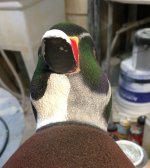
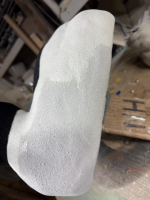
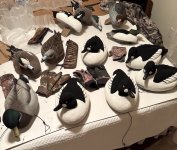
Why we hand paint white. For durability, for the ability to repaint easily. I usually touch up the white every two or three years. Secondly, white flocking is simply not white enough. Here are a few examples. Sometimes like on this wood duck head, I'll airbrush the white areas, while they seem fairly white, they aren't even close, so I hand paint over the area I airbrushed white. On large areas like the side of this goldeneye you can see the difference between the white flocking and the painted over flat white. The white area on the GE was flocked twice, white paint, white flocking and it's still not white/white. The most important color of flocking is black, the second most important color is white. The white surface painted over with flat still has the non glare surface, but it is much whiter than white flocking and won't stain as easily and can be repainted by anyone who can pick up a paint brush.

IMG_3635.JPGtempImageuiTAuS.png
 
Wow! There is a lot of great information here. While I'm not new to hunting, I am new to this forum and I may soon be new to flocking my own decoys as well. Before I do anything, I do have a couple of questions. Don, when you say that you won't flock flexible decoys, are you talking about the EVA foam decoys or some other type of flexible decoy? Also, how thick should the paint be for the first and second layers? Should it be a thin coat (wet but no drips), a medium coat, or a thicker coat (could drip if you're not careful)?

Lastly, I failed every art class that I ever took, I have painted decoys over the years, but I've never used an airbrush. Can I paint flocked decoys with regular brushes while I'm coming up to speed with an airbrush, or should I just commit and know that it will take some time to get something presentable?
 
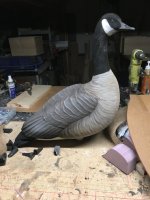
any decoy that is not rigid is not a good candidate for flocking. Eventually the paint will crack and some will even flex off in pieces. Of course we've seen that even with new decoys. They do make a paint for flexible foam, but it is expensive and I have no idea how it would work for flocking. You can flock flexible decoys, but their life will be shorter, maybe a few years depending on how they are cared for. We have flocked those foam feather flex decoys and they do alright for a few years, and if you don't mind re flocking every few years it still works to some degree. I just prefer hard surface decoys with no flex. My favorite is rigid foam decoys, but we paint or flock and paint thousands of plastic decoys. This picture of a hardcore canada is part of several hundred we rehabbed, the way we got the paint off was primarily letting them sit outside for a long period of time and the flocking on the heads would peel right off. They were down to nearly nothing but black plastic when we started our rehab. I had 18 refinished decoys like this one behind my mower shed when we moved here 7 years ago, exposed to the elements of rain, snow, freeze, thaw, below 0 degrees to above 115 degrees and relentless sun. This is what the decoys looked like after the first 5 years. Of course they weren't being thrown around and beat to crap, but it still made me feel pretty good about our process.
IMG_3611.JPG


I figure I'm really not a good test case with my own personal decoys because I take care of my tools. I don't really baby them, but I do put them in slot bags to avoid them rubbing on each other. I do rinse them off when they get dirty and spray hydrogen peroxide on them when they get bloody and rinse that off. But I digress, flexible decoys are just not the best choice for flocking.


Here's the deal on painting over flocking with a regular paint brush, it's hard to blend. You will get block colors for the most part, however you already have that with the flocking, so you really don't need to paint over the flocking, just flock the major color sections appropriately. Here is my best example. several years ago we got invited along on a puddle duck hunt, I had mallard and wigeon decoys, all flocked. However I had one drake wigeon that was only flocked with the white cap, shoulder and femoral tract hand painted over the flocking with flat white. Zero airbrush detail. The decoys were set out between 20 and 30 yards. I didn't tell anyone about the flocked only wigeon which was right in the middle front of the blind, fully in view. No one noticed until I told them later and they still couldn't pick it out, the ducks didn't care either, we shot 3 limits of mallards, wigeon, and a bonus bull sprig. The wigeon was flocked that weird wigeon purple/beige/whatever color over the body with a grey head and black tertials and black rump and tail. It was just an experiment, who really knows what a duck sees, but I do know they react well to flocking and love anything with black flocking and white patches. I've been running an airbrush for 44 years, so it's kind of second nature to me by now, but I think you can take your time learning to use an airbrush on your decoys and hunt over just flocked ones. My own personal mallard drake decoys have black heads, not green, my hens are black ducks instead of mallards, flocked dark brown with beige heads and a dark brown top of their head. Ducks react to certain things, it has nothing to do with having the brain the size of a pecan, learning what triggers them to decoy is all I really care about and you can keep the flocking simple. The only thing I hand paint is the white areas of a decoy depending on species. If I hunted over plastic gallon clorox bottles, I'd still flock them black.

I'll go one step further and restate that double flocking is crucial to durability.
 
Lastly, I failed every art class that I ever took, I have painted decoys over the years, but I've never used an airbrush. Can I paint flocked decoys with regular brushes while I'm coming up to speed with an airbrush, or should I just commit and know that it will take some time to get something presentable?
I think you would shock yourself at the ease of use with an airbrush. If you can run a can of spray paint, its kind of like a mini version of that. There are some nuances and you learn to control air flow with how much pressure is put to the gun from the compressor, but its pretty simple stuff. You can lay down basic stuff without any lesson and about 10 minutes of practice with an airbrush gun. Then you will want to push your abilities and start getting that extra detail. I am not an artist either, but even I can use an airbrush pretty decently. Im no where near Don's ability and level of detail, but with enough time, i think i could figure it out. Layering is huge in the world of airbrush if you want that insane detail.

But for simple straight forward colors on a decoy, with minimal detail, its actually quicker than hand painting. you would shock yourself how quickly paint goes down and how quickly you can move through decoys. I usually have 8-12 on the bench and do one area on all the birds, change colors on the gun, then do the next section on all birds. I can get through a batch of mallards pretty darn quick. You have to hand paint white, Don mentions that in previous posts. Its MUCH slower going doing that than getting paint done with an airbrush, when it comes to painting flocked decoys.
 
Last edited:
excellent videos William.

One thing we didn't mention was how much paint, how thick etc. The only thing consistent about rustoleum is its inconsistency in thickness. Sometimes new out of the can it can be sludge, sometimes reasonably thin. I was working with sludge black this morning on second coats and it was tough sledding, but still effective. Experience will teach you more than we ever could, but but normally you paint right out of the can and you're fine. First coats are more or less a base, the coverage is usually kind of spotty depending on your speed, temperature and humidity. I'll say this over and over again, but always use gloss oil based enamel for your glue. It not only stays wet much longer, gloss is more durable. You don't want the paint on so heavy that it's running, but once I've put on the first coat, I do brush out everything to catch any runs and even out the paint. The first coat is your base, when you start doing second coats, you want to saturate the flocking, but not flood it, smooth it out to where you can see the fibers, you can even set it aside for 5 minutes to let the paint settle before flocking.

The nice thing about flocked decoys is you can use gloss paint, both to flock and to airbrush. In saying that, use the same oil based enamel, thin it a bit with 100% mineral spirits paint thinner. That's where the judgement comes in, getting it to the right consistency to flow through the airbrush is kind of a feel thing rather than a percentage thing since the paint out of the can is so inconsistent. Usually if I can get it to flow through my paint filter it's thin enough to go through my airbrush. You will fight with your paint bottles, especially if you don't paint regularly. There is almost always a skim over the top of the paint in your bottles that has to be cleared, then the tube in the bottle will probably be plugged and maybe even the cap friction coupling. It's just part of the process and it's not uncommon for me to spend an hour clearing bottles before painting. It's not as intimidating as it sounds, just part of the deal. Somedays it's as if the airbrush is a bear cat, sometimes it's like it's an extension of your eye and you just have to think the paint onto the object.

I will recommend a paasche VL with a #5 head assembly and needle. They are reasonably priced and pretty straightforward to take apart and clean. the vl5 loves pushing oil based enamel, which is a fairly heavy medium as far as airbrushes go. Once you get accomplished with an airbrush, the vl5 will do fine lines as small as 1/16th to a wide spray of an inch easily without doing anything other than moving the button back and forth. When you get to that fine detail we can talk later, don't need to give you information overload.

here are some links for sources. airbrush equipment, the best prices and best service --https://www.midwestairbrush.com/

Bottles are pretty spendy if you buy the paasche bottles. I generally get these bottles on amazon and consider them disposable. https://www.amazon.com/dp/B00BTAOBDC?ref_=ppx_hzsearch_conn_dt_b_fed_asin_title_1&th=1

paint filters. I frequently filter my airbrush paint and keep these on hand https://www.amazon.com/dp/B07XHSC44C?ref_=ppx_hzsearch_conn_dt_b_fed_asin_title_3&th=1

I use these brushes for flocking second coats. https://www.amazon.com/dp/B0BWNHXZJJ?ref_=ppx_hzsearch_conn_dt_b_fed_asin_title_3&th=1

I use this brush from walmart for bigger areas of flocking especially first coats. I keep it in a can of mineral spirits and use it for hundreds of decoys over the course of several weeks. https://www.walmart.com/ip/GOOD-1-5...1?classType=VARIANT&athbdg=L1102&from=/search

something else you will no doubt run into with rustoleum is the paint claboring up in the rustoleum can and virtually unusable. I get some regular coarse steel wool, kind of pull it apart to open up the mesh and make a depression in it over a container, then mix up the cruddy paint, maybe adding some thinner pour it into the new container through the steel wool. Rustoleum is fussy stuff, but it's the best paint for the job, however it's too expensive to waste. I'm beginning to ramble, but maybe you get the idea.

 
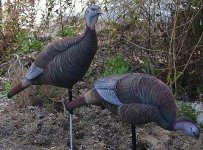
Thank you both for being so generous with your knowledge and time. I'm thinking that the airbrush will be a good Christmas gift for myself. I may not get any decoys flocked and deployed before the end of this season, but I'll try to get some done for next season. I'm also thinking about how I may be able to use some flocking on one of my turkey decoys. Now, if I can only get the wife to shorten my to-do list.....
 
Thank you both for being so generous with your knowledge and time. I'm thinking that the airbrush will be a good Christmas gift for myself. I may not get any decoys flocked and deployed before the end of this season, but I'll try to get some done for next season. I'm also thinking about how I may be able to use some flocking on one of my turkey decoys. Now, if I can only get the wife to shorten my to-do list.....
Ya we both run into that wife thing.... Mine sleeps in late, so I often times get to play around early in the mornings until she wakes up. The Paasche VL5 #5 tip with 30-40 psi out of a compressor works very well. Getting over spray, too much pressure. Getting paint build up on tip, either paint needs to be thinned with mineral spirits or its too little pressure. To get fine lines, you have to lower air pressure on compressor (or what I have found). When you get your airbrush, dont hesitate to ask for advice. First think you need to do is throw away the front protective cap and run it with a bare needle tip.
 
I posted these decoys up on the december workbench, but wanted to elaborate a little on the flocking.

I flocked the second coat of black early thursday morning, put them in my drying room till mid afternoon, then painted flat white enamel over the white areas and let it dry until afternoon on friday, My drying room used to be the guest room, it has a great ceiling fan is a notoriously warm room. Although friday morning, the white still felt a little uncured, we took them hunting anyway friday afternoon. I think cure time is like 5 days. The weather was continual rain, big time mossy conditions and black mud along the bank where we put them bag in slot bags. Then since I didn't want to make two trips, I drug the slot bag through the soup and expected to have to do a little touch up, but after a good rinse in the shop sink there was not a flaw or mark on them.. I would definitely recommend giving them some cure time, but this stuff is tough.

IMG_5420.jpg
 
The decoys i flocked as a result of this thread have been on a half dozen hunts. My buddies rave about them, mostly flocking in general rather than my attempt at applying it. The consensus is that the ducks like them a lot, as we have many birds drop right in, in locations where they would normally be wary. Could be green ducks, but I'm thinking the flocking really works.
 
I kept a pretty good journal the first few seasons my boys started hunting and for several years with regular decoys it was kind of hit and miss with daily averages per hunter at just below 3, which we felt pretty good about at the time. Limits were rare though back in those days. The first day I used flocked decoys was pretty mind blowing. With only 3 flocked goldeneye decoys in front of my son and myself, 75 to 100 yards below the guy we were hunting with who had regular mallard and wigeon decoys. Every mallard coming back to the river poured in to those three decoys as well as every goldeneye in the area. That year and the next several our daily average per hunter was over 5 and 7 bird limits were common. I can't bring myself to use my fancy painted cork decoys.
 
Back
Top