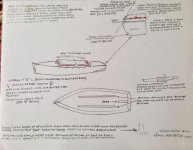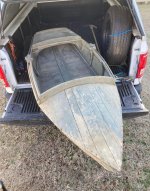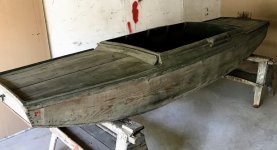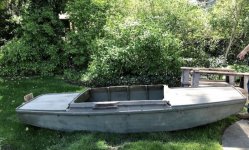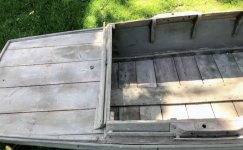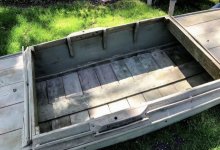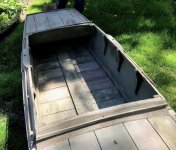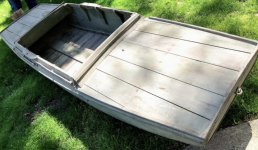
Cape may ditch box plans

CaptBobKeeney

Active member
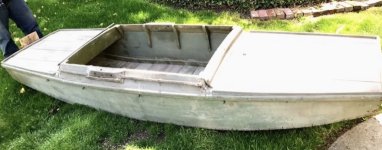
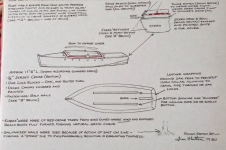
Here are cape may ditch box plans they are of a bateau style pictures are of a bateau style and garvey style. Drawing done by FH “Sunny” Sutton
 

Attachments

  • IMG_5777.jpeg
    IMG_5777.jpeg
    195.4 KB · Views: 37
  • IMG_5779.jpeg
    IMG_5779.jpeg
    612.3 KB · Views: 32
  • IMG_5776.jpeg
    IMG_5776.jpeg
    174.2 KB · Views: 30
  • IMG_5775.jpeg
    IMG_5775.jpeg
    261.4 KB · Views: 31
  • IMG_5773.jpeg
    IMG_5773.jpeg
    208.8 KB · Views: 31
  • IMG_5774.jpeg
    IMG_5774.jpeg
    266.9 KB · Views: 31
  • IMG_5772.jpeg
    IMG_5772.jpeg
    310.4 KB · Views: 32
  • IMG_5771.jpeg
    IMG_5771.jpeg
    234.9 KB · Views: 31
  • IMG_5770.jpeg
    IMG_5770.jpeg
    153.9 KB · Views: 34
  • 5ADA0A3B-C58F-4836-9698-8BE0EDC66FC8.png
    5ADA0A3B-C58F-4836-9698-8BE0EDC66FC8.png
    1.8 MB · Views: 36
Last edited:
The variety of duck boats you come into contact with is something else. Honestly, I'm a bit perplexed why some of these designs, or elements of, haven't made their way to today's commercial duck boat makers. When I look at the boats in your collection and compare it to today's commercial offerings I see a lot of things that both look better and probably serve the hunter better missing in what the commercial makers are producing. Some of them are downright FUGLY.
 
The variety of duck boats you come into contact with is something else. Honestly, I'm a bit perplexed why some of these designs, or elements of, haven't made their way to today's commercial duck boat makers. When I look at the boats in your collection and compare it to today's commercial offerings I see a lot of things that both look better and probably serve the hunter better missing in what the commercial makers are producing. Some of them are downright FUGLY.
This is undoubtably true, but I think many of the design elements and details that make these old boats look and serve better are hard to build in materials and construction methods suitable for mass construction at an affordable price. And the market for duck boats is so small that it's hard to sell enough boats to recoup investment costs in fiberglass or plastic molds or precision aluminum fabrication.
 
On those boxes--is there any difference in the ability to grass up and hide the Garvey-style hulls vs. the bateaux-style? To my eye, the harder lines on the Garvey may not blend as well, but that may be covered up by a proper grassing job.
 
This is undoubtably true, but I think many of the design elements and details that make these old boats look and serve better are hard to build in materials and construction methods suitable for mass construction at an affordable price. And the market for duck boats is so small that it's hard to sell enough boats to recoup investment costs in fiberglass or plastic molds or precision aluminum fabrication.
Jeff

Absolutely. You are correct it is largely driven by modern manufacturing processes. But I think there is still room for old ideas. For example, I don't know of a single major aluminum jon boat manufacturer that offers a decked boat with cockpit. County Line does but they are tiny and have a waiting list. Also, their hull's angular discontinuous shape hurts my eyes. In my best estimation the big brands are all going after the same market. That being a duck boat configured for a jack plate outboard or surface drive meant to go fast in curvy stumpy waters. They are great at that but absolutely SUCK in chop, are insanely heavy, and not really meant to shoot from. They transport hunters. There are so many great designs and features from the past that will never be incorporated in mass produced hulls because the demand seems to be driven by hunters who think a duck boat's purpose is to go fast and carry a ton gear.

My comments remind me of a post from the earliest days of the site where a participant was deciding between two modern day barges marketed as duck boats. One of the boats had 500 more pounds of payload than the other. As the fellow posted about his trepidations of going with the smaller capacity my friend Jeff Smith made a comment that illuminated the absurdity of it all. He said it like this. "Nothing pisses me off more than to leave 500 pounds of hunting gear on the dock."

I miss his practicality and sense of humor.
 
Jeff

Absolutely. You are correct it is largely driven by modern manufacturing processes. But I think there is still room for old ideas. For example, I don't know of a single major aluminum jon boat manufacturer that offers a decked boat with cockpit. County Line does but they are tiny and have a waiting list. Also, their hull's angular discontinuous shape hurts my eyes. In my best estimation the big brands are all going after the same market. That being a duck boat configured for a jack plate outboard or surface drive meant to go fast in curvy stumpy waters. They are great at that but absolutely SUCK in chop, are insanely heavy, and not really meant to shoot from. They transport hunters. There are so many great designs and features from the past that will never be incorporated in mass produced hulls because the demand seems to be driven by hunters who think a duck boat's purpose is to go fast and carry a ton gear.

My comments remind me of a post from the earliest days of the site where a participant was deciding between two modern day barges marketed as duck boats. One of the boats had 500 more pounds of payload than the other. As the fellow posted about his trepidations of going with the smaller capacity my friend Jeff Smith made a comment that illuminated the absurdity of it all. He said it like this. "Nothing pisses me off more than to leave 500 pounds of hunting gear on the dock."

I miss his practicality and sense of humor.
Totally agree--especially about the extra 500 pounds. I'd add that for boats of similar design and displacement, every extra pound of weight in the empty boat is a pound of payload you can't carry. Don't get me started on mud motors. My blood pressure is high enough already. There is no place I hunt where getting there faster is a major factor in my safety, happiness, or success. Seaduckers and those who hunt big water may feel otherwise.
 
On those boxes--is there any difference in the ability to grass up and hide the Garvey-style hulls vs. the bateaux-style? To my eye, the harder lines on the Garvey may not blend as well, but that may be covered up by a proper grassing job.
Jeff,
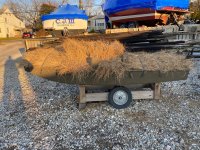
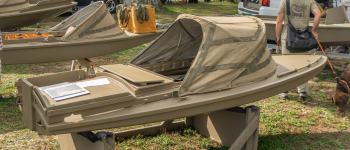
the Garvey style hulls do have harder lines, but in these small style as ditch boxes, they are meant to sit and hide and sunk in mosquito ditches and then covered in grass so the hard lines of it are not a worry. I will attach a Garvey style ditch box in a picture below all grass up. To the left with the shotgun on it is the garvey ditch box you can see how it blends in
 

Attachments

  • IMG_0352.jpeg
    IMG_0352.jpeg
    863.7 KB · Views: 17
  • IMG_0370.jpeg
    IMG_0370.jpeg
    811 KB · Views: 17
Jeff,
the Garvey style hulls do have harder lines, but in these small style as ditch boxes, they are meant to sit and hide and sunk in mosquito ditches and then covered in grass so the hard lines of it are not a worry. I will attach a Garvey style ditch box in a picture below all grass up. To the left with the shotgun on it is the garvey ditch box you can see how it blends in
Thanks. A lot Maine salt marsh was never mosquito-ditched, but I've done my share of hunting from canoes or kayaks or just a seat tucked up inside a narrow little creek. I hadn't thought about a boat or box that would float in there. It would be a neat way to hunt. I guess I need a pond box!
 
What is difference in design between a pond box and a ditch box?

Rick
Rick, there isn’t too much of a difference between a pond box and a ditch box. Back then both boats were meant to row and be dragged or staged on a salt pond or mosquito ditch. To today’s standards a pond box is more of a layout blind that you can drag then a boat thats able to be rowed.
 
Back
Top