And so it begins, Van Sant style restoration

jode hillman

Well-known member
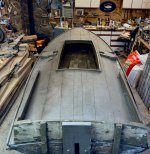
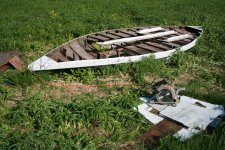
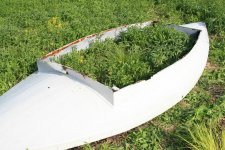
Now that duck season is over, I'll be starting this winter's project. The restoration of a traditional van sant style sneak box. She Will need a transom replaced, some frame replacements, hull boards replaced and a new epoxy glass job to fix the old delaminated poly resin. I'll update as I progress.
 

Attachments

  • IMG_7758.jpeg
    IMG_7758.jpeg
    739.5 KB · Views: 26
  • IMG_7759.jpeg
    IMG_7759.jpeg
    521.9 KB · Views: 25
Judging by her looks she only needs fresh paint. But that's why we inspect and not just buy based on pictures. I look forward to seeing what you turn her in to.
Yes. That's what I thought! But I got lured in by a half assed restoration done sometime in the 80s. Haha.

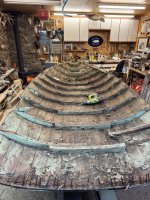
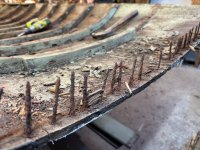
They made it look good but didn't address underlying problems. First step is getting her torn down and the deck off to get at stuff like this.

Original construction is bronze boat, nails and galvanized head nails. But there are lots of rusted deck screws throughout that were added later which is making teardown a pain.
 

Attachments

  • IMG_7762.jpeg
    IMG_7762.jpeg
    473.6 KB · Views: 25
  • IMG_7760.jpeg
    IMG_7760.jpeg
    438.3 KB · Views: 21
  • IMG_7766.jpeg
    IMG_7766.jpeg
    556.9 KB · Views: 21
  • IMG_7768.jpeg
    IMG_7768.jpeg
    397.3 KB · Views: 21
Jode~

I will be following this with great interest - of course!

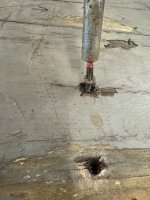
Question: How will you remove the deck screws? Dave Clark told me how he uses a small diameter hole saw (presumably without its pilot drill) to isolate each screw - then remove them (screwdriver, pliers, Vise-Grip et cetera) after the plank is lifted off. I have not yet tried this technique. The benefit would be that you could have a pattern for each new plank. And, I imagine some planks will be too far gone to save - especially if they have been fastened twice.

All the best,

SJS
 
Jode~

I will be following this with great interest - of course!

Question: How will you remove the deck screws? Dave Clark told me how he uses a small diameter hole saw (presumably without its pilot drill) to isolate each screw - then remove them (screwdriver, pliers, Vise-Grip et cetera) after the plank is lifted off. I have not yet tried this technique. The benefit would be that you could have a pattern for each new plank. And, I imagine some planks will be too far gone to save - especially if they have been fastened twice.

All the best,

SJS
Steve, that sounds like an interesting idea I would imagine I could also use a very small Forstner bit to get them majority of the putty out that's what we've been covering the screws so far.

I am not sure if the deck boards are screwed nailed or both.

I removed the rub rails and they were both nailed and screwed. They came off in pieces.

I'm hoping to avoid that with the deck boards. I think I will have an answer later tonight. I'll keep you updated.

Thanks for that tip from Dave.
 
Jode~

I will be following this with great interest - of course!

Question: How will you remove the deck screws? Dave Clark told me how he uses a small diameter hole saw (presumably without its pilot drill) to isolate each screw - then remove them (screwdriver, pliers, Vise-Grip et cetera) after the plank is lifted off. I have not yet tried this technique. The benefit would be that you could have a pattern for each new plank. And, I imagine some planks will be too far gone to save - especially if they have been fastened twice.

All the best,

SJS
Steve, I have been able so far just to find the areas of putty over top of the screws. Scrape the putty away with the painters five and one tool and try to remove the screw. Most of the screws just spin.

The planking is tongue and groove, so I had to start at the port side and work my way to starboard.

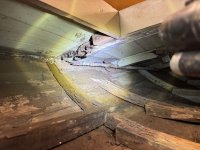
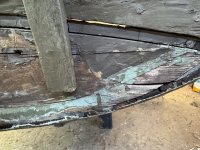
Once I started removing the planking, you can see there is much more significant dry rot and termite damage than I had anticipated.

She is quite literally coming apart in my hands.

I'm going to continue to remove the planking and see if I want to proceed with the restoration or just send her to the boat graveyard.

As far as I can tell, this is a very old sneak box that has already gone through two refits in its lifetime.

In my estimation, the oarlocks and the Decoy boards were replaced during her last refit, perhaps in the 1980s.

Quite literally, the fiberglass is the only thing holding this boat together.

 

Attachments

  • IMG_7771.jpeg
    IMG_7771.jpeg
    473.2 KB · Views: 27
  • IMG_7772.jpeg
    IMG_7772.jpeg
    483.9 KB · Views: 24
  • IMG_7769.jpeg
    IMG_7769.jpeg
    528.7 KB · Views: 27
  • IMG_7775.jpeg
    IMG_7775.jpeg
    549.1 KB · Views: 28
  • IMG_7776.jpeg
    IMG_7776.jpeg
    458.4 KB · Views: 27
  • IMG_7777.jpeg
    IMG_7777.jpeg
    684.2 KB · Views: 27
  • IMG_7774.jpeg
    IMG_7774.jpeg
    321.5 KB · Views: 27
Cool old boat, What a shame.
First time I think I’ve seen termite damage in a hull on this site.
 
Cool old boat, What a shame.
First time I think I’ve seen termite damage in a hull on this site.
I agree, Carl.

The boat was stored inside of a sea air container.

At some point in time, it must've started leaking. Then got dry rot. Then mold and mildew. I really didn't think it was this far gone.

I have the material, I have the time, I have the knowledge, I just don't know what I will do at this point. I think I will remove the rest of the deck boards and then make a decision.
 
Now that duck season is over, I'll be starting this winter's project. The restoration of a traditional van sant style sneak box. She Will need a transom replaced, some frame replacements, hull boards replaced and a new epoxy glass job to fix the old delaminated poly resin. I'll update as I progress.

Harsh reality, the hull pics you posted made it look great, the rest, not so much.
 
Steve, I have been able so far just to find the areas of putty over top of the screws. Scrape the putty away with the painters five and one tool and try to remove the screw. Most of the screws just spin.

The planking is tongue and groove, so I had to start at the port side and work my way to starboard.

Once I started removing the planking, you can see there is much more significant dry rot and termite damage than I had anticipated.

She is quite literally coming apart in my hands.

I'm going to continue to remove the planking and see if I want to proceed with the restoration or just send her to the boat graveyard.

As far as I can tell, this is a very old sneak box that has already gone through two refits in its lifetime.

In my estimation, the oarlocks and the Decoy boards were replaced during her last refit, perhaps in the 1980s.

Quite literally, the fiberglass is the only thing holding this boat together.
Jode~

Sorry to see all the evidence. Of course, anyone trying to save old stuff will encounter discouraging surprises. I have been fairly lucky with most of our 200-year-old farmhouse - but some parts could not be saved (I'm thinking of our "summer kitchen" and our south porch). I have discarded 2 duckboats over the years. I offer the following not to discouage - but to support the decision to scrap if you so decide.


I have probably posted these photos before as "Death of a Duckboat"

It began as a 2-man Scooter (what most would call a layout boat). It was found on the side of the road by my friend Craig Kessler. The FREE painted on it was an omen....

After hauling it - somewhat skeptically - the 250 miles up here, I soon decided it was neither sound enough nor big enough to serve as a two-man. Thus, the Sawall and Skilsaw.....

Death 1.JPG

The interior showed little to inspire....

Death 3.jpg

The decks and cockpit were fairly sound - but still too narrow for more than one gunner.

Death 5.jpg

Thus, it was not worth the time and materials for a whole new bottom.

Death 4.jpg

I did salvage the floorboard - a nice piece of 5/8 Douglasfir plywood - to be used in a later project. I resisted the idea of keeping it as a "traditional" flower planter....

Death 6.jpg

Many small bits went to the burn pile or the transfer station (as in "dump").

Death 7.jpg

A thorough clean up of the autopsy/demolition site followed...

Death 8.jpg

And - eventually - some flowers did honor the departure of the vessel.

Death of duckboat 9.jpg

As it happens, a few years later I was given this photo of the 2-man in action. Note that the gunner on the port side has his left leg outside of the coaming - and the decks are. awash fore and aft. (I also restored the white 1-man in the photo as the BRUD SKIDMORE.)

B28 Wally, with rumplik & Dufek CROPPED.jpg

So - best of luck with your big decision.

SJS
 
Jode~

Sorry to see all the evidence. Of course, anyone trying to save old stuff will encounter discouraging surprises. I have been fairly lucky with most of our 200-year-old farmhouse - but some parts could not be saved (I'm thinking of our "summer kitchen" and our south porch). I have discarded 2 duckboats over the years. I offer the following not to discouage - but to support the decision to scrap if you so decide.


I have probably posted these photos before as "Death of a Duckboat"

It began as a 2-man Scooter (what most would call a layout boat). It was found on the side of the road by my friend Craig Kessler. The FREE painted on it was an omen....

After hauling it - somewhat skeptically - the 250 miles up here, I soon decided it was neither sound enough nor big enough to serve as a two-man. Thus, the Sawall and Skilsaw.....

View attachment 72774

The interior showed little to inspire....

View attachment 72775

The decks and cockpit were fairly sound - but still too narrow for more than one gunner.

View attachment 72778

Thus, it was not worth the time and materials for a whole new bottom.

View attachment 72777

I did salvage the floorboard - a nice piece of 5/8 Douglasfir plywood - to be used in a later project. I resisted the idea of keeping it as a "traditional" flower planter....

View attachment 72779

Many small bits went to the burn pile or the transfer station (as in "dump").

View attachment 72780

A thorough clean up of the autopsy/demolition site followed...

View attachment 72781

And - eventually - some flowers did honor the departure of the vessel.

View attachment 72782

As it happens, a few years later I was given this photo of the 2-man in action. Note that the gunner on the port side has his left leg outside of the coaming - and the decks are. awash fore and aft. (I also restored the white 1-man in the photo as the BRUD SKIDMORE.)

View attachment 72783

So - best of luck with your big decision.

SJS
I'll know better in the next few days once I get the rest of the decking off.

Not everything can be saved
 
Welp final update. I've never had a boat looks so good from the outside that was so bad on the inside. Dry rot, wet, rot, termite damage. Once I took the planking off, it literally crumbled in my hands. it was literally held together with fiberglass , Bondo and deck screws.


All was not lost. I will save some of the deck planking to use for dead mounts and with various Decoy carving projects. The rest of the boat will go towards heating my shop probably for the next two weeks!
 

Attachments

  • IMG_7782.jpeg
    IMG_7782.jpeg
    437.4 KB · Views: 8
  • IMG_7781.jpeg
    IMG_7781.jpeg
    696.1 KB · Views: 8
Jode,
Maybe it can't be saved...any reason why you couldn't use it as a male plug to construct a 100% rot free fiberglass boat? RM
Mainly because it's a displacement hull boat.

When originally built it was meant to be rowed sailed or used with a very small horsepower motor. It will not plane. And other than the nostalgia of it I really don't like slow boats.

The areas I generally hunt have anywhere from a 2 to 7 mile run to reach the gunning area. There are better more modern designs, more conducive towards the Hunting conditions. I encounter every day.
 
Back
Top