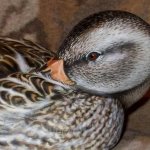
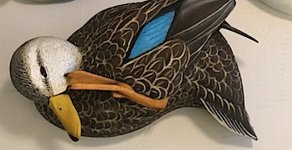
Do I really need to paint on the 300 feathers on the face or can I just leave it like this? I am finding the exercise rather tedious. This is a wooden head I carved that I will be putting on a herters body that I burlapped. It will be for big water hunting, mixed into my layout rig.

You are using an out of date browser. It may not display this or other websites correctly.
You should upgrade or use an alternative browser.
You should upgrade or use an alternative browser.
Black duck head
- Thread starter Kevin Puls
- Start date
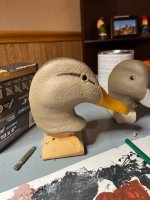
Put some feathers on 1 head. Then take that one and one other head (without feathers) and put them on the hood of your car. Step back 25 yards. Turn and look at the 2 heads. I'm betting they'll look similar enough that you'll decide you don't need to paint 300 feathers. You may decide just to do a few flecks for contrast.
I don't say any of the above to make light in any way of the amazing work by some of the decoy artists I've seen here - I'm awed by their work and would love to try may hand at it one day. But if you're just wanting hunting decoys and don't have the personal artistic interest and patience, all you've got to worry about is how they look beyond 25 yards.
I don't say any of the above to make light in any way of the amazing work by some of the decoy artists I've seen here - I'm awed by their work and would love to try may hand at it one day. But if you're just wanting hunting decoys and don't have the personal artistic interest and patience, all you've got to worry about is how they look beyond 25 yards.

Does a bear shit in the woods???? Get to paint flecking! Dont stop til your hand is stuck in the same position and tears start to run down your face!Do I really need to paint on the 300 feathers on the face or can I just leave it like this? I am finding the exercise rather tedious. This is a wooden head I carved that I will be putting on a herters body that I burlapped. It will be for big water hunting, mixed into my layout rig.
In all reality, I havent really flecked any of the hen heads like don does. Im always envious of his hen and black duck heads though and i will likely take some time and learn the technique this summer on some already hunted birds. Contrast is everything when decoying birds. So in all reality, I actually think heads without all the flecking works better to draw attention from distance. Ive kind of attempted it but it starts to muddy up and I think it takes away from that contrast. Where Don, and many others are so good is they can put that flecking into the head but not lose the undertone contrast from a distance. Believe me, if birds get close enough to realize there isnt flecking on that head and its not real, it should be dead. Don says it all the time, he takes things much further than he needs to in order to kill ducks. But Don, and many others on here, are artists through and through. There are artists here and there are hunters here. I try to play somewhere in between, and maybe one day when I want to build decoys for the fun of it vs feel like I need to get them done for the season upcoming, then i may push the limits further and further. That head will hunt. Mount it up and get the decoys muddy!
I never do that crazy detail on my personal duck decoys. It's totally unnecessary from a decoying standpoint. The standard decoys were were selling all last summer had no flecking, just like this.
This black duck head is buff, black, and some brown and white. Simple and effective.
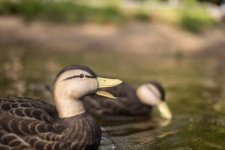
These are what I call enhanced with flecking, from a birds point of view it means nothing, from a buyers point of view at least in my case it's expected.
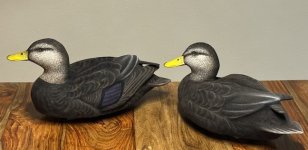
The flecking part takes me about 15 to 20 minutes, but adds a bit of artistic character that probably does sell decoys. I have over 200 custom decoys on order right now.
I will admit I enjoy the artistry part, but also understand the reality of decoying. I just want feet down, so close that the birds will have to touch water before they can climb back out. Likely I could do that by flocking a mallard completely black.
My son painted the non flecked black duck, he gets annoyed with my messing around, he will paint a black duck in 15 minutes, it takes me two hours. My thing is if you can ignore the income part, hourly wage of making decoys or you are just making them for yourself, just do the best you can at the level you are at. I think william and I are more concerned about motion and flocking.
This black duck head is buff, black, and some brown and white. Simple and effective.
These are what I call enhanced with flecking, from a birds point of view it means nothing, from a buyers point of view at least in my case it's expected.
The flecking part takes me about 15 to 20 minutes, but adds a bit of artistic character that probably does sell decoys. I have over 200 custom decoys on order right now.
I will admit I enjoy the artistry part, but also understand the reality of decoying. I just want feet down, so close that the birds will have to touch water before they can climb back out. Likely I could do that by flocking a mallard completely black.
My son painted the non flecked black duck, he gets annoyed with my messing around, he will paint a black duck in 15 minutes, it takes me two hours. My thing is if you can ignore the income part, hourly wage of making decoys or you are just making them for yourself, just do the best you can at the level you are at. I think william and I are more concerned about motion and flocking.
100%. Movement is key and flocking has changed my mind on everything.I think william and I are more concerned about motion and flocking.
Thanks. I think I’ll try a wash for some texture. Then move on the the body.
I’ve been texturing with gesso and acrylic sculpting clay and agree that it’s a real game changer. Not the flocking I see here but half as good. I brush paint so that’s a limiting factor as well. I have an airbrush in a box in my basement that is defective because it doesn’t turn my decoys instantly into works of art.100%. Movement is key and flocking has changed my mind on everything.
Wait til you flock your first decoy. You'll never go back. let us know when you're ready and we will walk you through it sir.I’ve been texturing with gesso and acrylic sculpting clay and agree that it’s a real game changer. Not the flocking I see here but half as good.
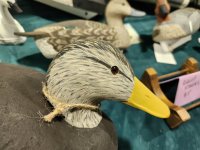
Not works of art... gimme a break. Looks real good sir. This is acheivable with paint pens over flocking. Do me a favor, do one of your bodies with a head that is flocked and just try paint pens over flocking. You might surprise yourself. Not muddied up at all like I got trying. VERY VERY NICE! Start small with the flocking, may surprise yourself and want to try a body next.
I'm thinking you got my post mixed up with someone else's. I was just showing one of my black ducks. I've done a bunch of them, no 2 turn out the same. I try something different every time and am never 100% satisfied. Thats just washes over the ticking on the head iirc, made that bird a couple years ago. I like the softer affect the washes gave.Not works of art... gimme a break. Looks real good sir. This is acheivable with paint pens over flocking. Do me a favor, do one of your bodies with a head that is flocked and just try paint pens over flocking. You might surprise yourself. Not muddied up at all like I got trying. VERY VERY NICE! Start small with the flocking, may surprise yourself and want to try a body next.
No offense to you guys that flock but I will never mess with it, I have zero desire to try it.
I did, im sorry buddy. It looks really good. you have that flecking in the head down. Not muddy at all, shows the feather detail well, and gives the nice contrast from a distance. Well done sir.I'm thinking you got my post mixed up with someone else's. I was just showing one of my black ducks. I've done a bunch of them, no 2 turn out the same. I try something different every time and am never 100% satisfied. Thats just washes over the ticking on the head iirc, made that bird a couple years ago. I like the softer affect the washes gave.
No offense to you guys that flock but I will never mess with it, I have zero desire to try it.
No apologies necessarily I was just trying to clarify the intention of my post. Thanks for the compliment.I did, im sorry buddy. It looks really good. you have that flecking in the head down. Not muddy at all, shows the feather detail well, and gives the nice contrast from a distance. Well done sir.
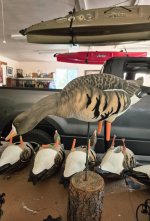
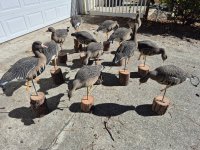
Confusion aside…paint pens might be interesting. But I did some dry brushing and stepped back 15 feet. Looked great. Birds won’t care. I’ll be honest my black ducks are herters bodies that I inherited from my good friend Jon Yenni and heads that I carved from pine that he gave me. He is not longer with us. Not works of art but they are not 100% my creations either. I obsess over the other decoys I make. I need to give myself a break. Thanks everyone.
If you are painting a smooth surface decoy whether it's a slick of fine feathering. You don't want to use oil based paint pens, they are strictly what I use for flocked decoys. They are glossy on smooth surfaces, but not on flocking. So if it's a smooth surface, it's better to paint by hand, you can still easily do the flecking with a small brush. I did this mallard hen probably 20 years ago, smooth surface, no feathering or wood burning or rotary stones, completely smooth. It's a pretty simple technique with a single small brush I get for about $3 at hobby lobby, it's a master's touch, #4 round. You kind of have to catch on to getting your paint to the right viscosity to flow well whether it's oil or acrylic. This mallard painted with acrylic and the paint dries fast, so you have to have a plan in mind where you want the color to go. Having the right load of paint in the brush is something you will learn with experience. The next thing is the rule of 3, that is to get a 3D effect you need 3 colors or 3 shades of color, at least. Often I have 5 colors or more. The flecking is done with short strokes with a small brush and building color and contrast throughout hundreds and thousands of short lines. This entire decoy was painted with that little #4 brush over a brown base. The eyes are glass, but everything else is painted along with the nostrils. The little brush can be flattened by dragging it across your pallet giving you a very sharp edge to do things like the little splits against the bill. Keep in mind no two mallard hens are the same, some have very light heads, some very dark, some speckled some fairly plain. I did much less fleshing on this smooth finish black duck, but still the same process. It's much easier to do with a paint brush over a smooth surface decoy than paint pens over a flocked decoy. I'm just more successful with flocked decoys for hunting, but decorative or smooth surface decoys I'll be hand painting,