
Now that's using the old noggin. Very clever idea that I hope future builders will see and repeat.


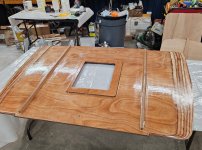
That's a great idea! Homemade gasket. Perfect.Waiting on the epoxy on the sole pieces to cure a bit more, I did a dry run at a hatch cutout with my router to get a sense of how many passes I'd need to make, etc.
Then decided to test an idea to add a seal with some 1/4" rubber tubing, less for sealing and more for preventing chatter. The tube walls are only about 1/16" thick - good for being malleable, but may not hold up so I may look for something with thicker walls. On the other hand, shouldn't get lots of direct wear. As always, I welcome your thoughts and recommendations.
View attachment 72077
View attachment 72078
View attachment 72079
Whale Supersub low profile pump. 1100 gph. They make one with a built-in sensor, but while Whale pumps have a decent reputation their sensors don't. Thus I'm using the plain pump and a Johnson sensor.What brand pump is that? Never seen one like it.

You do such a nice job. Makes me jealous, and envious that I don't have a heated work space for wintertime.Been doing some upland training with my lab the last few weeks and helping my bride after breaking her wrist (fall on ice) so have worked very little since my last post. But figured I better do and post something after the shit I'm catching in another thread.
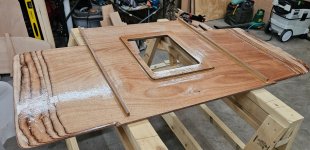
Several comments on sole support. I really didnt want to create air pockets by adding longitudinal runners, but after thinking about it a bit realized a couple ribs on the bigger sole pieces would add plenty of strength and rigidity without boxing anything in - and made good use of some waste.
View attachment 73459
View attachment 73460
Between high humidity and temperature swings, I worry (probably too much) about condensation and, thus, captured water in sealed spaces. My below-sole space has large limber holes front-to-back so any water can exit easily - and as large as I felt I could make them and keep structural integrity in their parts to maximize airflow (I'll probably also remove the access covers when not in use). I think as long as you have a way for moisture to drain and/or evaporate, you're good.Nice! That is a great solution which will make a world of difference to the rigidity of those pieces when stood upon.
What’s the reason for not wanting to create sealed air pockets? I joined some of my compartments by drilling holes through the stringers/keelsons then installed a combination of deck plates and drain plugs so that the sealed sections could breathe when the boat is stored or not in use.
I’ll shoot some pics tonight.
Between high humidity and temperature swings, I worry (probably too much) about condensation and, thus, captured water in sealed spaces. My below-sole space has large limber holes front-to-back so any water can exit easily - and as large as I felt I could make them and keep structural integrity in their parts to maximize airflow (I'll probably also remove the access covers when not in use). I think as long as you have a way for moisture to drain and/or evaporate, you're good.
Looks like you have it well thought out.View attachment 73500
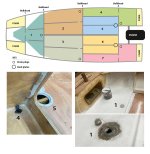
Here's what I did. I'm not worried at all about condensation/captured water (maybe I don't worry enough -- I do worry about weight and strength however.)
I drilled holes to join some of the under-floor compartments into 7 individual zones. Each zone has its own breather in the form of either a deck plate or bung-style drain plug. When the boat is not in use I will have all the breathers open.
I still have to buy and install the drain plugs for zones 2 and 3, which will be the same style as no.1

Here's what I did. I'm not worried at all about condensation/captured water (maybe I don't worry enough -- I do worry about weight and strength however.)
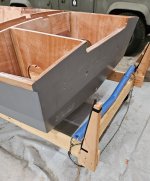
An early impression on the slickness of the Wetlander product I put on the bottom of the boat...
As you've seen in earlier photos, the boat is resting on 4 or 5 cross-pieces (each covered in float-tubes) on my cradle. I got it mostly "flat" fore to aft, but it is very slightly bow-high compared to how it would ride in the water. I'd put some "retainers" on the rear of the cradle to make sure the boat didnt work its way off as I got in and out, worked inside the boat, or rolled the boat around.
Yesterday I was installing some backer board/thickeners for the step-n-trim tabs I'll be installing (to control any porpoising I may get), and needed to slide the boat forward a foot or two to get some screws in to pull those tight while epoxy set. Sliding the boat was a breeze, took very little effort pulling from the front - but I had to work quickly, as just the weight of the boat would allow it to slide slowly back to the retainers (maybe a minute or two) even with the minimal slope. I definitely won't have any problems sliding it on and off trailer bunkers. As long as it wears reasonably well, I think I'll be very pleased with the product.
View attachment 73576
Yep, that will be the test for sure - I never fully believe the claims, but if a light sanding and repaint every few years works that will be awesome.That is great to hear that you are happy with it. How do you deal with the inevitable chips and dings in the wetlander if it is so slippery? Can you touch it up and have it stick to itself around a repair? Is there a special patching procedure?
*** Never mind, I looked it up after I posted. They say it is fine to paint over itself and adheres to itself, but I kind of don't believe it. You have to tell us at some point in the future once you get some hard use in and need to do some repairs. ***