2025 Devlin Snow Goose Thread

how is your visibility over/around the dodger?

Missed this... I've run with it up on a rough day with someone standing at the front of the cockpit watching the water ahead. I don't think you appreciate the height of the bow and what a dodger would add. I would never consider running with it the dark.
 
Henry,
I racked my brain on this same topic and came to the conclusion that flapper boards work better on smaller cockpit, layout style boats. A large cockpit like yours is a bitch to hide and The Duck Boat Company blind is the best solution that I've seen. In fact I originally considered purchasing their boat but wanted a more conventional design for fishing.
You seem a little spooked about a sewing project but if you can stitch and glue a boat, sewing will come easy. Bending tubing is as simple as filling a tube with sand and clamping it to a form. Good luck with your design.
RM
 
Last edited:
You may be right about them fitting better on smaller boats - I just like the simplicity of them, and the woodworking aspect, particularly on a wooden boat. Still thinking on it - and also on your challenge to go ahead and get a SailRight machine.
 
You may be right about them fitting better on smaller boats - I just like the simplicity of them, and the woodworking aspect, particularly on a wooden boat. Still thinking on it - and also on your challenge to go ahead and get a SailRight machine.

Don't need a fancy machine, any good quality machine will stitch several layers of 1000D cordura.
 
Good quality home machine will definitely stitch 1000 to 600 denier Cordura nylon. Its all about the proper needles. My wife has sewed at least 6 for me on her home machine. Its a Brother brand. Actually have a half finished one waiting for her to finish now but its going on a different boat than originally designed for. Of course 600 denier is easiest, especially when you start sewing on grassing loops thru doubled over sections of material.
 
Henry,
Not to change topic, but I just had a thought that you may want to look into. I don't know what kind of fasteners you intend to use on your grassing rails, but attaching a nut and washer at the farthest reaches can be about impossible. Better to dry fit and epoxy a nut and washer in the appropriate place to be used later. RM
 
Missed this... I've run with it up on a rough day with someone standing at the front of the cockpit watching the water ahead. I don't think you appreciate the height of the bow and what a dodger would add. I would never consider running with it the dark.
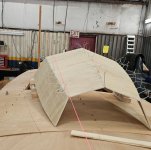
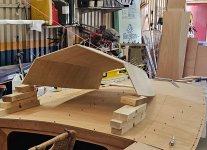
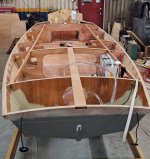
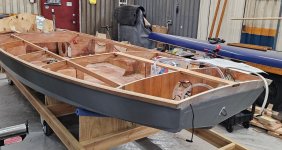
Thought about this more last night and realized it would be simple enough to rig a line from head-height at the back to the nose to get some measurements and take the guess-work out of what would obstruct vision. It also struck me that our stitch and glue process provided a simple way to use some scraps to mock up a dodger in order to get workable measurements.

IMG_20260312_131241.jpg

IMG_20260312_131320.jpg

By shortening (lengthwise) this one a few inches, I could get a little more height at the cockpit-side and increase the wind/water break without sight impact. I'll tweak, then have it as a model for a canvas dodger - though no reason, I guess, it couldnt be epoxied wood. or even glass.
 
Built up a spot for a trolling motor quick mount before removing the decking to get back to work on the "innards".

IMG_20260323_153548.jpg
IMG_20260323_153629.jpg

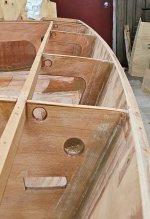
Still noodling on blind plans, but one note for future builders... I tried to think through the majority of potential bulkhead penetrations before installing them, to reduce working at odd angles and to make epoxying the penetration end grain easier. As in the picture below, my initial thinking was to tuck wiring under the deck just behind the coaming. Made sense to me as a place least likely to get banged on by something. But playing with blind designs I realized that if I wanted to run vertical blind tubes (think TDB style as mentioned above), those would need to be close to the coaming and my wiring plan would be an obstruction. So, I'd probably recommend putting chase holes close to the hull sides rather than close to the coaming... and think I'll go ahead and drill new chases further outboard in case I decide to go for that type of blind.

IMG_20260323_153458.jpg
 
Laying out electrical components and wiring to be sure my wiring diagram/plans work and to finalize placement of switches, circuit breakers, outlets, etc. so I can cut final holes and determine any other support needs.

IMG_20260325_135104.jpg
IMG_20260325_135023.jpg

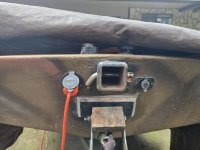
I was originally planning to put the charging outlet and TM outlet on the bow transom, but it just doesn't feel right placing them there with risk of the bow diving into chop... and with them then entering the undrained flotation compartment. Yes I can take extra care sealing them and will have an access hatch, but I'm leaning towards installing them on the port side of the deck where, should either leak, any water would just find its way to the bilge. Any thoughts from the experts?

 
Laying out electrical components and wiring to be sure my wiring diagram/plans work and to finalize placement of switches, circuit breakers, outlets, etc. so I can cut final holes and determine any other support needs.


I was originally planning to put the charging outlet and TM outlet on the bow transom, but it just doesn't feel right placing them there with risk of the bow diving into chop... and with them then entering the undrained flotation compartment. Yes I can take extra care sealing them and will have an access hatch, but I'm leaning towards installing them on the port side of the deck where, should either leak, any water would just find its way to the bilge. Any thoughts from the experts?

I have both the TM and Charging port on the bow of my boat. I have a deep cycle battery in the bow with the on board charger so this made sense at the time. After having my boat for 15 years and 2 houses the outlet where I charge from has always been positioned at the stern from where the boat is stored. I just need a longer extension cord which is not a big deal. However some times at o'dark thirty I forget to unplug it and drive off. If the plug was at the stern it would pop out easily and not damage the extension cord. When this boat dies and I build another it will be in the stern for this reason. I ran a sealed PVC pipe from the bow to the bulkhead which is filled with floation and as far as I know there has been no water intrusion. I was more concerned about water getting in when not in use since I store my boat outside and I live in SW Washington where and it rains all the time. I jack the trailer tongue up up so any water that gets in past he cover drains out. Hope this helps!
20260326_083340.jpg
 
I have both the TM and Charging port on the bow of my boat. I have a deep cycle battery in the bow with the on board charger so this made sense at the time. After having my boat for 15 years and 2 houses the outlet where I charge from has always been positioned at the stern from where the boat is stored. I just need a longer extension cord which is not a big deal. However some times at o'dark thirty I forget to unplug it and drive off. If the plug was at the stern it would pop out easily and not damage the extension cord. When this boat dies and I build another it will be in the stern for this reason. I ran a sealed PVC pipe from the bow to the bulkhead which is filled with floation and as far as I know there has been no water intrusion. I was more concerned about water getting in when not in use since I store my boat outside and I live in SW Washington where and it rains all the time. I jack the trailer tongue up up so any water that gets in past he cover drains out. Hope this helps!
View attachment 75063
Thanks Neal!
 
KInd of surprised your not running your wires inside conduit or is that in plan latter?
Just checking layout for now, but... I think I'm going to just use some braided sleeves, with zip ties/zip tie mounts very so often. I'm not a big fan of conduit - makes it more difficult to re-route or to add something later. I have some 1" vinyl tubing I was thinking of slitting long-ways and using, but braided sleeving is cheap and easier to cut, and doesn't hold any moisture. I may use some plastic/pvc pipe for the sections of nav light lines running through the flotation compartments, both to make fishing replacement lines through easier and to route any moisture that does sneak in through lights to an open part of the boat.
 
But playing with blind designs I realized that if I wanted to run vertical blind tubes (think TDB style as mentioned above), those would need to be close to the coaming and my wiring plan would be an obstruction. So, I'd probably recommend putting chase holes close to the hull sides rather than close to the coaming... and think I'll go ahead and drill new chases further outboard in case I decide to go for that type of blind.
Henry,
Since you are running braided sleeving, is it really necessary to cut new electrical chases? Vertical blind tubes shouldn't interfere with the very meldable softsided electrical conduit that you are planning.
RM
 
Back
Top