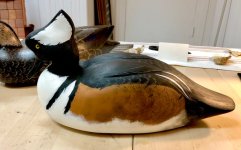
Hoody body pattern

Kevin Puls

Well-known member
Supporter
I’m going to do a hooded merganzer or two. We have them in my area in spades. I might take one for the wall this year.

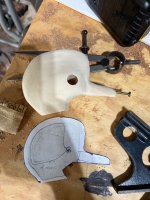
I have a head pattern. What species of birds would be similar in body size and shape? I have a pattern book with many common species.
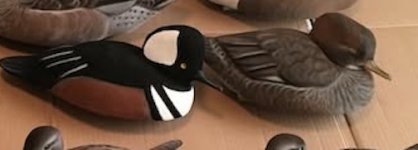
 
As far as a similar body shape, probably a bufflehead would be close.

As with any pattern I develop I do a ton of research, look through thousands of photos. I get an idea of the look I want on a head or body, usually pretty generic on the body to allow for multiple poses. Heads vary so much you really just need to settle on a particular look you like within the confines of reality or in some cases a stylized version.

My hoodie pattern is very close to the same size and shape as my bufflehead pattern.


489039360_1218469893312938_9116767128112838172_n.jpg
 
Alot of my duck patterns come from Grayson Chessers book. If not directly from the book I have modified his patterns to suit my needs. The hooded merganser I posted in the other thread was based off his wood duck pattern. I obviously changed the shape some to be more merganser but the basic dimensions came from his pattern. Personally I think its a tad small if I was using the patterns for actual gunners and not what mostly end up on people's shelves but I am a fan of big decoys.
 
As far as a similar body shape, probably a bufflehead would be close.

As with any pattern I develop I do a ton of research, look through thousands of photos. I get an idea of the look I want on a head or body, usually pretty generic on the body to allow for multiple poses. Heads vary so much you really just need to settle on a particular look you like within the confines of reality or in some cases a stylized version.

My hoodie pattern is very close to the same size and shape as my bufflehead pattern.


View attachment 77797
Thanks Don. I agree with the sentiment. A diver body has some variation but not a ton of it. I might cross a bufflehead with a red breasted merg body.
 
Alot of my duck patterns come from Grayson Chessers book. If not directly from the book I have modified his patterns to suit my needs. The hooded merganser I posted in the other thread was based off his wood duck pattern. I obviously changed the shape some to be more merganser but the basic dimensions came from his pattern. Personally I think its a tad small if I was using the patterns for actual gunners and not what mostly end up on people's shelves but I am a fan of big decoys.
Interesting. I will say given the way I confused them in low lights with woodies in my youth that would make sense. I’m not kidding when I say hoodies are the most common bird in my area at times.
 
Interesting. I will say given the way I confused them in low lights with woodies in my youth that would make sense. I’m not kidding when I say hoodies are the most common bird in my area at times.
I figured they were roughly the same size so it was a good place to start. I will say I plan to slim down the top profile some on the next one I make.

If it makes you feel better my red breasted merganser pattern basically came from his pintail pattern and one of his pintails I have. They are similarly sized and both pretty streamlined birds. I've only made one bird off that pattern so far and will probably tweak that pattern next time as well.
 
Im thinking if you don’t want to alter the body pattern much, bufflehead.
But Im confident you could do a number of different body patterns and have it looking really good.
Last season, I saw a raft of a few hundred hoodies, Im not used to that. I was probably 300-400 yards away with some glare on the water. Looking at them through binoculars, I COMPLETELY mistook them for bluebills, and then buffleheads for minutes.

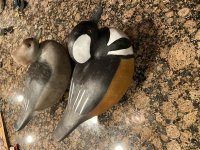
Here’s a pair I did off of Keith Muellers pattern.

IMG_4407.jpeg
 
Im thinking if you don’t want to alter the body pattern much, bufflehead.
But Im confident you could do a number of different body patterns and have it looking really good.
Last season, I saw a raft of a few hundred hoodies, Im not used to that. I was probably 300-400 yards away with some glare on the water. Looking at them through binoculars, I COMPLETELY mistook them for bluebills, and then buffleheads for minutes.

Here’s a pair I did off of Keith Muellers pattern.

View attachment 77805
Those are sweet!
 
Im thinking if you don’t want to alter the body pattern much, bufflehead.
But Im confident you could do a number of different body patterns and have it looking really good.
Last season, I saw a raft of a few hundred hoodies, Im not used to that. I was probably 300-400 yards away with some glare on the water. Looking at them through binoculars, I COMPLETELY mistook them for bluebills, and then buffleheads for minutes.

Here’s a pair I did off of Keith Muellers pattern.

View attachment 77805
We have rafts of redbreasted mergies like that on parts of Tampa Bay.
 
We have rafts of redbreasted mergies like that on parts of Tampa Bay.
Not to change topic, but do you see a lot of full plumage drakes? Seems like if I find a group of 25 RBMs, it may only have 1-3 with a green head.
Common mergs still more brown ones but not as much.
Wasn’t sure if it took them a few years for full plumage, or came in in spring time maybe?
I haven’t noticed the same thing with hoodies.
 
It's kind of a common thing amongst divers for hen heavy looking groups during hunting season. We use lots of hen decoys for buffleheads, usually 9 hens and 2 drakes improve our ability to decoy by a significant amount. What we noticed was lots of groups of buffleheads will seemingly only have one or two drakes in them until about a decade ago, noticed a "hen" my son shot looked like a boone and crocket trophy hen, way bigger than a hen should be, but researched a little and found with those pink feet to be a second year drake. The same thing is true with goldeneye, it's fairly common to have a brown headed drake with a dull white spot in its second year. About the only way with a second year GE is they will have a black bill, no orange. What we do find with GE is older drakes tend to decoy late morning and are often in small groups and singles and decoy best to drake decoys. Kind of weird things to consider when you are a diver hunter.

We have lots of redbreasted mergansers in the spring during the caddis hatch on the Henry's Fork here in Idaho, but rarely during hunting season. Common mergansers are, well, common.

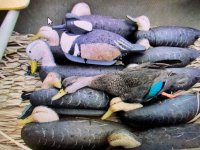
When I'm designing my decoy groupings I think a lot about the drake and hen ratios, balancing visibility with biology. The birds will tell you what they want to see.
 
For my hoodies I have taken any redhead or Bluebill pattern and added a longer tailboard(in cork bodies) or just sketched a pattern on wood. Like Don alluded to earlier, the heart and soul of a decoy is in the head and neck. You could glue an amazing head on a football and it would work and look good.
 

Attachments

  • IMG_4666.jpeg
    IMG_4666.jpeg
    330.6 KB · Views: 8
  • IMG_0099.jpeg
    IMG_0099.jpeg
    580.9 KB · Views: 8
Last edited:
Not only do I have good advice here, I have several paint schemes to mimick!

Good head on a football. lol. I keep telling myself ducks are round and decoys don’t need carved in feathers to work.
 
Last edited:
Correct me if I'm wrong but it takes all divers a couple years to mature right?
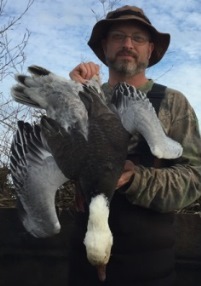
Yes in some cases. Hence my multi year quest for a mature long tail duck. I have harvested my share of juvenile drakes that came in straight on. I lost the only mature bird on a guided hunt because they didn’t want to pick up birds until 2-3 were down on the water.
 
Back
Top