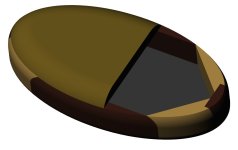
A hollow wood decoy plan, more computer play.

Robert L E

Active member
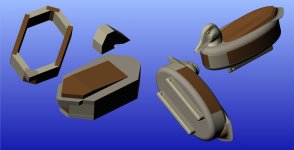
I drew this up about a year and a half ago base on a couple of prototypes that I have actually made. (alas I cannot find my camera or I would post pictures) The fish mouth parts are 1" stock, the rest 3/4".

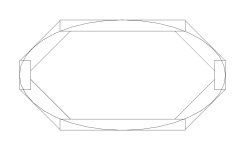
The advantage of the fish mouth glue joints is the increased glue surface and they self align. All angles are 45 or 90 degrees.

It looks like a nightmare but the pieces of the carving block are all simple to cut on a table saw and glue up is easy. I assembled the side pieces on top of the bottom board, put the top board on, clamped lightly with two C-clamps, tapped on the side pieces to fine tune the alignment, then snugged the clamps up.

My prototypes did not have the good oval shape the computer helped me with and I also decided to put two keels on so they would sit flat on ice or the ground (or a shelf). The ones I made float with a water line about where the bottom glue line is.

I have an overflowing 5 gallon bucket of heads already carved and waiting for bodies, some have been waiting a long time.

Bob

edit- I've also been thinking about making boxes like this with either a hinged or lift-off lid.
deke.jpg
 
Last edited:
Robert,

Looks like you put alot of thought into this idea ! And a very good one at that if you have any plans on this set up i would love to have a set if you would be willing to share

Great Idea
Mike
 
I'm curious, not to denigrate you or your project, but what was your goal behind this? I just don't see the advantage in it. Could you explain it to me?
 
Terry- I liked your signature and since it also applies to me, I copied it. I wear it on a hat all the time.

Why? The price of cork. I like projects. I have a 5 gallon Bucket O' Heads that need bodies. I can knock out the parts with a table saw. I like the idea of hollow wood decoys but not gouging out the hollow.

I got the idea after reading an article in Wooden Boat Magazine and while reading about oval cross section hollow spars I got the idea. I made two prototypes that came out easier and better than I thought, so I modeled an improved version in the computer. They rounded up better than the CAD model shows. The time on the computer was way too long but how can you explain a hobby?

It is an idea that would work for me for making a gunning decoy that would see some time in the water but not soak multiple days.

It would be easier and probably cheaper to just buy some more plastic decoys but that is not the point.

Bob
 
Bob:
First off congratulations on being a Father to one of this Nations finest! Please give him/her a hearty "Thank You" from our family. I haven't had a chance to change my profile, but he is now a former Marine! He is home to stay now, couldn't be happier. How about yours?

No, I wouldn't profess to have a hobby be cheap or easier, rather the opposite! LOL I guess I place my priorities a bit differently in that I see my material cost as being about the cheapest part of this hobby (I carve White Cedar gunning decoys). Not that you can't have a rig doing it your way, just if you're going through the trouble, I would suggest to carve it with a good material. It adds to the enjoyment of working with your tools and in the end your decoy will probably has a greater intrinsic "value".

Not a challenge to your style, just a different perspective......

Good Luck!!
 
My son is a Hollywood Marine having never been stationed out of California in 18 months. That will not last much longer as he is doing some pre-deployment training at Twentynine Palms right now.

I may knock out a dozen decoys as a test. If I am unhappy they will go to the auction house. I've done this before with over sized cork decays that I made and some teal decoys I hacked out of pine. It doesn't matter how dissatisfied I am, somebody else will buy them.

Bob

P.S. Terry- Ya gotta admit that this would make a pretty good box for a dresser.
 
Last edited:
Can you do a computer pic of how thin the joints would be after rounding? Seems to me they would be pretty thin.What are you gluing them together with? That's a lot of glue joints for me to worry about. They look "Delaware River-ish" in shape, do you have one done? Any pics? Looks like a lot of fun on the table saw...don't they make a router or shaper bit that will cut the mouths? You could really crank them out that way. I appreciate your son's service also and wish you all the best.
 
These images show a block rounded 1.5", with a .5" bottom rounded .75". You can see there is a problematic point but it is a point and not an area of thinness.

In actuality I would not round in such a geometric manor and would have slightly more material there. Even as drawn it would be stronger than you would ever need to protect from blunt impact due to the thicker areas around the thin points and the inherent strength of compound curved surfaces.

As you can see there is a lot of gluing surface and I was thinking of Gorilla glue.

Bob

elip.jpg

The corners are 1" thick material, the sides and top 3/4", and the bottom either 1/2" as shown above or 3/4". It is 7 1/2" wide by 14" long. The height as shown above, from top of top to bottom of bottom, is 3".

The height is to personal taste but the length/width ratio needs to be about this although the overall all dimensions can be smaller. (larger would be a problem unless the wood was thicker)

plan.jpg
 
Interesting. I was thinking more along the lines of a BB puncture. I'd use Titebond3...I am totally disgusted with poly glues.
 
Man, you making marquetry or marsh things? I assume all the changes represent joints? Have to agree with Harker and Terry--fewer joints, less trouble.
 
Back
Top