

Greg
I've been away for a few days and just got back.
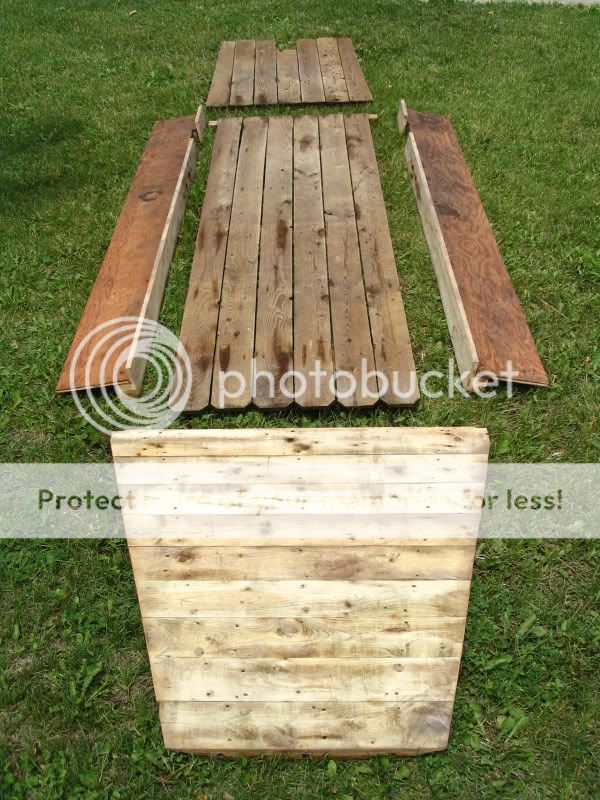
Floor boards; I started by making the center section just wide enough to fit between the "uprights" that support the upper deck of the hull. The center sections are made from salvaged fencing materials. Then I cut and fit a support piece for the side sections. The side sections use a finger jointed 2x4 (ripped to proper size) with a full length "rabbit" cut to create a lip along the inside edge of each side section. This lip extends about an inch above the 1/4" plywood used for the "surface" of each side section. The 1/4" plywood was cut and fit by trial to conform to the hull profile as it met the side section (along it's length, mostly just a taper). I wanted everything easily and quickly removable, therefore the notch in the side pieces engages the previously mentioned uprights and the cross piece on the center section sits just behind those uprights. The short board in the rear section lines up with the drain plug. The side sections are designed to sit higher than the center sections. I figured if I store my gun and case on a side section, the center will "flood" from dog water and I will notice and bail it out, before my gun case gets flooded.
I don't presently have the dimensions but can measure them for you if needed, let me know.
Wiring schematic; none that I drew up. I used a small 12volt 7amp gel cell similar to what guys typically use to power winter ice fishing electronics. I have three fused switches. One each for bow light, all around light, and inside lights. The all around light is actually located adjacent to one of the oar locks and is extended above my head when standing in the boat. The location and height allow me to run the mud motor with out interference and I don't get blinded while doing so. The battery sits behind the upright and plugs into the switch box via a custom wire loom. The wires run thru 1/2" pvc to the bow and all around light. Both the switch box and pvc was epoxied into place as the means of attachment.
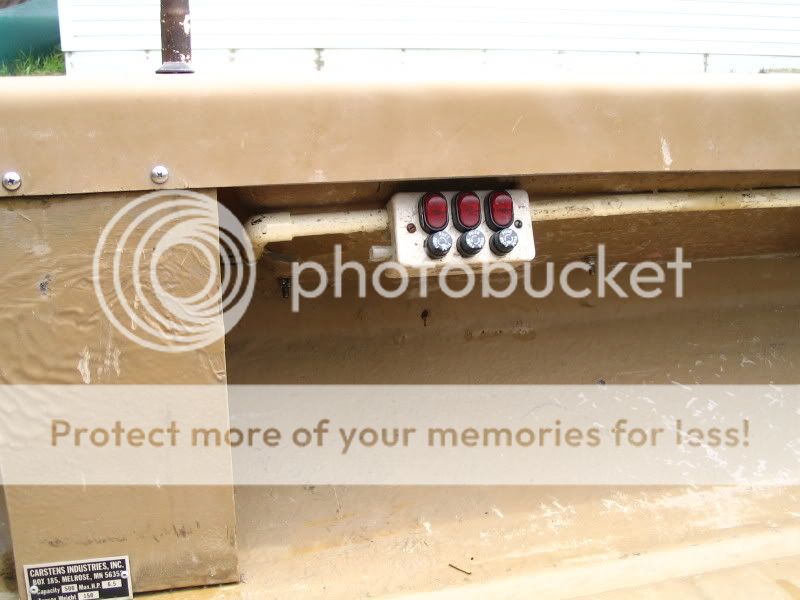
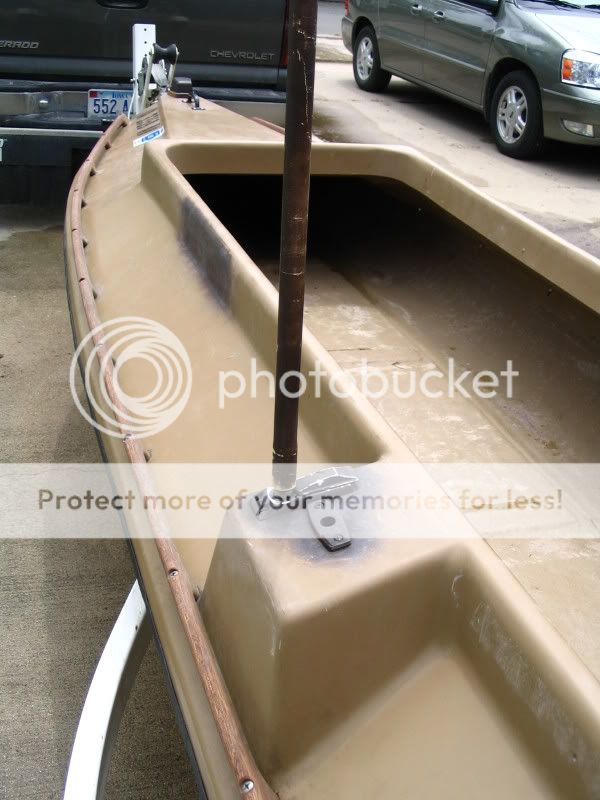
grassing rails; Were made from Mahogany and bolted to the hull using 1/4" dia. thru bolts of stainless steel with nuts and fender washers inside. The nuts and washers are visible in the picture showing the switch box. Where the inside of the hull was not accessible, threaded inserts were epoxied into place instead of the nuts and washers.
Hope this helps you.
I've been away for a few days and just got back.
Floor boards; I started by making the center section just wide enough to fit between the "uprights" that support the upper deck of the hull. The center sections are made from salvaged fencing materials. Then I cut and fit a support piece for the side sections. The side sections use a finger jointed 2x4 (ripped to proper size) with a full length "rabbit" cut to create a lip along the inside edge of each side section. This lip extends about an inch above the 1/4" plywood used for the "surface" of each side section. The 1/4" plywood was cut and fit by trial to conform to the hull profile as it met the side section (along it's length, mostly just a taper). I wanted everything easily and quickly removable, therefore the notch in the side pieces engages the previously mentioned uprights and the cross piece on the center section sits just behind those uprights. The short board in the rear section lines up with the drain plug. The side sections are designed to sit higher than the center sections. I figured if I store my gun and case on a side section, the center will "flood" from dog water and I will notice and bail it out, before my gun case gets flooded.
I don't presently have the dimensions but can measure them for you if needed, let me know.
Wiring schematic; none that I drew up. I used a small 12volt 7amp gel cell similar to what guys typically use to power winter ice fishing electronics. I have three fused switches. One each for bow light, all around light, and inside lights. The all around light is actually located adjacent to one of the oar locks and is extended above my head when standing in the boat. The location and height allow me to run the mud motor with out interference and I don't get blinded while doing so. The battery sits behind the upright and plugs into the switch box via a custom wire loom. The wires run thru 1/2" pvc to the bow and all around light. Both the switch box and pvc was epoxied into place as the means of attachment.
grassing rails; Were made from Mahogany and bolted to the hull using 1/4" dia. thru bolts of stainless steel with nuts and fender washers inside. The nuts and washers are visible in the picture showing the switch box. Where the inside of the hull was not accessible, threaded inserts were epoxied into place instead of the nuts and washers.
Hope this helps you.