Any Knowledgeable Machinist?

Larry J

Active member
Was wondering if anyone out there can recommend the correct type of bit to drill through an impact wrench socket. (Believe it or not, this is for a duck boat.) Using a tabletop drill press, I was able to drill through one side of the socket with the pilot point of a ½" DeWalt bit, but I hit refusal after that. I’ve tried two types of DeWalt bits (broke one) and something called "Black Gold" and none will finish the hole. Must be the molybdenum.

Second question. Would it be easier to drill through a Morse Taper Shank Sleeve (#3 inside; #4 outside). I’m not sure what type of metal they’re made of.
http://www.grainger.com/Grainger/items/3L898

thanks.

 
Not a machinist by any stretch of the imagination, but sharp bits and lots of lubrication and cooling helps on drilling many metals. Did you drill "dry" or did you try a cutting oil? Sometimes WD-40 will do the trick.

Huntin Dave is the man and will give you a proper answer...
 
I'm no machinist either but I did stay at a Holiday Inn once....

The impact socket is hardened steel which makes it VERY difficult to cut/drill/distort (kinda the point of it). In any case, try a milling bit and keep the oil flowing.

Only other option would be to anneal the socket, drill it, then harden it again.
 
Does milling bit have another name, I'm not finding any such animal on grainger.com.

I used oil when drilling. had no problem getting through with the pilot point. then everything came to a screetching halt.
 
As much as I hate to link to wikipedia....

http://en.wikipedia.org/wiki/Milling_cutter

You're looking for an end mill bit. though I've only used a vertical end mill & didn't need to buy any bits....
 
Last edited:
Larry,

Most likely what has happened is that the area in which you are trying to drill your hole has become "work hardened" This happend from too high of rpms. The pilot point cut because it was a smaller diameter and the speed of the cutting edge(on the pilot point)was slower than the speed of the cutting edge of the larger diameter of the full size bit.

How close to actual size do you need to hold the hole size too? If it is not real important especially if the hole comes out slightly larger than 1/2 inch, then you might still be in luck for not too much money. Use a carbide masonry drill bit. Either run it dry or with water for a lube (no oil)

As to drilling the taper shank reducing sleeve. Same principles apply, It will be made of a high carbon steel which if over heated at the cutting edge, it too will harden right before you eyes. Use a sharp bit, Keep the rpm to around 150 and keep it cool with cutting oil or water
 
Larry ,

Send it to RI and i will drill it with a carbide drill or better yet a carbide endmill , like Dave said it is probarly work hardened in that area these sockets are usually hard to a piont anyways . Oh ya i am a Tool And Die maker for the last 25 years and opening up my own shop . Good luck let me know if you need any other help


Dave M
 
Dave and Dave,

thanks for the tips and offer. The hole size needs to be precise, so i may try a test hole at low speed to see if it's possible. if i'm not successful, I may take you up on your offer Dave and send it to RI. I've got a lot of time invested so far and don't want to quit just yet. ultimately, i may need to have something machined for my purpose. thanks again.
 
Not a machinist or tool and die maker but have drilled a lot of holes. I concur with both Daves. I would get another socket and start over. Most of the problems with drilling holes is the drill bit is traveling too fast as Dave mentioned. You are not cutting but just heating up the metal of the socket or the drill or both. You can use water to cool if you like but that is not the complete answer.

When you drill if you do not see chips or a spiral of metal coming from the hole you are just heating the metal or bit. This often because the drill bit is moving too fast. I often cuss at my drill press because I can't slow it down enough. I won't quote revolutions per min but how fast can you spin around in a circle. Thats how fast your drill should turn. I usually drill holes dry with out lube or water, less mess. Take your time with the right pressure and speed you will get done.

One more thing it is difficult to get good drill bits in a big box store and some times in the local hardware store. If you have in your area a place that sells to machine shops or millwrights or machine tools.They should have top grade drills.
 
The other thing I would do is step drill it. In other words start with a 1/8 hole, then 1/4
and so on.
Trying to get a 1/2 through there in one shot is gonna be tough no matter what the
rpm.
 
Success!! thanks guys. I was able to complete the drilling by slowing the rpm, stepping the drilling with different sized bits and also using a carbide tipped masonary bit.

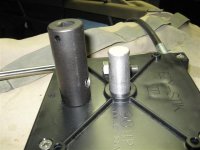
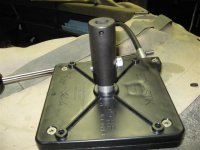
Gene Jr. if you're reading this, I used a 1/2"-drive 15/16" deep-well impact socket as an extention for the stick steering stem. It slips right over the stem. There's no way I'll be able to drill a hole in the thick top part of the socket to insert the ezy-glide handle, so i'll just use a 1/2" drive breaker bar (snap-on brand) as the steering handle. maybe have it tack-welded to the socket. it will also pivot up and down. this is probably clear as mud, so i'll post a pic tomorrow, minus the breaker bar handle. this should save your nuckles.

oh, if you're planning to make one, drill the hole in the socket at 5 degrees to line up with the angled hole in the stem.
 
Larry,

As soon as I saw your question I had a good idea what you were up to. I use hand tools every day and love snap-on but I would consider craftsman for your breaker bar handle, save more than a few bucks I would think. But then what is the price of cool!!!

I saw a quick release steering wheel on a jr. drag race car the other day. Has the wheels turning about taking the stick off and putting a QR wheel on the shaft coming out of the ez-glide box. Hmmm?

I didn't forget about the transom brace project. It's still in the "back of my mind" design phase. I think I may make a steel one myself and then have a friend copy it in SS or aluminum for me. If you don't get into the salt much I'll send you the steel prototype. If you do get into saltwater let me know and I'll have him fab up two. Are you using a short or long shaft? Mine is a long shaft so I may have to give it some additional consideration if you are running a short shaft. Shouldn't be a big deal though.

Good luck on the project!

Gene Jr.
 
Pete,
I thought Millwrights used big hammers almost exclusively. The tougher the job, the bigger the hammer.

Before I bought anymore drill bits etc. I would replace the socket or take the work to a real machinist.

Not being lazy, just trying to be practical.

Harry
 
Gene, I considered the removanble wheel when you first suggested it, but thought it might take up a too much room. Hope it works out for you. Check out the pic of the steering wheel on the TBD that Eric Bilby just sold in the classifieds.

I've attached a couple of pics of the extension i just finished. now I can concentrate on mounting the system and buying a motor.

steering 001 (Small).jpg
steering 002 (Small).jpg
 
Harry, I am not a Millwright but my father was. Two of my uncles, three of my neighbors. Growing up I was well versed in the language of Millwrights. If you listened to them talk and couldn't visualize, you had no cue. I still have some of my fathers tools those you can use for other things. He sold the rest to an apprentice. A couple of the Millwright had been carpenters before becoming Millwrights and one of there expresstions was "eye ball it". One day I was on a construction site and a fellow was having trouble leveling and it was not critical. I said eye ball it. A fellow standing near bye said " Oh No another eye baller" We had a good laugh about that.
 
Back
Top