
Call making supplies

benp

Well-known member
Supporter
Where do y'all source materials for calls, especially the reeds?

I have not made a duck call before but the idea has been there, it just hasn't reach priority status but since we have a board just for calls, I decided I want to start the planning.

Are metal reeds better than plastic ones? I only have one call, which is a teal call, that has a metal reed so really unfamiliar with the differences.

Is there a particular wood that works better than others or maybe is there a hardness factor to consider. I know for turkey box calls the hardness of the box compared to lid makes a difference, I assume duck calls could be similar.
 
I’ve cut Mylar reeds from sheets at Hobby Lobby. Look in the sewing section. You want 0.010 versus 0.014. It’s used for pattern making. Metal vs Mylar reeds comes down to what works with your tone board design. Arkansas/ J-frame is completely different from a Reelfoot style with metal reed.

As far as woods go, there aren’t many great native hardwoods for cutting inserts from. Bodock/hedge apple is probably the best native option. You want the hardest, oiliest stuff you can find. Cocobolo, African Blackwood, and bocote are classic exotic call woods. Some people are allergic to the oils in them.

As far as a good starting point, use a 5/8” bore on your barrel and 1/4” bore for your insert.

You’re getting me fired up to go spin some wood. It’s been years since I’ve done it.
 
Okay, it would be nice to see some visuals of the differences in tone boards for the two different materials.

I would need to make a jig to hold the call in a drill press to drill the barrel hole or modify my lathe, it only has centers. I might can make a plate jig that I could screw to the wood and attach the spindle head.

Definitely has things turning in the brain... didn't intend a pun there.
 
Also what thickness metal is typical? I assume stainless steel, a particular hardness or am I overthinking this part.
 
I'm headed up the road for some dog training early tomorrow, but will try to get some pictures of both styles of calls and jigs when I get back - either tomorrow afternoon or Wednesday morning.

Sources of mylar sheets and other supplies:

If you want to start making Arkansas j-frame calls, my best advice is to make yourself 2 jigs from any dense hardwood - 1 flat jig and 1 jig based on your favorite sounding call. I'll show some pictures when I take them. The one based on your favorite call will help you get an insert and toneboard that actually makes a sound and be a confidence builder. It will also serve as a reference point for inserts you make on the flat jig and shape by hand - what you're going to learn is that small differences in slope, where slope starts and where it ends, as well as length/depth of the tone channel relative to top of the tone board and slope all can make significant differences... and the secret is finding the right combination to make any sound at all, much less a good duck sound. Reed material, thickness, and shape all make a difference, too. Bottom line, it can be a long, iterative process... but I found it a lot of fun (in addition to periodically frustrating.

As for woods, there are tons of options. As Michael mentioned, bois d'arc/bodark/hedge/osage orange is a common favorite. Walnut makes a superb call, as does maple. Many old callmakers used cedar with great success.

Also agree with Michael about drilling first, then turning on a mandrel (made from wood, metal, or there are commercial options if you really get into it). That goes for both inserts and barrels. I'll also grab a picture of my first homemade barrel mandrel - it will give you some ideas.
 
As far as woods go, there aren’t many great native hardwoods for cutting inserts from. Bodock/hedge apple is probably the best native option. You want the hardest, oiliest stuff you can find. Cocobolo, African Blackwood, and bocote are classic exotic call woods. Some people are allergic to the oils in them.

Right up front, I'm a pretty much literally every-open-day-since-'84 call user who's never considered building one from scratch. So it may be a dumb question, but I'm curious why cedar isn't a viable option? Virtually all of the traditional Louisiana style calls I've seen had cedar floating toneboards and wedges.
 
Right up front, I'm a pretty much literally every-open-day-since-'84 call user who's never considered building one from scratch. So it may be a dumb question, but I'm curious why cedar isn't a viable option? Don't know that I've ever seen a traditional Louisiana style call in which the floating toneboard and wedge weren't cedar.
I’m far from an expert- much closer to rank amateur- but I when I messed around with those softer woods I wasn’t satisfied. They sounded pretty decent but I couldn’t generate much volume.
 
Last edited:
I’m far from an expert- much closer to rank amateur- but I when I messed around with those softer woods I wasn’t satisfied. They sounded pretty decent but I couldn’t generate much volume.
Makes sense and would be an issue for me, as well. I can run most loud calls soft, but will lock a soft one up well before its as loud as I often want afield.

Perhaps the closest I ever came to buying a call with little or no hope of using it in my work was a very simple Albert Thibodeaux design, with a barrel much like the friend's homemade one seen with Robertson's above, but a more egg-shaped insert, made of persimmon with cedar works. May have been the simplest among the several a friend who collected Albert's calls had showed me, but it would have broke me over, had its lack of volume not stood in the way.
 
Okay, it would be nice to see some visuals of the differences in tone boards for the two different materials.

I would need to make a jig to hold the call in a drill press to drill the barrel hole or modify my lathe, it only has centers. I might can make a plate jig that I could screw to the wood and attach the spindle head.

Definitely has things turning in the brain... didn't intend a pun there.
A few pictures and descriptions that may be helpful... more in subsequent posts.

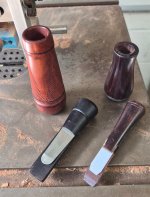
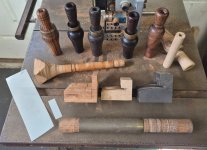
Comparison of Reelfoot-style metal reed call (one of mine) and Arkansas-style j-frame call (this is a Howard Harlan). A Reelfoot has a flat toneboard and curved metal reed, held in place traditionally by a wooden wedge (wedge, reed, and insert are held in place in the barrel via friction fit). Traditionally they are 3/4" bore and a bit larger, though they can be made smaller and with smaller bores. An Arkansas-style call has a sloped/curved toneboard and a flat, mylar reed. Typically 5/8" bore.

IMG_20260630_175258.jpg

IMG_20260630_175229.jpg

IMG_20260630_175200.jpg
 
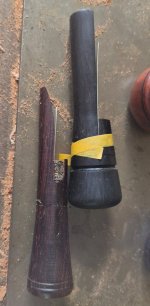
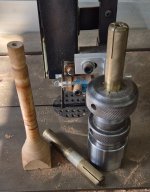
Mandrels - on the left, my initial homemade mandrel for turning barrels - used between centers. The length of this mandrel matches the 5/8" bore of a call barrel very closely - it is not super tight, but nor is it loose enough to allow any slop/wiggle. Friction for turning is provided by the expanding end of the mandrel. You can also turn grooves for o-rings. On the right, brass expanding mandrels in a collet chuck. A nice advantage of these is the collets can also hold a turned insert (before cutting the toneboard) for the purpose of drilling the tone channel and exhaust on the lathe.

IMG_20260630_175325.jpg

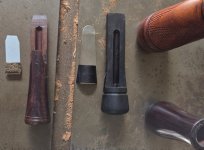
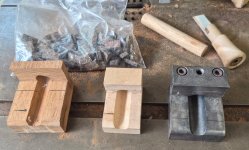
Following are a few pictures of some of the tools I used way back when I was making Arkansas-style calls, including a few jigs for cutting and shaping toneboards. I couldn't find my metal flat jig, but it is similar to the wooden one on the left. Essentially, a turned and shaped insert is mounted into a jig, which holds it first for rough shaping on the bandsaw (or coping saw) and then for final shaping with rasps/files/sanding. The obvious problem with wooden jigs is that they wear... but you can extend life by taping them with painters tape and by only filing/sanding until you just wear into the tape. These calls were some of my very earliest (and they look like it!).

IMG_20260630_180206.jpg

IMG_20260630_180006.jpg
 
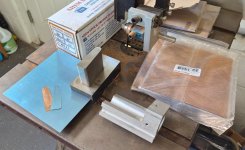
By comparison, these are some of my tools for making Reelfoot calls - including shim stock (phosphor bronze and German or nickel silver - others use stainless steel, too), a punch for cutting reeds out of the stock (a time-saver vs cutting with shears plus repeatability), and an aluminum jig I made to hold inserts steady while machining a flat tonebard.

IMG_20260630_175908.jpg
 
Last edited:
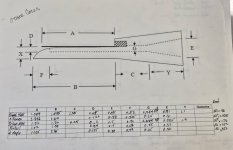
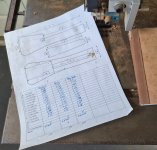
Last, as mentioned before, there are lots of variables that add up to final sound (or even lack thereof), so coming up with a way to experiment and track results is really important as you iterate. If you look closely at the insert on the right of my Ark call supply pictures, you'll see I turned some dowels that I sleeved into a turned exhaust - this was my way of experimenting without wasting lots of wood. More valuable to me were worksheets to note and track changes (only change 1 thing at a time) ,below is a picture of the one I used... then a picture of a variant I made when I was learning Reelfoots. In addition to tracking your own iterative testing, there is huge value in learning by measuring and documenting other calls.

IMG_20260630_175635.jpg

IMG_20260630_175836.jpg
 
@HenryHawthorne
Wow, that's a lot of great info that helps make sense of things. Definitely have a better understanding and plan going forward.

I like the wood insert mandrel for centers, that is probably what I'll do to get started, and I like your call dimension tracking sheet. I am fortunate to have access to a machine shop and tooling to make some jigs so may have to draw some things up to work that out.

I don't have any calls that are the Reelfoot metal style so that's new to me even though I knew metal reed calls existed.

Thanks for sharing all of that, I hope some others get inspired to turn some calls out too from this.
 
@HenryHawthorne
Wow, that's a lot of great info that helps make sense of things. Definitely have a better understanding and plan going forward.

I like the wood insert mandrel for centers, that is probably what I'll do to get started, and I like your call dimension tracking sheet. I am fortunate to have access to a machine shop and tooling to make some jigs so may have to draw some things up to work that out.

I don't have any calls that are the Reelfoot metal style so that's new to me even though I knew metal reed calls existed.

Thanks for sharing all of that, I hope some others get inspired to turn some calls out too from this.
I know you're a good bit north of me, but if you find you're going to be close to the Wilmington area for any reason shoot me a note, would be happy to have you visit and do some hands-on.

Would also be happy to share the metal Ark-style jig that is pictured. That is not a custom jig (the one I eventually had made appears lost from various moves 15-20 years ago, along with my later Ark-style calls), but a generic jig one of the suppliers at the time was putting out (may have been from Pintail, but I don't remember for sure). I don't think it yields a great sounding call, but it does yield an insert that works... and was of value to me at the time in providing a starting point. Let me know, happy to send it to you - in fact, happy for it to be shipped around to anyone interested in getting started as seeing and using a jig is useful in contemplating how to make your own or just assessing whether you want to get into this hobby.

I'll see if I still have the file for those tracking worksheets - or if I have blank ones I can scan and add to the resource section.

For those interested in metal reed calls, @FD Roe has a tutorial in the Resources section - which I used years ago when I started making this style. I make mine a little differently (different tools, similar process), and made a tutorial for THO some years back. That site is dead but I'll see if I can find that and share here, too.
 
Look in the Resources section under the topic "Duck call making" and you will find my tutorial on making the Reelfoot style call. Near the end of the tutorial under "Backup" you will find the details on how to make the jig that I use. There is also a list of suppliers of materials that I use.
 
Back
Top