Cloth question

John Oliver

New member
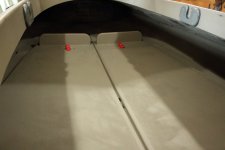
I am rebuilding a 18' Duck Hunter and placing a 1/2" Okume ply over the existing 1/2" Okume plywood. I want to take some flex out of the bottom. I am going to finish the floor with a expoy/fiberglass coat and walnut grit finish.

Is there any special cloth (carbon fiber, kevlar, etc.) that would help reducing the flex other than standard 6 oz cloth?

Should I place the cloth between the layers or just on top?
 
1.) I'd use plain woven 6 oz. If you are trying to correct oil canning, adding 1/2" ply will handle it. Oil canning places the interior of the sole in tension across the width. Carbon is strong under compression, so it is not worth the expense. FG handles tension best.

2.) Is the original sole glassed in epoxy? I hope so. Otherwise the inevitable damage to the paint will have allowed moisture to get into the underlying ply and the whole bottom might be mushy. You'd be covering up a problem instead of fixing it. If it is glassed in polyester resin FG, you are also in trouble, because polyester has pores that allow water that never comes back out.

3.) No fabric is necessary between layers of ply in my experience. You get better adhesion that way in my experience. Just tape the seams and layer of 6 oz. on the wear surface.

Nate
 
I am rebuilding a 18' Duck Hunter and placing a 1/2" Okume ply over the existing 1/2" Okume plywood. I want to take some flex out of the bottom. I am going to finish the floor with a expoy/fiberglass coat and walnut grit finish.

Is there any special cloth (carbon fiber, kevlar, etc.) that would help reducing the flex other than standard 6 oz cloth?

Should I place the cloth between the layers or just on top?

John~

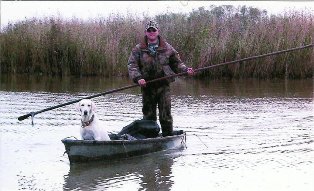
I am unfamiliar with the Duck Hunter vessel. A photo or 2 would be very helpful.

I agree with Nate's thoughts - but I have reinforced "oil-canning" floors with a different approach. I certainly agree that fabric alone will add almost no stiffness.

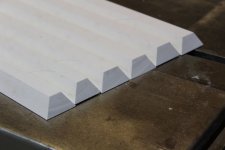
On a number of South Bay Duckboats - whose hulls are all 'glass - I have added intermediate floor frames (and reinforced the existing cracked frames. I use PVC "lumber" - milled to a trapezoidal cross section - and secure the frames with 1708 biaxial (with mat) and epoxy. This is much less weight (and cost) than plywood. (I know of no gunning vessel wityh inch-thick hulls.)

The milled PVC:

sm 1 Balabus - intermediate floor frames.jpg

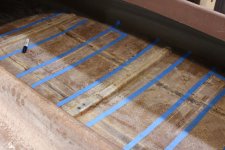
I mask for the biaxial+epoxy - for both the existing frames and the new intermediates:

sm 1 - Locating intermediate frames and masking reinforcements.JPG

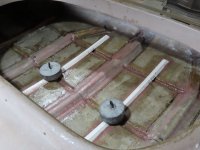
The frames glued into place with thickened epoxy - with weights (35 pounds or so) for "clamping".

sm Intermediate Floor Frames - Cullen.JPG

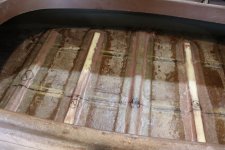
1708 with mat is saturated on the bench - on a sheet of plastic - then laid over the frames. I use a roller, a chip brush and my gloved hands to work the 1708 to the frames and floor - and to remove air bubbles and excess epoxy.

sm Cullen SB - Floor Frames.JPG

I do not know if this approach would work with your vessel. I put removable floorboards (1/2-inch AC plywood) over these frames. Wooden turn-buttons hold everything in place.

FB 23.JPG

Hope this helps!

SJS
 
Wow, I love that milled PVC idea but I am trying to stay true to the wood and use only wood products. Love it though.

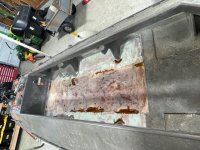
I am very confident the bottom is sound since it was well encapsulated in epoxy. I just removed the 2' floor runner because the original epoxy bond to the bottom did not take in one section. Both pieces were well sealed. Since the boat had torsional movement (not sure that is oil canning?) I am running the floor runner out to the sides and effectively making the bottom 1" thick. I just think the torsional movement is because the boat is too big for a 1/2" floor. I was also going to run a 1x4 white oak longitudinal and tie the bulkheads together.

1780582095977.jpeg
 
Given that the duck hunter is a “modern” design for ply construction, I wouldn’t hesitate to use PVC (or encapsulated wood) stringers to stiffen the floor. Another 1/2” of ply and all the associated epoxy and glass will add significant weight.
 
Another 1/2” of ply and all the associated epoxy and glass will add significant weight.

That is what I was thinking. A lot of weight. From what I have seen on this page over the last 30 years, stringers seem to be the better answer.
 
Thanks everyone!

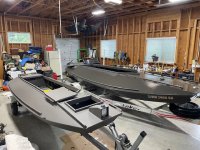
This is the only 18' DH in existence with a 5' bottom (I think), most of them are 14' x 4'. I did consider the added weight, but it carries three guys, dog, 50 merc and deeks with no problem. The sheet of Okume is 36lbs, epoxy is 8lbs and 2 1x4 white oak is 11lbs?

Do you think Longitudinal stringers or transverse to take out the torsional action? If I go with transverse, I am going to have to go with some sort of raised floor. The longitudinal will make a great gear backstop and blend right in.

Here is the 18' on the right next to my 14', and yes I have a boat problem. They are both killers!

IMG_7450.jpeg
 
Last edited:
John~

This is a head scratcher... I have never dealt with a torsion (hull twisting) problem. I would have thought the nice big plywood bulkheads fore and aft of the cockpit would have kept her stiff. Without the boat in front of me, I hesitate to offer any solution.

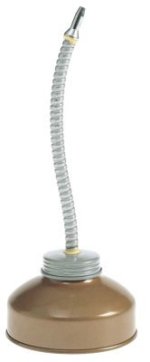
BTW: Oil-canning is a different problem. The term describes a condition where the hull bottom - usually aluminum, 'glass or plywood (rarely planks) - has inadequate framing and so can pop in and out betwixt frames. The name comes from a certain kind of Old School oil can - where one used a thumb on the thin metal bottom to force oil out of the spout.


oil can.jpg

A good feature in an actual oil can - not desirable in a boat bottom.

All the best,

SJS
 
Last edited:
Torsion? I am stunned a hull with that many angles has any torsional flex whatsoever.

You need to add both longitudinal and horizontal support to counter torsion. Adding a solid layer of plywood across the bottom will add both. That hull isn't meant to be ultralight weight, so I wouldn't sweat adding a layer of ply to the sole. You may be able to use thinner ply or composite instead of 1/2" ply to cut weight. I'd add ribs across the bottom to supplement the horizontal stiffness and place composite panels between them. Based on the issue being torsion, I can't argue with a layer of woven carbon fiber under the FG because there are compressive forces at play during torsion. I haven't worked with carbon fiber personally, so it is best to consult someone with more knowledge than me to determine the best layup.

Nate
 
Last edited:
Back
Top