Devlin Honker Build Prep

Joe LaPorta

New member
I have been looking at various plans for my first build for a few months. Got a chance to meet the CLC guys at the Mystic wooden boat show to go over the step by step process with me. Originally was planning on doing a Cackler or BBIII or buying an Estuary, but I have a few kids who are getting older and a wife and I’d rather a little more versatility even if it results in a tougher-to-hide boat. I live in Connecticut so mostly coastal and CT River area use. Is a Honker “too much boat” for a first time build? I plan to start it the actual boat in March and give myself four to five months to do it. Any advice is appreciated.
 
I'm a first-timer, building a Snow Goose. I guess the answer is ultimately determined based on your skillsets (woodworking, epoxy experience, etc.), but based in my SG experience I'd say it is not too much for a first-timer. I've been doing woorkworking in various forms for many years, I'd label myself as between moderately skilled and advanced for a hobbyist, but had no epoxy nor boatbuilding experience. I grew up on the water, so also had a good handle on boating in general, primarily smaller (<20 ft) craft.

If you look at my SG build thread, you'll see I've been at it much longer than 5 months - I'm on track for about 18 months +/-. I need to try to estimate my hours, but I'd say 5 months is doable if you have a good skillset and can throw the hours at it. I'm retired, but have taken extended breaks for vacations, etc. and don't work on it every day. I have put in a few full 8-12 hour days, but most days 3-4 hours. Epoxy and glass work is slow on your own (mixing in small batches, etc.), but the biggest slowdown is waiting on epoxy to cure. As a first-timer, you'll also have to build in time for experimenting and figuring how to do things.

Devlin's book is a real help, and I'd also recommend the WEST Systems pdf on epoxy if you aren't experienced with epoxy. And definitely start a build thread, you'll get lots of great advice and support here. Looking forward to following your build!

 
I'm a first-timer, building a Snow Goose. I guess the answer is ultimately determined based on your skillsets (woodworking, epoxy experience, etc.), but based in my SG experience I'd say it is not too much for a first-timer. I've been doing woorkworking in various forms for many years, I'd label myself as between moderately skilled and advanced for a hobbyist, but had no epoxy nor boatbuilding experience. I grew up on the water, so also had a good handle on boating in general, primarily smaller (<20 ft) craft.

If you look at my SG build thread, you'll see I've been at it much longer than 5 months - I'm on track for about 18 months +/-. I need to try to estimate my hours, but I'd say 5 months is doable if you have a good skillset and can throw the hours at it. I'm retired, but have taken extended breaks for vacations, etc. and don't work on it every day. I have put in a few full 8-12 hour days, but most days 3-4 hours. Epoxy and glass work is slow on your own (mixing in small batches, etc.), but the biggest slowdown is waiting on epoxy to cure. As a first-timer, you'll also have to build in time for experimenting and figuring how to do things.

Devlin's book is a real help, and I'd also recommend the WEST Systems pdf on epoxy if you aren't experienced with epoxy. And definitely start a build thread, you'll get lots of great advice and support here. Looking forward to following your build!

Thank you - I’ve read Sam’s book front to back a few times and was considering calling to discuss it before starting with him. I infrequently carve decoys and have a very basic background in woodworking though I have access to any tools needed through friends and family if I don’t have it myself. What I seem to excel at best is if I don’t know how to do something I usually know someone who does. Epoxy is probably the one thing I am most comfortable with!
 
Thank you - I’ve read Sam’s book front to back a few times and was considering calling to discuss it before starting with him. I infrequently carve decoys and have a very basic background in woodworking though I have access to any tools needed through friends and family if I don’t have it myself. What I seem to excel at best is if I don’t know how to do something I usually know someone who does. Epoxy is probably the one thing I am most comfortable with!
Sam is still pretty accessible, or was a year ago, when I needed to talk through the plans with him. At that point they were redoing many of his plans to reflect his shift towards building them upside down - and the SG plans I received still had a foot in both camps, if you will, and lacked a few critical measurements. He and his team were good about making revisions and getting new plans out to me within a reasonable amount of time.

If you've read the book and been perusing build threads here, you'll probably already know that his plans and book don't always provide a specific how-to. In some areas there is a bit of ambiguity and assumption that each builder will bring their own experience and skills to the table and perhaps do something a bit differently than he would. It is in those areas, as you come across them, where you'll find the most benefit from folks on this site that have been through one or more builds. In other areas, he can be very prescriptive - I generally followed his guidance in those areas closely.

When you buy plans, Devlin also includes a pdf booklet - much of what is in it is in his published book, but there were some extra tidbits in there, as I recall. Look through this site for some of @Steve Sanford 's recommendations on boat-building books. I found some of them on used book online stores, and will say they provided some background understanding I found helpful, as well as some useful techniques (see Steve's most recent post for an example, a technique that definitely helped me with large arcs).
 
I have been looking at various plans for my first build for a few months. Got a chance to meet the CLC guys at the Mystic wooden boat show to go over the step by step process with me. Originally was planning on doing a Cackler or BBIII or buying an Estuary, but I have a few kids who are getting older and a wife and I’d rather a little more versatility even if it results in a tougher-to-hide boat. I live in Connecticut so mostly coastal and CT River area use. Is a Honker “too much boat” for a first time build? I plan to start it the actual boat in March and give myself four to five months to do it. Any advice is appreciated.
Joe~
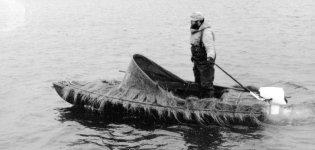
While I will always be a strong advocate of building one's own vessel(s) - I am working on my 20th currently - I want to offer some alternative "food for thought". Instead of building the entire boat from scratch, you might consider finding "just the right hull" on the used market - and modifying it for gunning. I have done this on 3 vessels. This process saves LOTS of time and LOTS of money. So, it might be a good place to begin your boatbuilding career.
This was a Herter's 13-foor cartopper (1960s) - that I got from my father-in-law for free.
Two-man Sneakbox - SJS at helm.jpg
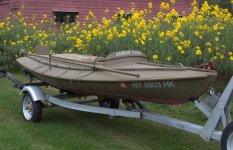
The JAMES CAIRD began life as a Beetle Swan (one of the very first fibreglass production boats from the 1950s). Friend/co-builder Mike Fishman got it for "free or cheap".
sm CAIRD - portrait stbd bow quarter.jpg

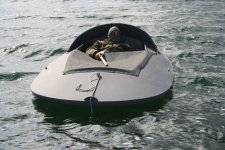
WHITE-WING began life as an O'Day Daysailer - also initially costing "next to nothing".

I describe the building process at: https://stevenjaysanford.com/white-wing-2-man-scooter/
sm WHITE-WING - The hide.jpg

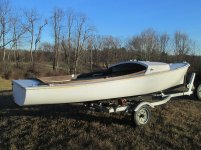
The Daysailer is about 17-foot LOA with a beam just over 6 feet I have contemplated modifying one along the lines of a TDB - for 2 or 3 gunners. They are very common on the web - often for very low prices.

Willsboro Daysailer - Starboard Side - 6 December 2012 - small.jpg

Finding the right hull is, of course, critical. Any hull for a gunning vessel needs to have little draft and be reasonably light. I look for bottoms with flat sections (little deadrise, aka VEE) and a straight run (bottom in profile is mostly straight without a deep forefoot. If speed is needed, you would need a strong bottom - and so more weight. I have yet to experiment with a Daysailer. As it was designed with a planing hull - not a displacement hull like most sailing craft - I am curious to know how one would perform under substantial (25+ HP).

In my vision, a Daysailer would need: 1) a lower sheerline (but significantly more freeboard than the WHITE-WING; 2) a crowned deck; 3) a flat floor at the cockpit; 4) a motor board or modified transom to get the needed 14 degree transom angle; then any and all of the custom features that come with a purpose-built duckboat.

So - just one more thing to keep you awake at night.as you contemplate your build. I apologize if I have derailed your dreams, your plans - or this thread.

All the best,

SJS
 
Back
Top