Last edited:

You are using an out of date browser. It may not display this or other websites correctly.
You should upgrade or use an alternative browser.
You should upgrade or use an alternative browser.
Fishing Pics
- Thread starter John P
- Start date
Capt. Jack Passie
Well-known member
The six guys holding their catch is just a typical day, theres nothing special about that catch. All the Bass are filleted by the mate and packaged for the trip home. Each angler goes home with about 12lbs of fillet. i'm sure some of it does go to waste but I've been doing this for 40 years and talking to my customers I think most of it is consumed by my customers or their friends. The pile of Bass in the Port corner of the Windy is from a day commercial fishing. This year I'm allowed to sell 230 Striped Bass last year it was 241. The Stripers that we harvest commercially must be between 24 and 36 inches and regestered with a metal tag through the mouth and gills. They are packed out and shipped to the Fulton Market and then sold at retail markets or restarants. A good day is a 12 pound average per tag. Nothing goes to waste on the Windy.

DeWayne Knight
Active member
I hate to see pictures like this. I have a hard time believing all those stripers will end up on the dinner table. I hope I am wrong.
Jim/Fowlfishing
You'd probably hate to see pictures of charter boat coolers full of Walleye from Lake Erie then too! 6 fish per man per day limit...6 guys on a boat plus a captain and a mate equals a LOT of fish...
Where I come from there's no commercial fishery for stripers, and anglers, on or off a charter boat, can keep just one striper a day.
We're fishing the same migratory population of stripers that you are.
Whatever you think of the current regulations--yours, mine or the ones down in the Chesapeake--this is a system that does not make sense.
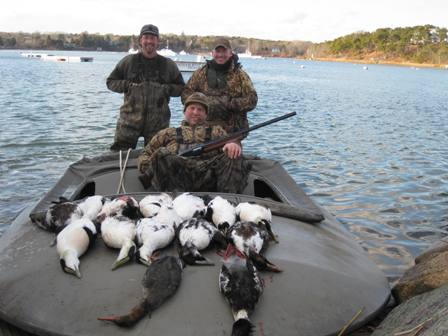
Imagine management of ducks where Maine allowed market hunting, Massachusetts let you harvest 4 black ducks a day, and New York allowed you to kill only a single drake for conservation reasons. Our striper regs on the East coast don't make any more sense than that would.
We're fishing the same migratory population of stripers that you are.
Whatever you think of the current regulations--yours, mine or the ones down in the Chesapeake--this is a system that does not make sense.
Imagine management of ducks where Maine allowed market hunting, Massachusetts let you harvest 4 black ducks a day, and New York allowed you to kill only a single drake for conservation reasons. Our striper regs on the East coast don't make any more sense than that would.
Just to add, I think there may be very few areas more prone to abuse than the current laws for the sale of striped bass. A year or so ago, my family took me to a very nice and very pricy restaurant for my birthday. The special of the day was "fresh local striped bass", and I was sorely tempted, as this restaurant's chef is recognized as something of a genius with fish, and there are few fish I like more than fresh striped bass.
But, living in a state where sale of wild striped bass is illegal, and where to my knowledge there are no striped bass farm operations, and being something of a wise-ass, I asked the waiter what he could tell me about the origin of the fish. Where was it from, how fresh was it, and was it wild caught striped bass, or the farm-raised hybrids?
He came back and assured me that it was local, wild, and very fresh.
I was a guest of my family and didn't want to make a scene, so I dropped the subject, ordered a shellfish dinner that was excellent, and kept my opinions to myself. The restaurant was either selling illegal fish, or they were lying to their customers. Maybe both.
But, living in a state where sale of wild striped bass is illegal, and where to my knowledge there are no striped bass farm operations, and being something of a wise-ass, I asked the waiter what he could tell me about the origin of the fish. Where was it from, how fresh was it, and was it wild caught striped bass, or the farm-raised hybrids?
He came back and assured me that it was local, wild, and very fresh.
I was a guest of my family and didn't want to make a scene, so I dropped the subject, ordered a shellfish dinner that was excellent, and kept my opinions to myself. The restaurant was either selling illegal fish, or they were lying to their customers. Maybe both.
Michael McCord
Active member
Jeff, the waiter may well have been lying, or selling illegal fish, but consider this- I live in Knoxville, TN, and produce from as far away as Indianapolis can be sold as "locally grown" at the farmer's market. Last I checked, Kentucky was between Tennessee and Indiana, and I hardly consider produce from 2 states over to be local.
Maybe, but this place made a big deal about local procurement, and the menu included a list of truly local farms that provided their produce and much of their meat and fish. You know--farms in the town or maybe a couple of towns over. As far as I know, most of the farmed striped bass on the market comes from the mid-Atlantic region, which is surely not local to Maine. (Imagine selling local blue crab in a Maine restaurant, or "local lobster" in Maryland.) And, if it's a striped bass/white bass hybrid, which all the farmed striper is, then it ought to be advertised as such. It may still be excellent, but a wiper is not the same thing as a striped bass.
Anyway, my bigger point was that our striped bass commercial/recreational management system is a damned confusing mess. If what we have is essentially one stock from the Carolinas to Maine, we ought to manage it as a single stock, with consistent regulations from one end of the migration to the other. You know, like we manage ducks . . . . . species with a very similar life history.
Anyway, my bigger point was that our striped bass commercial/recreational management system is a damned confusing mess. If what we have is essentially one stock from the Carolinas to Maine, we ought to manage it as a single stock, with consistent regulations from one end of the migration to the other. You know, like we manage ducks . . . . . species with a very similar life history.