Steve Sanford
Well-known member
Good morning, All~
I recently received this question from member John Ascherman:
Steve: I painted my hen very similar to your Homer. [see https://stevenjaysanford.com/tutorial-painting-homer-mallards/ ] Why did you paint it like that? I really like it otherwise I wouldn’t have painted mine like that. I was wondering would it be too hard to paint smaller single feathers? I was thinking it would be hard to do on Walnut coating? I’m guessing it would be a lot more time consuming? What your thoughts? Best regards John
I opted to reply in this broader post as I get similar inquiries with some regularity. In essence - in my view - painting gunning decoys is fundamentally different from painting more elaborate fine art pieces - what I call my "mantelpiece" birds.
Dr. Burke addressed the matter famously in Eugene Connett's Duck Shooting Along the Atlantic Tidewater. Chapter XVII is Making and Painting Decoys.
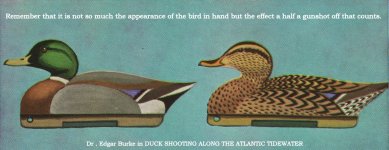
For gunning stool, one does not need the "every feather" approach as used by Audubon.
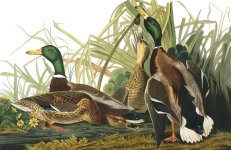
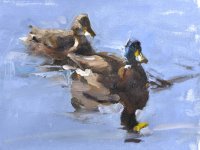
One needs a more impressionistic approach - which looks at the subject from a distance and analyzes the areas and shapes of hue (color) and tone (dark-light). Here is a highly impressionistic rendering of Mallards by a contemporary artist:
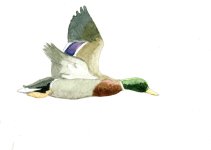
Here is a watercolor I did (circa 2011) - minimal details but all the information needed to identify the bird.
In my tutorial here on duckboats.net, I applied this impressionistic approach to LL Bean Coastals.
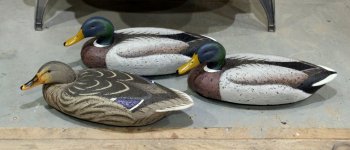
Here are the Homer Mallards to which John refers.
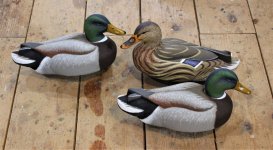
The development of this approach to painting puddler hens began when I bought my first dozen Herter's Model 72 Mallards - circa 1966. I was disappointed to see the vague spray-painted factory job upon their arrival. (This photo is from a current interwebs ad.)
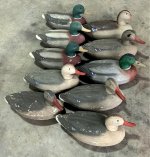
However, I had anticipated the far-from realistic paint and re-painted the whole rig - 5 Mallards and 7 Blacks - before they ever hit the water. I have no photographs of that rig (although I still own them) - but will say that I painted lots and lots of individual feathers on the Hen Mallards. They were somewhat similar to the Pintail (hollow Pine) I carved in the the early 80s. Back in high school, I had not learned enough about brushes and thinning to put fine markings on the heads.

This Shoveler Hen is very close to a Mallard Hen, of course.
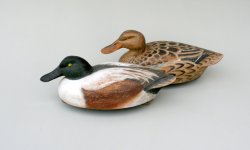
By the early 80s I was putting finer paints on my mantelpiece birds. I did this Greenwing for my parents around 1990.
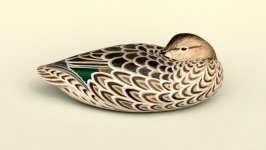
I bought my first E Allen decoys after I moved upstate (the dairy country of Washington County). Keith Mueller carved the masters - and I tried to do him justice with a paint scheme that depicted just enough feathers. Note that these birds were intended for beaver ponds - so a flush keel, no ballast, and just a 3-ounce pyramid sinker for an anchor.
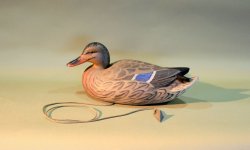
My big breakthrough - and the point of this post - came when I decided to repaint the "rig of my youth". I was not yet coating gunners with epoxy+sawdust/Walnut shells nor with burlap. I did, however, want a mix of head postures, so I warmed some necks with my Bernz-O-Matic and squashed a few down into a comfortable tuck. More important, I applied my impressionistic approach to the whole decoy.
Here are the key elements:
1) Bill with distinct saddle
2) Distinct crown back to neck
3) Eye-stripe stops before it connects with crown
4) "Mustache" line on lower cheek
5) "Orange" wash on front of face
6) Back darker than sides
7) Chest with reddish cast
8) Undertail pale
9) Dark streak marks flow from chest onto sides - longer and wider aft
10) Body color as edgings on a few back feathers
11) Pale edging on the upper edges of side streaks and on outer edges of back feathers. Adding that "third tone" makes things pop.
12) Rump blends softly onto whitish tail feathers.
NOTE: No fine markings on face. No speculum (but I have added to most subsrquent "impressionistic" puddler hens.
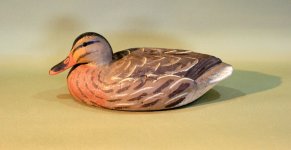
The 3 or so rows of feathers on the sides are intended to give the birds a streaked look at that half-gunshot distance. Most puddlers nest in grasslands and so the hen plumages must hide in last year's grasses and weeds. Like most grassland birds, the streaking begins right behind the bill, runs through the eye and flows aft - right to the tail. Puddle ducks use the same strategy - to my mind.
From a practical perspective, gunning paint jobs should use the fewest brush strokes possible to achieve the desired effect.
So - since the mid-90s when I found my new approach to fooling puddle ducks, I have applied similar paint schemes to numerous makers and numerous species.
Here are some factory-burlapped Herters Model 63s. Note that I do take the time to add the flecking to the faces of my hen puddlers. As with the detailed specula, they show that "certain something" that says: Someone took a bit of extra time. The effect is most important in the hand....and to the gunner.
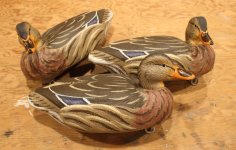
Chesapeakes.
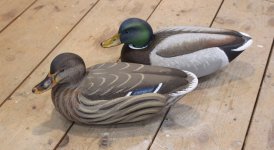
Wildfowlers.
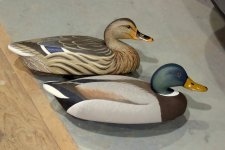
Herter's Model Canada (with some custom modifications to the head and back).
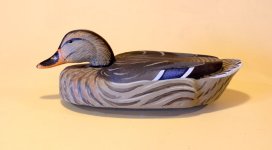
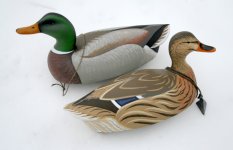
A hollow Pine pair I carved.
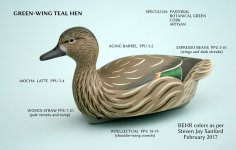
All my Behr paint charts show puddler hens with the simple, streaked paint.
One last thought: If putting in lots of body feathers, it is very easy to lose the forest for the trees. Make certain that the major areas of color are not lost and that the painting holds together as one.
Hope this is helpful!
SJS
I recently received this question from member John Ascherman:
Steve: I painted my hen very similar to your Homer. [see https://stevenjaysanford.com/tutorial-painting-homer-mallards/ ] Why did you paint it like that? I really like it otherwise I wouldn’t have painted mine like that. I was wondering would it be too hard to paint smaller single feathers? I was thinking it would be hard to do on Walnut coating? I’m guessing it would be a lot more time consuming? What your thoughts? Best regards John
I opted to reply in this broader post as I get similar inquiries with some regularity. In essence - in my view - painting gunning decoys is fundamentally different from painting more elaborate fine art pieces - what I call my "mantelpiece" birds.
Dr. Burke addressed the matter famously in Eugene Connett's Duck Shooting Along the Atlantic Tidewater. Chapter XVII is Making and Painting Decoys.
For gunning stool, one does not need the "every feather" approach as used by Audubon.
One needs a more impressionistic approach - which looks at the subject from a distance and analyzes the areas and shapes of hue (color) and tone (dark-light). Here is a highly impressionistic rendering of Mallards by a contemporary artist:
Here is a watercolor I did (circa 2011) - minimal details but all the information needed to identify the bird.
In my tutorial here on duckboats.net, I applied this impressionistic approach to LL Bean Coastals.
Here are the Homer Mallards to which John refers.
The development of this approach to painting puddler hens began when I bought my first dozen Herter's Model 72 Mallards - circa 1966. I was disappointed to see the vague spray-painted factory job upon their arrival. (This photo is from a current interwebs ad.)
However, I had anticipated the far-from realistic paint and re-painted the whole rig - 5 Mallards and 7 Blacks - before they ever hit the water. I have no photographs of that rig (although I still own them) - but will say that I painted lots and lots of individual feathers on the Hen Mallards. They were somewhat similar to the Pintail (hollow Pine) I carved in the the early 80s. Back in high school, I had not learned enough about brushes and thinning to put fine markings on the heads.
This Shoveler Hen is very close to a Mallard Hen, of course.
By the early 80s I was putting finer paints on my mantelpiece birds. I did this Greenwing for my parents around 1990.
I bought my first E Allen decoys after I moved upstate (the dairy country of Washington County). Keith Mueller carved the masters - and I tried to do him justice with a paint scheme that depicted just enough feathers. Note that these birds were intended for beaver ponds - so a flush keel, no ballast, and just a 3-ounce pyramid sinker for an anchor.
My big breakthrough - and the point of this post - came when I decided to repaint the "rig of my youth". I was not yet coating gunners with epoxy+sawdust/Walnut shells nor with burlap. I did, however, want a mix of head postures, so I warmed some necks with my Bernz-O-Matic and squashed a few down into a comfortable tuck. More important, I applied my impressionistic approach to the whole decoy.
Here are the key elements:
1) Bill with distinct saddle
2) Distinct crown back to neck
3) Eye-stripe stops before it connects with crown
4) "Mustache" line on lower cheek
5) "Orange" wash on front of face
6) Back darker than sides
7) Chest with reddish cast
8) Undertail pale
9) Dark streak marks flow from chest onto sides - longer and wider aft
10) Body color as edgings on a few back feathers
11) Pale edging on the upper edges of side streaks and on outer edges of back feathers. Adding that "third tone" makes things pop.
12) Rump blends softly onto whitish tail feathers.
NOTE: No fine markings on face. No speculum (but I have added to most subsrquent "impressionistic" puddler hens.
The 3 or so rows of feathers on the sides are intended to give the birds a streaked look at that half-gunshot distance. Most puddlers nest in grasslands and so the hen plumages must hide in last year's grasses and weeds. Like most grassland birds, the streaking begins right behind the bill, runs through the eye and flows aft - right to the tail. Puddle ducks use the same strategy - to my mind.
From a practical perspective, gunning paint jobs should use the fewest brush strokes possible to achieve the desired effect.
So - since the mid-90s when I found my new approach to fooling puddle ducks, I have applied similar paint schemes to numerous makers and numerous species.
Here are some factory-burlapped Herters Model 63s. Note that I do take the time to add the flecking to the faces of my hen puddlers. As with the detailed specula, they show that "certain something" that says: Someone took a bit of extra time. The effect is most important in the hand....and to the gunner.
Chesapeakes.
Wildfowlers.
Herter's Model Canada (with some custom modifications to the head and back).
A hollow Pine pair I carved.
All my Behr paint charts show puddler hens with the simple, streaked paint.
One last thought: If putting in lots of body feathers, it is very easy to lose the forest for the trees. Make certain that the major areas of color are not lost and that the painting holds together as one.
Hope this is helpful!
SJS