Newest double ender

jode hillman

Well-known member
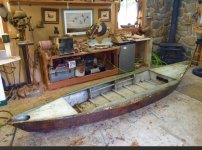
A big thanks to Sharp eyed Bobby Keeney for the lead on my latest resto candidate.

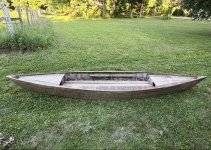
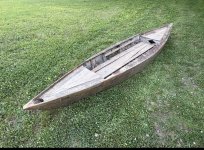
An early Alvin Beal ( Canton NJ) rail skiff. All mahogany and white cedar. She needs some TLC but should be a nice worker in the rice.

All mahogany and white cedar construction. She was found by the seller behind a barn only 2 miles from where she was originally built in Beals shop. I'm planning on having her in shape for Septembers Tuckerton show.
 

Attachments

  • IMG_9166.jpeg
    IMG_9166.jpeg
    591.9 KB · Views: 32
  • IMG_9167.jpeg
    IMG_9167.jpeg
    622.8 KB · Views: 33
Sweet! I don't recall seeing one like that has raised sections front and rear.
Correct, Beal had his own take on the style, not your typical deck over sides Maurice River style skiff. He was in Salem county, about 20 miles north of the Maurice. ( but still in good historical Rice country)

He is the same builder as this skiff that I restored in 2017.

That was a later version made of plywood. I'll attach that below.
 

Attachments

  • IMG_9139.jpeg
    IMG_9139.jpeg
    239 KB · Views: 20
A big thanks to Sharp eyed Bobby Keeney for the lead on my latest resto candidate.

An early Alvin Beal ( Canton NJ) rail skiff. All mahogany and white cedar. She needs some TLC but should be a nice worker in the rice.

All mahogany and white cedar construction. She was found by the seller behind a barn only 2 miles from where she was originally built in Beals shop. I'm planning on having her in shape for Septembers Tuckerton show.

Jode,

That is one mighty fine rail skiff. Ya got me when I read "All mahogany and white cedar". I look forward to your progress reports. I know it will be Top Shelf when your done.

Best regards
Vince
 
A big thanks to Sharp eyed Bobby Keeney for the lead on my latest resto candidate.

An early Alvin Beal ( Canton NJ) rail skiff. All mahogany and white cedar. She needs some TLC but should be a nice worker in the rice.

All mahogany and white cedar construction. She was found by the seller behind a barn only 2 miles from where she was originally built in Beals shop. I'm planning on having her in shape for Septembers Tuckerton show.

Good morning, Jode~

Another real charmer! I look forward to meeting her at Tuckerton.

A couple of questions (of course!):

LOA? Beam? (Draft: not much) Year of construction?

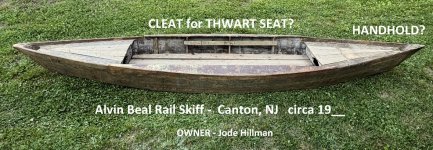
Beal Rail Skiff - Jode Hillman 2026 with TEXT and QUESTIONS.jpg

I presume the Mahogany is for the frames - and Atlantic White Cedar for everything else. Is the Cedar mostly about a half-inch thick?

Those little ports at the ends of the decks look like handholds - that also vent the under-deck compartments (and let the mice out) ?

Are the amidships cleats supports (risers) for a thwart seat ?

Any of the floorboards removable? If so, how are they held in place?

All the best,

SJS

 
Jode,

That is one mighty fine rail skiff. Ya got me when I read "All mahogany and white cedar". I look forward to your progress reports. I know it will be Top Shelf when your done.

Best regards
Vince
Thanks Vince. I found a little bit of white oak as I am disassembling her but still all top-notch materials throughout. Looking forward to the project.
 
Good morning, Jode~

Another real charmer! I look forward to meeting her at Tuckerton.

A couple of questions (of course!):

LOA? Beam? (Draft: not much) Year of construction?

View attachment 76663

I presume the Mahogany is for the frames - and Atlantic White Cedar for everything else. Is the Cedar mostly about a half-inch thick?

Those little ports at the ends of the decks look like handholds - that also vent the under-deck compartments (and let the mice out) ?

Are the amidships cleats supports (risers) for a thwart seat ?

Any of the floorboards removable? If so, how are they held in place?

All the best,

SJS
Good eye, Steve! She is 14 feet long by 36 inches wide at the gunnels. Depth is 10"!

I am not certain of the year , but I'm going to ballpark it in the 1950's to 60's based on the bronze ring shank nails, galvanized nails and slotted screws used in construction.


The mahogany is for the framing. Half inch white cedar for the planking. I have found a few pieces of white oak, notably for the rear stem.

I do believe that the semicircle cut outs are handholds. I was scratching my head as to their usage. But they fit perfectly in your hand when you go to lift the skiff.

I was wondering myself about the midship cleat.

I have not seen any wear patterns on them indicating a seat. But it is possible. I may slide a piece of white pine in there just to see how it feels and may possibly rebuild it this way.

These floorboards were nailed in place by a previous owner.

But there were the remnants of three longitudinal braces that they were secured to. I believe they just fit snug against the framing and lift out.

That will be the way I rebuild it.
 
Last edited:
Jode, you had me at "double ender"
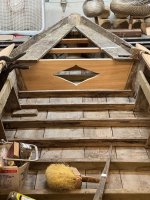
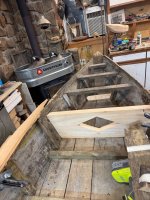
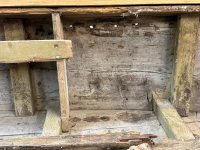
Friday night update. I have the front and back decks removed. Therefore, I am able to inspect the vessel closer. It turns out she has been through at least one total refit before. I am guessing at the hands of the original builder as I do not see any signs of changing the original design or construction style.

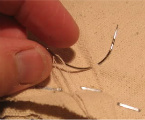
The original nails were an 1-1/4" bronze ring shank.

The refit nails were heaver gauge, 1-3/4" common head galvanized

I'm gonna push back my date of original construction, perhaps 1940s. I'm guessing in the refit must've happened in the late 70s or early 80s.

At the time of refit 50% of White oak frames were replaced with mahogany. The white oak frames that are left are held together with so many fasteners there is barely a virgin piece of wood left. I will replace those that need it. Mainly underneath the fore and aft deck compartments. Removing the old fasteners will probably drop her weight by 5 pounds at least lol.


Also, at time of refit, the rear outer stem was replaced with mahogany.

I will be following suit replacing the front outer stem as it took a heavy blow which cracked and dented the original Cedar. ( It looks like someone had it in the bed of a pick up truck and backed into something or ran into a dock at speed)
 
Friday night update. I have the front and back decks removed. Therefore, I am able to inspect the vessel closer. It turns out she has been through at least one total refit before. I am guessing at the hands of the original builder as I do not see any signs of changing the original design or construction style.

The original nails were an 1-1/4" bronze ring shank.

The refit nails were heaver gauge, 1-3/4" common head galvanized

I'm gonna push back my date of original construction, perhaps 1940s. I'm guessing in the refit must've happened in the late 70s or early 80s.

At the time of refit 50% of White oak frames were replaced with mahogany. The white oak frames that are left are held together with so many fasteners there is barely a virgin piece of wood left. I will replace those that need it. Mainly underneath the fore and aft deck compartments. Removing the old fasteners will probably drop her weight by 5 pounds at least lol.


Also, at time of refit, the rear outer stem was replaced with mahogany.

I will be following suit replacing the front outer stem as it took a heavy blow which cracked and dented the original Cedar. ( It looks like someone had it in the bed of a pick up truck and backed into something or ran into a dock at speed)
Jode~
Sounds like you are enjoying your Voyage of Discovery! Good detective work.....
1780733186598.jpeg

I am making similar discoveries restoring/renovating our Granary (14x20 post-and-beam barn). Although our farm was created on paper in 1825, there is no way - except sometimes deeds or wills - to determine the age of construction. This is exacerbated by the fact that outbuildings commonly re-purpose timbers from other buildings. So - "sometime since 1825" is the best we can do. No bronze fasteners in any event!

All the best,

SJS
 
Back
Top