
You are using an out of date browser. It may not display this or other websites correctly.
You should upgrade or use an alternative browser.
You should upgrade or use an alternative browser.
Ringer
- Thread starter Chris Toy
- Start date
Matt_n_Barb
Well-known member
[font=Verdana,Arial,Helvetica]"The judges were all duck hunters this year and not carvers so that may have had a lot to do with their likes and dislikes."
subjective bias that changes with a whim......
I like the looks of the decoy; now for the real test, go hunt with it.
Matt
[/font]
subjective bias that changes with a whim......
I like the looks of the decoy; now for the real test, go hunt with it.
Matt
[/font]

Andy Grant
Well-known member
I can't imagine someone not being proud to make or own that decoy. That being said, a great decoy may not always make a great 'contest decoy'.
You mention seeing your decoy bob in the water. While the composite keel may be more than adequate for hunting conditions, is it the best for pool conditions? Without adjusting any weight, you are simply relying on the density of the material to be exactly what you need. It may be or may not. Had you added a little weight, it may have improved the performance.
I also notice that on your decoy you don't have the typical height on the delineation of the side and back feathers. It seems most ringneck decoys have this line rise markedly up and in at the rear. Is yours wrong? No. But maybe the judges like it the other way.
From any pictures of the Westlake pool I have seen, the lighting looks poor at best. Perhaps by really brightening up any of the white or lighter areas, a decoy would stand out a bit more in the sub par lighting.
Take these suggestions for what they are worth. I am certainly not a contest decoy carver, maybe barely a carver. Just my observations and what I would do in your shoes. What you should really do is talk to some successful contest carvers. It is good to learn from your mistakes, but better to learn from someone else's.
You mention seeing your decoy bob in the water. While the composite keel may be more than adequate for hunting conditions, is it the best for pool conditions? Without adjusting any weight, you are simply relying on the density of the material to be exactly what you need. It may be or may not. Had you added a little weight, it may have improved the performance.
I also notice that on your decoy you don't have the typical height on the delineation of the side and back feathers. It seems most ringneck decoys have this line rise markedly up and in at the rear. Is yours wrong? No. But maybe the judges like it the other way.
From any pictures of the Westlake pool I have seen, the lighting looks poor at best. Perhaps by really brightening up any of the white or lighter areas, a decoy would stand out a bit more in the sub par lighting.
Take these suggestions for what they are worth. I am certainly not a contest decoy carver, maybe barely a carver. Just my observations and what I would do in your shoes. What you should really do is talk to some successful contest carvers. It is good to learn from your mistakes, but better to learn from someone else's.
John Lawrence
Active member
Chris,
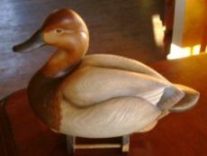
The photo is a little difficult to tell by but these things stand out to me.
First the head shape is very nice but it looks to be a little too large in relation to the body. That may be just the way you shot the photo though.
I'd take a look at the slope of the upper mandible and the height of the upper mandible where it connects with the head.
I'd also take a look at the white stripe that along the bottom edge of the upper mandible. Check some reference as the where the white starts and ends on the front of the bill (ringbill) and the white stripe at the end of the bill where it hits the head. Generally they don't connect.
From the photo I can't tell if the "ringneck" is there or not but there should be a ring of reddish- brown color at the transition point of the neck to the breast. If it is missing think about adding it. If there is one think about brightening of lightening it so that you get that "identifier".
The front top edge of the drake ringneck's side pocket takes a fairly strong sweep across the front of the scapulars towards the middle of the back and turns very white in relation to the rest of the color tones. That sweep remains kind of wide until just before the neck.
An important characteristic of ringneck drakes are that the tops of the rear of the side pockets take a dramatic sweep up. It looks like they almost touch if viewed from the side and is very noticeable if viewed from the top.
Once again the photo is hard to distinguish but the way I see ringnecks the black on the rump and the breast is very brownish as opposed to the black on the scapulars which is more blueish. That difference of shades could make a difference when a decoy is entered in a contest.
These are some things that stick out to me from a quick observation of your photo.
I have no clue as to whether the three guys who judged would be able to pick these things up though.
The photo is a little difficult to tell by but these things stand out to me.
First the head shape is very nice but it looks to be a little too large in relation to the body. That may be just the way you shot the photo though.
I'd take a look at the slope of the upper mandible and the height of the upper mandible where it connects with the head.
I'd also take a look at the white stripe that along the bottom edge of the upper mandible. Check some reference as the where the white starts and ends on the front of the bill (ringbill) and the white stripe at the end of the bill where it hits the head. Generally they don't connect.
From the photo I can't tell if the "ringneck" is there or not but there should be a ring of reddish- brown color at the transition point of the neck to the breast. If it is missing think about adding it. If there is one think about brightening of lightening it so that you get that "identifier".
The front top edge of the drake ringneck's side pocket takes a fairly strong sweep across the front of the scapulars towards the middle of the back and turns very white in relation to the rest of the color tones. That sweep remains kind of wide until just before the neck.
An important characteristic of ringneck drakes are that the tops of the rear of the side pockets take a dramatic sweep up. It looks like they almost touch if viewed from the side and is very noticeable if viewed from the top.
Once again the photo is hard to distinguish but the way I see ringnecks the black on the rump and the breast is very brownish as opposed to the black on the scapulars which is more blueish. That difference of shades could make a difference when a decoy is entered in a contest.
These are some things that stick out to me from a quick observation of your photo.
I have no clue as to whether the three guys who judged would be able to pick these things up though.
Last edited:
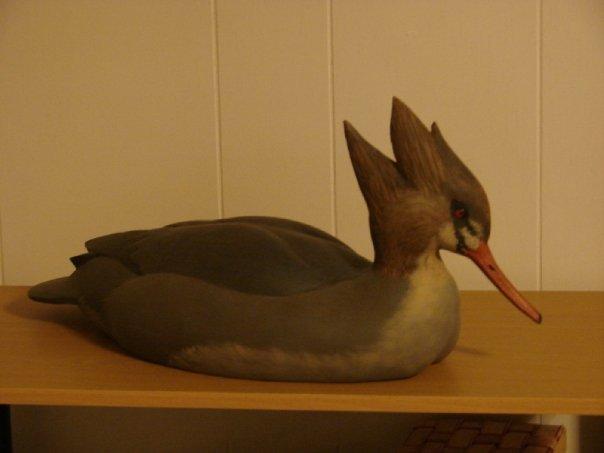
Chris, I think I may have set a record for being the first out. From where I was watching the judging of the scoters, it appeared as though the handler threw my drake surf into the pool , and one of the judges simultaneously dove in after it! It was on the deck before its splash died! Son of a ..... gun! John Linn
Joe Brewer
Active member
I can't believe that the keels had anything to do with the eliminaton as the judges never saw the keels. They do not handle the decoys but maybe got a fleeting glance at the bottom when the handlers picked them up. The judges were all duck hunters this year and not carvers so that may have had a lot to do with their likes and dislikes. I do know for sure that they did not like bobtails as they pulled every one in a hurry including a couple of mine. If you think the judges are biased against composite keel material....paint it then they will never know for sure. The pool is always a crap shoot but still always fun and a great way to support the show so don't be afraid to enter.
I was just kidding when I said that. My gwt had composite keels and won the rig contest and they didn't look as nice as yours chris. Definately a crap shoot. There could have been 3 different judges and they would have picked different birds. It sure can be exciting though! Great ringer by the way!
Willy
And btw....really nice Blackjack Chris....I liked it a lot. I also had a Ringer in the contest but no cigars......you pays your money and takes your chance.