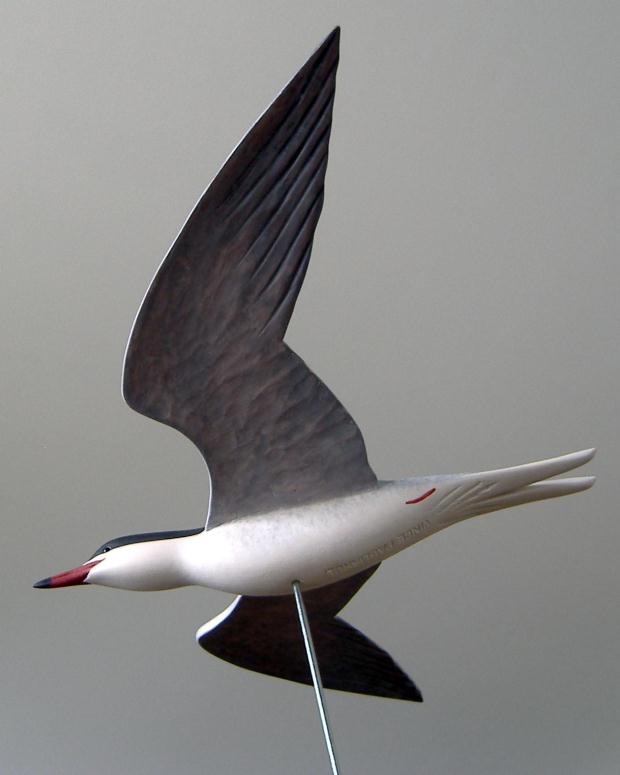
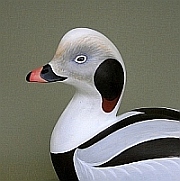
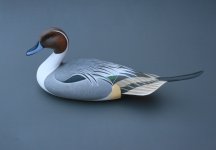
Round bottom decoys?

Kevin Puls

Well-known member
Supporter
I noticed at the recent decoy show that some wood decoys are round bottomed.

Why is that? What keeps them upright in the water? Do they float better than flat bottoms?
 
I noticed at the recent decoy show that some wood decoys are round bottomed.

Why is that? What keeps them upright in the water? Do they float better than flat bottoms?
Makes me think of “upper bay” style decoys which are usually turned on a lathe, in this case, a round bottom seems necessary just to make them. They generally have some lead on the bottom, but no keel.
They bob side to side a good bit, but probably self-right much easier than a solid body flat bottom decoy using the same amount of weight.
Probably a similar situation with carolina style decoys
For more contemporary non-upper bay, non-Carolina etc. style decoys, I can really only guess. But real ducks are pretty round, so I can see why some would like it.

 
Makes me think of “upper bay” style decoys which are usually turned on a lathe, in this case, a round bottom seems necessary just to make them. They generally have some lead on the bottom, but no keel.
They bob side to side a good bit, but probably self-right much easier than a solid body flat bottom decoy using the same amount of weight.
Probably a similar situation with carolina style decoys
For more contemporary non-upper bay, non-Carolina etc. style decoys, I can really only guess. But real ducks are pretty round, so I can see why some would like it.
I'm pretty sure that you can turn flat bottom decoys on those lathes too. The blade just slaves to whatever master pattern you put in it.

I agree though, when I think round bottom decoys I think upper bay birds.
 
Any indication they were hollowed and weight epoxied on the lower have of the round? Would help them self right, float correctly, and be keel less. Not sure what the advantage of being a rounded decoy is besides looking pretty cool.
 
Well made Round Bottom decoys (hollow & solid) from certain areas ride the waves like battleships. Study the History of the decoys and see and touch as many as ya can. Plus flat bottom decoys with keels beat the hell out of each other in transport and storage. I prefer round bottom decoys and I've made and used just about all styles. My 2nd favorite as far as use are the flat bottom Canadian Decoys. People will tell ya certain type of decoy works better in moving water than in large bodies of water (river vs Open water & marsh) that's BS. Ya make em correctly and they work correctly. The Old Decoy Makers/Carvers did it best and ya cannot improve upon the wheel but we still try. WHY?

my 2 cents
 
Have often thought about adding a few round bottom decoys mixed with others in the spread with the hope that they did roll to a certain degree to add the illusion of more movement. Never hunted with round bottoms but have read in some of the older gunning books that from a distance the round bottoms did indeed appear more like real birds. This thought would apply mainly for the calmer days in open water not when that brisk 15-20 north wind is blowing. No help needed on those days
 
James,

The real birds have a Oval shaped body not round. Make/Carve your decoys with a Oval shaped body, and make sure the most weight is in the bottom half of the decoy. Add a lead pad weight to the bottom in the correct place, and the most minimal anchor attachment. For large ducks with higher heads and geese use as light a head (hollow if you must) as possible. Think Less Weight above the water line and you will have a mighty fine decoy for any type of water hunting. The more of this style of decoy you create the better they shall become and you Will Be Amazed.

Best regards
Vince
 
I noticed at the recent decoy show that some wood decoys are round bottomed.

Why is that? What keeps them upright in the water? Do they float better than flat bottoms?
Round bottom birds, self right with less weight. They're generally lighter, easier to carry in small boats and they move wonderfully on small secluded waterways.

They also line up to the current naturally with their streamline shape without the need for a keel. A huge advantage tidal waterways where they would need to sit flat on the mud at least half of the time you're hunting

Just about the perfect Decoy shape overall except anywhere for big water.
 
Round bottom birds, self right with less weight. They're generally lighter, easier to carry in small boats and they move wonderfully on small secluded waterways.

They also line up to the current naturally with their streamline shape without the need for a keel. A huge advantage tidal waterways where they would need to sit flat on the mud at least half of the time you're hunting

Just about the perfect Decoy shape overall except anywhere for big water.
Here's a link to the Wigeon below on the water round bottom n keel less.


Attachments

  • IMG_7582.jpeg
    IMG_7582.jpeg
    384.5 KB · Views: 8
  • IMG_7598.jpeg
    IMG_7598.jpeg
    577.1 KB · Views: 8
Most of Upper Bay decoys were mass produced and had round bottoms and an oval cross section. They can bob a little unrealistically on big open water but it also imparted a lot of movement. Some of the coastal VA carvers still like round bottom brant because nothing screams brant more than those flashes of white as they rock and bob back and forth in the waves.
 
Back
Top