Sanford Gunning Box?

I think Steve has hit on a good point that I've thought for several years, especially when I see hunters pushing what I feel is the limit for various watercraft. The point being that not all watercraft are built or designed to be used in all bodies of water. There's a difference in hunting a flooded rice field in Louisiana, or a marsh where the water is 3' deep, and hunting a large reservoir or bay where the water is over 30' deep and freezing cold, and whitecaps are a distinct possibility. Just something to keep in mind as you consider where you intend to use a certain watercraft. Wading out of the marsh after a capsize in water that's 3' deep is a whole lot different than fighting for your life in water 30' deep at 22 degrees.

Fred
 
Wow! I haven't checked in for a while. Thank you for all the posts, info and advise. I do like to build boats, but I only have use for so many. I'd love to build one from an old, proven design, but then modern construction practices get in the way (stitch and glue for one). I'm not sure what I'll do next. Just spent 2 days in nasty wind in my little marsh boat I just finished, with my electric cheater hung off the transom. I'm still tired for some reason? Thank you all. And especially for those archived plans in the resource section!
 
Troy

I think the build series is off to a great start. I like the first video and thought you did a nice job crediting Steve for the design and his help. I suspect the next video isn't that far behind because you seem to get after it. Nice work.
 
That's a great video. Has another part come out yet? At 8' I might even be able to slip the dog in behind me with a bit of Mods to dodger.
 
Well... I started the Sanford Gunning Box. Already thinking about something else, yet summer will come and my interest's will shift, and the next build will likely be at this time next year. And so the story goes.
Good morning, Troy~
First let me say that I am enjoying this! It brings a sense of deja vu. The first time I ever visited duckboats.net - I was still working and not yet a member - I happened across a post where the members - a couple of whom I knew - were discussing the Sanford Gunning Box. I felt like I was eavesdropping. I joined sometime after retiring in 2010 - and started my own website a couple of years later. This topic was among my first posts.

Back to your YouTube: Excellent! You are a natural teacher. I admire your shop for its size and cleanliness - and your 2 good knees. (Mine were both replaced shortly after I retired.) As anyone can see from my website, I truly enjoy sharing the knowledge and information I have gathered over my lifetime - especially as it relates to ducks, duckboats and decoys. So, I really appreciate you spreading the "word" more broadly, in a contemporary format - and with an engaging personality. I appreciate the kind words you send my way and also your self-deprecating humor. Good job all around!

You do mention that you expect me to "pick apart" your production. Nothing of the sort is coming your way, but...since you opened the door.....
Just 3 minor points:

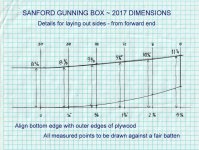
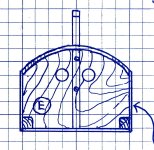
1) Plan Modifications - You mention how I modified the plans. The key changes are in the width of the floor (bottom). They are a wider up near the shoulders and at the forward end. I have always made boxes of varying (custom) lengths).


sm 2017 Floor and Side Dimensions - with TEXT.jpg

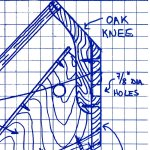
Detail:

sm 2017 Side Dimensions - details - with TEXT.jpg

The reason I did this was to make assembly much easier because the bend was needlessly abrupt (tighter arc). Especially because I am almost always a 1-man shop, the wider box is significantly easier to bend and hold whilst fastening the sides to the bottom.
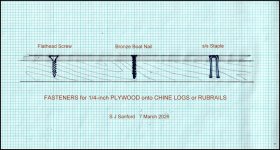
2) Fasteners - Although you have not yet gotten to fastening, I see you plan to use screws. I much prefer either bronze boat nails or s/s staples. Both are stronger because they create much smaller penetrations through the thin plywood.
Coffin - fasteners TEXT sm.jpg

Because the screws must be flatheads - the fasteners need to be flush to allow for 'glassing - they must be countersunk - either with an actual countersink when pre-drilling or even just when driving modern deck or sheetrock-style screws without pre-drilling. The countersinks remove, weaken and compress the wood fibers, Thus, it is fairly easy to remove plywood with these big perforations by tugging firmly. I sheathed my first duckboat with screws - but quickly went to Anchorfast nails on later vessels.

One of my local Home Depots carries bronze (their website erroneously uses the word copper...) but I get mine nowadays through the mail:
https://www.jamestowndistributors.com/product/product-detail/1926
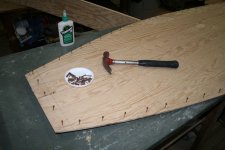
I like #14 x 7/8" for this application. I do not pre-drill but do start them all before gluing et cetera.
sm 3. Start all boat nails before fastening..jpg

When I built a few of my earlier vessels, a local lumberyard (Kirkup's Lumber in Bayshore, NY) catered to boatbuilders. Their boat nails were in open wooden bins. You filled a brown paper bag with however many pounds you needed - grabbing them with a steel claw - and weighed them on a hanging scale. (Of course they also had long lengths of clear quarter-sawn lumber and marine plywood of all kinds and sizes. A real taste of yesteryear.)

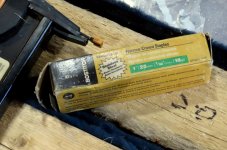
Having said that, I also like s/s staples. As a one-man shop, the pneumatic stapler allows me to hold the work with my left hand - rather than taking the time to clamp things down - and drive each staple with just a gentle pull on the trigger. Much faster! Again, I use 7/8" staples for the gunning box.

sm 7 Bunks - ss staples.JPG

3) Tools - I understand that you are gearing your instruction to builders with modest shops. However, I would add router to the list. (I began using my Dad's when I was 12 and own 3 nowadays - and I still "need" a laminate trimmer for some delicate tasks.). Of course, a rasp or Surform can round the outer edges.

The other more modest tool is a spring clamp. I worked for decades without them - now they are used for almost every project. I have dozens within reach above my head. So much quicker than C-clamps (lots of those, too). For example, I hold the ends of my straightedges and fairing battens with spring clamps.


So - more praise!
Very nice job explaining the layout and the use of fairing battens. I have a bunch of varying lengths, thicknesses and materials. Clear wood for the longer, gentler curves; PVC for the tighter radii.

I am also glad that you tried the Skilsaw for the long, gentle curves. I have always found it the better tool to avoid lumps and hollows. Also - for anyone building more than one box and stacking the plywood (I have done 5 boxes at a time), the Skilsaw blade will not wander as a Sabre Saw (jigsaw) can.

So - keep up the great work!

All the best,

SJS
 
Anyone familiar with the Sanford Gunning Box? I know it was intended as a "gunning box", but has anyone who has built one used it on open water of any kind? I was thinking about building one for fun but am curious about it's versatility before I commit to buying materials. Looking for a cheap and easy multipurpose boat build.
Don't think it is ment for open water use. I think it is used on land, marsh to sit in. I have seen them towed behind a skiff to a shooting spot.
 
Good morning, Troy~
First let me say that I am enjoying this! It brings a sense of deja vu. The first time I ever visited duckboats.net - I was still working and not yet a member - I happened across a post where the members - a couple of whom I knew - were discussing the Sanford Gunning Box. I felt like I was eavesdropping. I joined sometime after retiring in 2010 - and started my own website a couple of years later. This topic was among my first posts.

Back to your YouTube: Excellent! You are a natural teacher. I admire your shop for its size and cleanliness - and your 2 good knees. (Mine were both replaced shortly after I retired.) As anyone can see from my website, I truly enjoy sharing the knowledge and information I have gathered over my lifetime - especially as it relates to ducks, duckboats and decoys. So, I really appreciate you spreading the "word" more broadly, in a contemporary format - and with an engaging personality. I appreciate the kind words you send my way and also your self-deprecating humor. Good job all around!

You do mention that you expect me to "pick apart" your production. Nothing of the sort is coming your way, but...since you opened the door.....
Just 3 minor points:

1) Plan Modifications - You mention how I modified the plans. The key changes are in the width of the floor (bottom). They are a wider up near the shoulders and at the forward end. I have always made boxes of varying (custom) lengths).


View attachment 73330

Detail:

View attachment 73331

The reason I did this was to make assembly much easier because the bend was needlessly abrupt (tighter arc). Especially because I am almost always a 1-man shop, the wider box is significantly easier to bend and hold whilst fastening the sides to the bottom.
2) Fasteners - Although you have not yet gotten to fastening, I see you plan to use screws. I much prefer either bronze boat nails or s/s staples. Both are stronger because they create much smaller penetrations through the thin plywood.
View attachment 73332

Because the screws must be flatheads - the fasteners need to be flush to allow for 'glassing - they must be countersunk - either with an actual countersink when pre-drilling or even just when driving modern deck or sheetrock-style screws without pre-drilling. The countersinks remove, weaken and compress the wood fibers, Thus, it is fairly easy to remove plywood with these big perforations by tugging firmly. I sheathed my first duckboat with screws - but quickly went to Anchorfast nails on later vessels.

One of my local Home Depots carries bronze (their website erroneously uses the word copper...) but I get mine nowadays through the mail:
https://www.jamestowndistributors.com/product/product-detail/1926
I like #14 x 7/8" for this application. I do not pre-drill but do start them all before gluing et cetera.
View attachment 73333

When I built a few of my earlier vessels, a local lumberyard (Kirkup's Lumber in Bayshore, NY) catered to boatbuilders. Their boat nails were in open wooden bins. You filled a brown paper bag with however many pounds you needed - grabbing them with a steel claw - and weighed them on a hanging scale. (Of course they also had long lengths of clear quarter-sawn lumber and marine plywood of all kinds and sizes. A real taste of yesteryear.)

Having said that, I also like s/s staples. As a one-man shop, the pneumatic stapler allows me to hold the work with my left hand - rather than taking the time to clamp things down - and drive each staple with just a gentle pull on the trigger. Much faster! Again, I use 7/8" staples for the gunning box.

View attachment 73334

3) Tools - I understand that you are gearing your instruction to builders with modest shops. However, I would add router to the list. (I began using my Dad's when I was 12 and own 3 nowadays - and I still "need" a laminate trimmer for some delicate tasks.). Of course, a rasp or Surform can round the outer edges.

The other more modest tool is a spring clamp. I worked for decades without them - now they are used for almost every project. I have dozens within reach above my head. So much quicker than C-clamps (lots of those, too). For example, I hold the ends of my straightedges and fairing battens with spring clamps.


So - more praise!
Very nice job explaining the layout and the use of fairing battens. I have a bunch of varying lengths, thicknesses and materials. Clear wood for the longer, gentler curves; PVC for the tighter radii.

I am also glad that you tried the Skilsaw for the long, gentle curves. I have always found it the better tool to avoid lumps and hollows. Also - for anyone building more than one box and stacking the plywood (I have done 5 boxes at a time), the Skilsaw blade will not wander as a Sabre Saw (jigsaw) can.

So - keep up the great work!

All the best,

SJS
Steve

I don't know why I have not got around to checking this post, but I'm glad I did! Nice to see a few comments on my video of YOUR creation! Totally agree and understand regarding all your comments. I wanted to use my stapler so bad, but I figure most guys don't have one so I stuck with the screws. The next video is out! Interesting, that you mention broadening the bow made for easier bending? I still had a very difficult time. I rather like the idea of pre-bending before assembly. I did this in my recent duck boat build and it made life so much easier. I'm well on my way part way through the third video where I glass the exterior, however I have a trip to go on so won't be doing much on the box for a while. I've decided it I can sell this box in short order, I will in order to buy more materials to build another in stitch and glue. My thinking is, if a guy is going to glass the outside, he may as well just build in epoxy and fiberglass all the way around. I think it might be easier and require fewer tools? I will find out.
Thank yoiu for the kind words!
Troy
 
Troy~
I started my day with another fun watch. I realized, though, that a big part of my enjoyment came from watching someone else do all the work!
Just a few thoughts.....
1) You have done what I have done - store your power tools right beneath the bench. Handy to grab when you need them - and easy to put back out of the way. I have never seen a reason to enclose them with doors, etc.
2) re Glassing: I think the most important benefit of 'glassing is the abrasion resistance on the bottom itself. I believe that I 'glassed just the bottoms and taped the chines on my first several boxes. While much of the abrasion is just when dragging across Salt Hay - there are enough bank mussels and sand, stone and shell on flats to give even a hard enamel a run for its money. Given the price of marine enamels these days, the materials costs for a light ( 6 or 7.5 ounce) cloth and the epoxy are not much more than sealing, priming, top-coating.

3) I think you were hunting for the word "beam" to describe the compass you used for the radius on the forward transom. I have a couple of beam compasses that I made - and now hang on the shop wall. I drill a 3/8' at one end to receive a pencil. The other holes are about 1/8-inch - for a deck screw (just a bit longer than the width of the beam). I drill these at inch or 2-inch intervals. The pencil stays in its hole but the screw is moved to adjust the radius.

sm 6. Lay out bow transom radius with beam compass..jpg

4) I like your rabbeted rubrails! It is just the sort of thing that I would do!

5) You said your next episode covers 'glassing. I am assuming you will install the stem in the bow first - correct?

Once again - you are doing a fabulous job - excellent teaching!. I am glad to see you survived the wrestling match with the sides-to-bottom fastening. I imagine you are now in recovery and getting regular physical therapy.

All the best!

SJS
 
Troy, I have enjoyed watching all your videos on sculling and your "just another duck boat" series, as well as the first one in this series. Making some notes as I watch:

You read my mind on the staples, as you were explaining the choice between stitch and glue vs chine log and screws I was wondering why you didn't use staples. Then you talked about it! Was the choice not to use those mainly to avoid another tool, cost, something else?

Well nevermind, you answered that too - appreciate the thought towards people who might not have or want to buy a stapler.

On the over-countersunk screw hole, maybe you could fix that on the fly if you notice it in glue up with some toothpicks or something else to fill back in the hole a little?

Re the underwear: I feel you are now duty (get it) bound to use those on every future boat build.

Only made it about 17 minutes in before back to work but looking forward to watching more later!

Edit: came back and finished it, looks good! Looks like the step to attach the sides was kind of a bear, definitely seems like either some helpers or a temporary way to bend the bottom would help.
 
Last edited:
Back
Top