Traveling Duck Boat

Sean C.

Active member
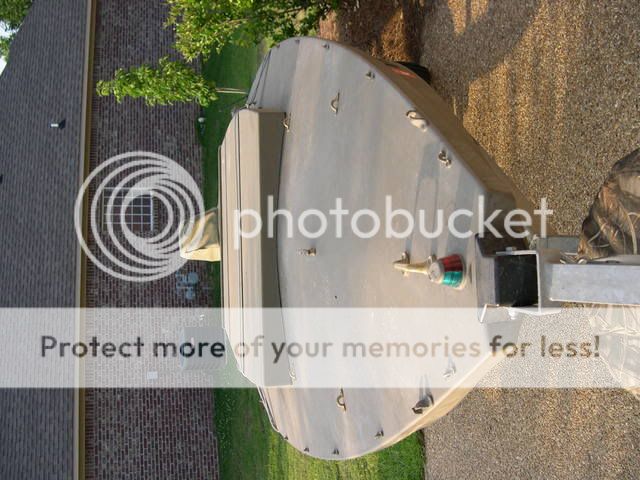
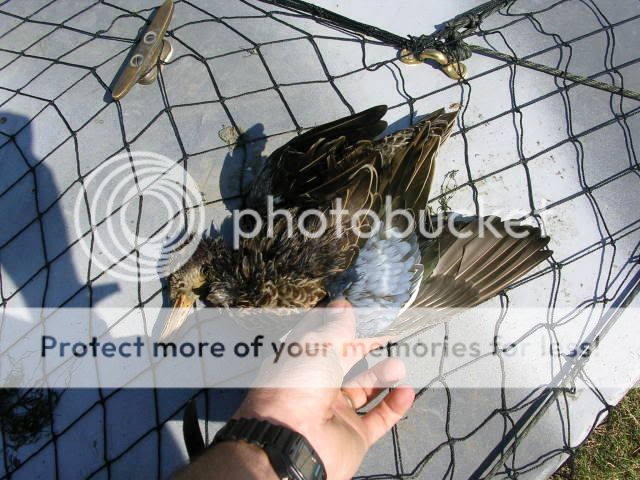
I currently use a "grass skirt" on my Scaup made from twine wrapped around a 3/8" rope, I am very happy with it, but am always looking for new ideas.

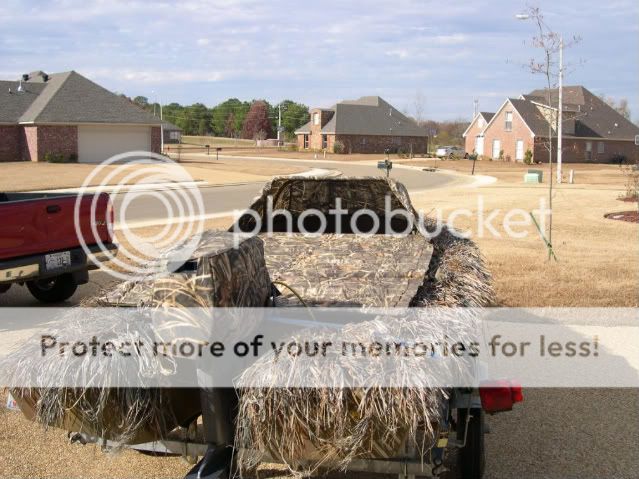
My question is two fold; The first is for those of you who use natural grassing to hide your boat. I know many of you travel down the road with the grass stuffed under your grassing rails and into your canvas loops, but does it stay put even at highway speeds? If so, what methods have you used to secure it? I mostly travel 100 miles on the Interstate to hunt, so it would really have to be solid. Logic would tell me this really wasnt possible for what I am doing, but perhaps you have had good luck with this.

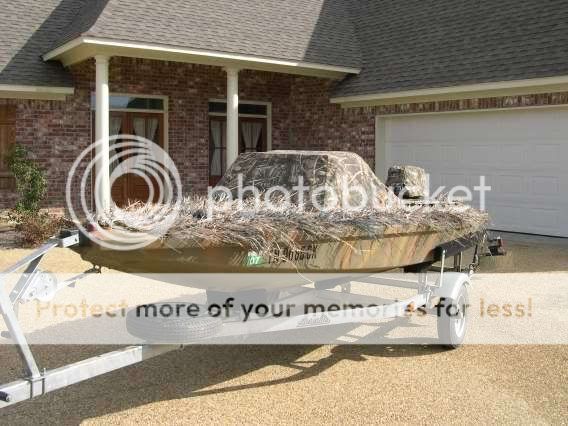
Second question: For those of you who use a dodger set-up like David Clark makes on his Estuary, you know where the canvas is almost blunt and verticle on the front side, can you travel down the highway with this in the upright position, or does the wind destroy it? The same question applies with transporting it with natural vegetation attached. I built a dodger at the beginning of this season that has a 45 degree slant back, but I really like the design of this sailboat style dodger.

Thanks for any input.

View attachment duckboat.jpg
 
Sean

Yes, it does stay put at highway speeds. I have found river cane to be the most durable of all the things I stuff in my grass rails. There is also an unknown weed that grows nearby (Bill Burruss do you remember helping me cut some on the side of a hill when you hunted with us?) that is mighty tough. The ornamental grasses I grow also stand up to trailering abuse. Without a doubt the most wear come from Cassie walking and rolling on my boats decks. Common weeds liek Johnson Grass works too but its shaft break a bit to easy and it then flops and breaks off. I'm not familr with the vegetation in your area but if you have access to some of the asian ornamental grasses they are worth a try.

Tell me about your twine skirt. The sheer clamp on my boat has a flute (round groove) cut in it for the purpose of stretching a 3/8" bungee tight and then tying twine like you have shown thereby breaking the sheer lines and extending the natural grass to the water line. Does it tangle when trailering? Does it create noticable drag when running in water?
 
Eric,

I am familiar with the grove and bungee you have (assuming its the same design you did on your Scaup). I had originally planned on following that design, but omitted at the last moment, not for any particular reason, just was not sure if I would ever use it. All I did to make this was buy a roll of bailing twine from a farm store (not sure how many feet, but a lot) and cut lengths into about 2.5'. I then just grabbed the two loose ends, wrapped it around the 3/8" line, and looped it back through itself. It took about 4 hours of doing this and a full roll of the bailing twine, and after a few hunting trips it looked very natural with the surrounding vegetation. It does a very good job of breaking the shear lines. I made it in one continuous length, to go up one side and down the other, with a brass snap hook at each end to clip to the transom tie downs, and one in the middle that hooks to the bow eye. I also installed a few bimini top eye pads down each side of the boat that I tie the skirt to in order to hold it in place. It does add a fair bit of weight after it has absorbed water, however the only performance difference I notice from it is that it eliminates the porpoising my boat does with just me in it (no tabs). As far as tangeling; it does not tangle, it does blow around when traveling down the highway, and get out of position, but it only takes a few seconds to reposition the grass with no tangles at all.
 
Sean

The path your stringer makes from the rear handles to the front bow is how I envisioned doing mine as well. Do you know if you can dye twine? The stuff I see has an oily substance on it that I've been told is to ward off rats so they don't chew through it. I suspect it would prevent dying. For a lot of the areas I hunt the look you've got is very good but I need a bit darker draping. If dye could be used to darken the twine I'd like to see that. How many hours did it take you to do yours? Have you considered adding more to drape into the cockpit?
 
Eric,
Yes the twine does have an oily nature, infact the first time I used the skirt I left an oil sheen on the water everywhere I went. Also, I would suggest doing this project outside, the smell of the twine is extremely powerful when new. You are probably right about the dye not working though, I have often thought about adding more grass that was dyed a darker marsh grass color, but i'm not sure if the dye would work. It probably took about 5 hrs total to make, easy job, just time consuming. As for adding more, I actually need to add some more to the bare spots that I have, but I really havnt thought about draping it inside the cockpit.....i'm sure it would really help break up the combing outline but I think between my dog and the rain we get up here I would have a real mess on my hands. Great idea though, would probably work well if my dog was less like a bull in a china shop.
 
Eric, I am not sure if you have diferent twine in the south but I have dyed the baling twine I buy in Minn. with good reasults, just use RIT dye in a bucket. I love using the stuff and it blends well with our vegitation as is. The older it get the better it looks. Good Luck.
 
Eric,

I'll try to get some pictures of the rope camo I have stockpiled at the farm for you. I ended up with ;) some 2 1/2" thick hemp rope, to the tune of around 200 feet, some years back. I died 1/3 of it in RIT dark green and 1/3 of it in RIT dark brown, and left the other 1/3 natural. I pulled it all apart, cut it into hanks and used it on my gatorhide and some other boats as well, letting it fray naturally and mixing it together. It works great and gets better with age....not a beall/end all, but it does add something when mixed with raffia and natural vegetation, and really mimics hydrilla and millfoil very well at the waterline. You are welcome to come by and help yourself to some to test out.

 
On the buggy style dodger, the ones Dave Clark makes are built in the style of high quality marine canvas work, in that every piece is rigid and taut - they are very strong. You could lift the boat with one of them, trailering is not giong to be an issue. From what I understand, marine canvas is Dave's background and it shows in his dodgers. I have seen a bunch of his work up close, I have heard that he will stand on the top of one his dodgers to show the strength.
 
Tom,
The best I've found to use for many purposes especially as decoy line is tarrred fisherman's twine size 80 works well for me. I order it from Memphis net and twine as they usually have a better selection at a better price. I suspect it does leave a little shiney something in the water when the tarred line is fairly new. I have seen a few spools in brown and green but i use black almost exclusively. If you are going to web search I'd search for tarred fisherman's twine.
Best,
Harry
 
Sean,

Another option is dyed raffia grass or one of the commercial variants. A lot of folks on the site have covered their boats with nylon netting and zip-tied on small bundles formed from looping grass around their hand. The loops are then cut with scissors so that the bundles have free ends making the mat looks like natural grass. This system has traveled ok for me over the last couple years (lots of 100 mile round trips at 70+ mph). Over time, the longer stands frayed and shortened, so I occasionally did a little touch up. My dodger folds down for travel, but I think this style camo would hold up fine on a dodger left in the up position. I did go back and reposition the outer edge strap eyes so that they screwed into the sheer clam, putting them within ½ inch or so of the outer edge of the boat. Originally, I had set them at 4 inches in, but the wind blew the grass back, leaving the shear exposed. I still have to fluff the edges back out once in position, but this takes little effort.

Another beauty of this system is at the end of the season, I just cut the zip ties holding the net to the stap eyes, roll up the mat, and store it til next season. The boat is then ready for fishing and crabbing.

Since taking these pictures, I have put the netting and raffia over the dodger and engine cover, as well as run 550 cord w/raffia to the boweye to camo the nose better. I plan on grassing the cockpit cover, some day.

DSCN13501.jpg


image0003-1.jpg


Strap eye position:

DSCN1887.jpg


Here is a picture of the nylon netting and 550 cord structure (this in on my Broadbill- somehow I failed to take pictures of this on the BB2).


DSCN1409.jpg


Have a fun season in the great Pacific Northwest!

-Bill

 
Eric,

Sure do- I remember those weeds being pretty tough, but not as tough as the hedge sheers! Hear from jeff lately? Isn't he out West now?

Take care,

Bill
 
Bill, I really like that idea, I might have to try it out. Thats not to say I dont care for my current set up, but I am always interested in possible improvements. I just noticed your in Olympia....no kidding! I might have to come see your hunting rig sometime. What part of Olympia are you in? Where are you doing most of your hunting?
 
ON my BBSB I use spartia grass and fit it under my grassing rails 3/16" space.
IF you take your time and fit the grass it will stay while trailering.
As for the spray doger. I have travel 30 mph on the water with no problem.
When I trailer I unclip the traps that hold it up and it folds down, I have no reason to trailer with it up.
One note at the very start of the season I may need to add a little grass and but then for the rest of the season it if fine...
 
Back
Top