What about Gators?

Capt. Jack Passie

Well-known member
Now I've never gunned Ducks and Geese down south, but I have hunted Deer and Hogs In South Carolina and they hahave plenty of big Gators there. Do you guys worry about you dogs when you send them on a bird?

 
Here's an article I wrote a few years back on the subject for the HRC mag:


Gator Safe in Gator Country
(Part 1)
by
Captain Jeff Kraynik
Central Florida Hunting Retriever Club


The alarm clock rang at 3:00 a.m., but the warmth of the bed seemed so much more comfortable than the cold chill of the morning duck blind. With no client’s waiting for me at the landings, I decided to roll over and go back to sleep in fruitless attempt to catch up on some needed rest.

It was just after daylight when the call came in. At the other end of the line were the sounds of sheer, bone chilling terror. At first I thought it was a prank call from a hunting buddy for sleeping in that morning, then as the callers voice subsided I realized that it was Bobbie on the other end of the line.

“He’s gone, he’s gone, he was only ten yards in front of me”, Bobbie kept repeating over and over gain. Fearing he was talking about his client, I kept asking what he was talking about and kept getting the same reply back, “He’s gone, he’s gone”. After five minutes of screaming and crying Bobbie was finally able to tell me what had happened. It all started at the levee.

Bobbie and I had taken this trail along the levee together a hundred of times before. Along the inside of the levee was the eight-foot deep rimmed ditch where the ever-present, fiery red eyes of death loomed just above the surface. Our palm frond blind lay waiting for us at the end of the mosquito impoundment levee. As we would walk, those glowing eyes were always a constant reminder of who as actually at the top of the food chain here, and it wasn’t us.

Luther, Bobbie’s 70 pound yellow Lab had been walking ahead of them in the darkness of the levee. With blinding speed like a thief in the night, the beast came from out of the darkness. The only thing heard was a splash; a best friend’s cries for help, then silence. It was all over in a matter of seconds. Luther was never seen again.

Each year on average around the Sunshine State (Florida), two dogs (retrievers/hog-coon dogs/deer hounds) are lost to alligator attacks during the hunting season.
Some say there wasn’t anything Bobbie could do about it, or could he?

The American Alligator has been around since the time of the dinosaurs and before man slithered up out of the swamps. Upon reaching four feet in length he is considered the top predator of the food chain with only bigger alligators and man to fear. With eighty-two self-replacing bone-crushing teeth, and a bite exerting 1800 pounds per square inch, most creatures of the marsh don’t stand a chance against such a perfect killing machine.

An alligator grows an average of one foot per year until the age of six. From that point on, their growth rate slows and they begin to both broaden and lengthen. The female alligator rarely exceeds nine feet in length, with seven feet being more of the norm. It’s their bull counterparts that can grow to over thirteen feet and in excess of one thousand pounds.

There is no accurate way to estimate an alligator’s age, but most agree that a twelve footer can be between seventy-five and one hundred years old. That means most old bulls have been around before the snowbirds began their migration south in an attempt to drain and claim the marshes as their own. As far as estimating a gator’s length, one only has to guestimate the distance between the top of the snout back to the center of the eyes. It is a naturally occurring phenomenon that this distance comes out to the total length of the gator.

Here in the Deep South, twice a year the marsh beast do not even fear man. Starting in late April or early May, the big bulls begin their search for a mate. Their travels to perpetuate the species can take them many miles through marshes, canals, over top of interstates, and sometimes into the backyard pools of million dollar homes. The urge to mate can become deadly, not only for man, but also for the younger bull alligators within the marsh.

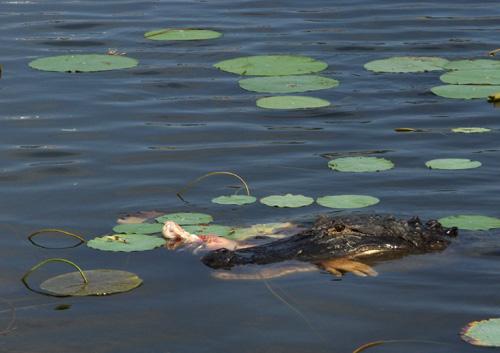
While scouting in late April before a hunt we observed a strange wake moving across the lake. To my amazement and terror, we observed an eight hundred-pound, twelve-foot bull alligator with a lifeless eight footer grasped between its jaws. We saw him submerge and begin his death roll along the bottom of the lake in an attempt to tear his prey into manageable pieces. Next the giant beast would be off to place his prey into his meat locker under some mud bank or fallen tree to tenderize and cure it for a week or two. Nothing will go to waste.

During their mating dance, the first thing you see is the bull’s entire back and shoulders balloon out of the water like an over filled child’s beach toy. Then a “bellowing”, bone shivering grown, like nothing you’ve ever heard before, fans out in every direction across the marsh. Finally like a brief rain storm, the water around the giants mid-section vibrates and showers out away from his great girth out to six feet. The ultimate call of the wild, carnivore style.

Moving into August with the heat and humidity of late summer, the first baby hatchlings begin to emerge from their months of guarded slumber. With mother never far away, she begins to hear the cries of her children from beneath the peat nest that she had constructed for them months earlier. As the hatchlings appear and with the loving touch of mother, she ever so gently places two or three of her babies into her deadly jaws and takes them to the safety of their new home in the dark tannic waters of the marsh.

For the next several weeks, she will defend her hatchlings with her life. Not just from the feeding bass, Great Blue Herons or giant snapping turtles, but from the ever-constant jaws of her former mate.

Once we were guiding a client on a September trophy hunt when we came upon a seven-foot female guarding a late season nest. Before I could pull the stick back to turn away into the opposite direction, she charged the fourteen-foot airboat and raked her T-Rex shaped teeth back and forth across the portside gunnel. After the attack subsided we could here her hissing in the darkness as we proceeded down the bank of the lake. Laughing as we disappeared into the darkness, the look of shear terror on the client’s face was nothing but “priceless.”

The irony in all of this is Florida is rank by the USFWS (1998) as number six in the United States for the harvesting of waterfowl. Sixteen ducks per hunter per season isn’t to shabby when you consider that the number one state of Louisiana only averages twenty-three ducks per hunter per season.

So you ask how does the waterfowler utilize his trained retriever and best friend with such a formable foe to deal with? That’s another story.

Captain Jeff Kraynik is a member of the Central Florida Hunting Retriever Club and the owner/operator of The Coastal Sportsmen of Florida. Captain Jeff and his crew specialize in waterfowl, dove, and alligator hunts. When the decoys and harpoons are put away, the crew spends the summer months poling client’s across the flats for tailing redfish, spotted seatrout, and the ever-wary snook. Capt. Jeff can be contacted at (321) 863-9182 or contact him on the web at www.coastalsportsmen.com

 
Last edited:
Gator Safe in Gator Country?
(Part II)
By
Captain Jeff Kraynik
Central Florida Hunting Retriever Club
Last month I posed the question whether Bobbie could have prevented the tragedy that claimed Luther’s life. After spending many hours speaking with him about that fateful morning, I would have to say “Yes” in this case, the loss of Luther could have been prevented. In Bobbie’s own words he admitted he became comfortable with his surroundings and took for granted that the cold weather meant that the alligators would be less active. He forgot that, at times, “dogs will be dogs” and will roam and explore their environment. Alligators are nocturnal feeders and prey on animals coming to close to the water’s edge. In Luther’s case the alligator saw a free meal of a wandering dog and took full advantage of it.

For waterfowlers here in the Sunshine State and in other parts of the southeast, there are some simple yet effective rules for hunting in gator country that when followed, should ensure a safe hunt for you and your retriever.

First and foremost, when hunting near alligator infested areas one must have and demand “total control” over his/her retriever. After properly conditioning the dog, I recommend the use of a Tri-Tronics® training collar in all hunting and training situations. It never fails once a dog gets a nose full of a crippled bird that he forgets what the “toot toot” of the come back whistle means. As we saw in Luther’s case, things can take a tragic turn in a blink of an eye. Walking your retriever at a heel or within close proximity en-route to any hunting situation is an absolute must. Just this simple practice can be the difference between a perfect day in the blind or a tragedy that is remembered for a lifetime.

Alligators are very predicable creatures in habit and habitat. Unless illegally fed, alligators like most wild animals have a natural fear of man. Larger alligators feel vulnerable in the shallow flats and potholes and won’t venture far from the safety of deep water. Smaller and medium sized alligators, though curious, will usually leave the area once confronted by the waterfowler.

I favor shallow, running water potholes off of the main river run or lake when hunting with the dogs. One should only hunt the dogs in these conditions no matter what the temperature, if it’s much deeper than that, the dogs should stay on the porch.

Before setting out, we will scan the waters for the red glowing eyes that will ultimately give the gators location away. If util;izing the hole we wish to hunt, a trip over to him with the boat is usually enough for him to leave the area.

When setting up, we’ll place the boat or blind between the pothole and the deeper water. This is where we want the majority of the birds will be dropping, out in front of us in the shallower water where were hunting. No matter how many times we’ve hunted an area, we always walk the pothole and set up a “ three point perimeter” from the boat or the blind prior to setting out the dekes. Using a walking stick, we check the entire inner perimeter for any underwater obstacles that the dogs may also become hung up on.

Once the hunting area is cleared, we utilize sticks, PVC poles or natural brush as markers and never violate the perimeter or send the dogs passed these points. If a crippled bird sails outside the perimeter the decision is made either to walk to dog over to complete the retrieve or chalk it up as part of your bag. The alligators and buzzards have to eat to.


Stay out of the “Gator Whallers.”

Whallers can be naturally occurring or artificial; deep-water pockets that form within the marsh during low water or severe drought conditions. Most of these whallers have been around for hundreds of years and have been identified by most serious waterfowl hunters. During severe droughts or wind shifts, the water may drain out of the marsh so fast that a larger gator may be forced to “whaller” out a new hole out of shear survival. Once the gator depletes the whaller of all trapped fish, turtles and smaller gator’s, he will begin to feed on animals that come to drink, including wandering retrievers.

We just experienced one of the driest and coldest winters in eleven years in Florida. I observed many hunters taking the cold weather for granted and hunting their retrievers in deep, alligator infested waters. These deepwater areas should also be “off limits” to the waterfowl retriever.

Here in the Dixie, many believe that once the thermometer drops below a certain point that alligators will den up in their mud caves and become inactive. This is true for the most part, but what many don’t know is that only a five-degree change in air temperature will send most alligators back out on the prowl. What is true is once a certain water/air temperature is reached an alligators digestive track will shut down and they will no longer feed. This will not though stop the gator from taking advantage of an easy meal that comes along. Remember that alligators are carrion eaters, so a week or two rotting in their meat locker until the water or air temperature warms up is preferred anyway.

During one of the colder mornings this year we were hunting a one-foot deep mudflat at the outer most edge of a large lake in the upper St. John’s Marsh when we realized a thin sheet of ice had formed. We knew it would be a bluebird day and the morning flight would be over early. After downing two blue winged teal and a pair of Mottled ducks, the sun broke above the tree line and we immediately felt the warm up coming. We were fortunate enough to down one more teal near the lake edge of the flat. Just as I was getting ready to send Hershey, my American Water Spaniel we observed a five- foot gator move up out of the lake and onto the flat. Like a Coast Guard Cutter breaking out a new channel, the gator moved through the sheet ice and completed a perfect marked retrieve. I would like to talk to the person who said alligators don’t feed once the water dips below sixty degrees.

After millions of years of evolution, alligators still need two things to regulate their internal temperature, sunlight and shade. You can have a big, deep lake with little or no shore cover with no alligators. You could also have several medium-sized gators’ sharing a small, shallow pothole surrounded by willows and floating mats of vegetation.

These are not only thing to take into consideration during hunting situation, but also during training prior to the season. Most of our training seasons take place in small to medium sized bodies of water. Prior to starting our training session, I watch the pond for several minutes looking for trails through the vegetation, nervous water, sunning alligators, and “Bubble Trails.”

Alligators moving quickly along the bottom of a lake or river create these bubbles trails. As they disturb the vegetation, bubbles or “swamp gas” is released and rises to the surface showing you the direction in which the alligator is moving. In shallower waters, if the bubble trail stops suddenly, this means that the alligator has “hunkered down” along the bottom. Using bubble trails is a common method used when hunting during alligator season. Larger gator’s can remain submerged for up to forty-five minutes. Any longer than that without resurfacing for air, he’s probably given you the slip and it’s time to move on.

When training in unfamiliar waters, walk the entire perimeter of the pond looking for pullouts and sunning spots. These will be bare dirt areas with little or no vegetation on them. On some of them you will also be able to see claw marks and tail drags. Launch a canoe and probe the bottom, getting a feel for what’s down there. While probing the bottom with the push pole or stick, look for deep holes and runs. If any of these indicators are observed or suspected, cordially move on to another pond.

Taking for granted that it is safe to use a fenced in pond can also get you and your retriever into trouble. If a gator wants in, he’ll push himself right underneath. If we wants over, I have personally seen an eight-footer manipulate his tail and push himself up and over a 6’ foot high, chain link fence. Take nothing for granted.

If you are unfortunate to have an alligator begin to swim towards your retriever you have very few options that you must execute quickly. If hunting, a shot across and in front of the alligator’s snout will normally deter him from any further aggression. When training, few us carry a loaded weapon around the park or training grounds. Since alligators are primarily sight feeders (just like the T-Rex in Jurassic Park) and instinctively snap at moving objects, throw an extra training dummy between the gator and the retriever. At the same time continue to give loud, sharp “toot toot’s” on the whistle. The gator will normally bite at this object, giving your retriever the extra time he needs t o get back to safety.

The eyes are the window to the souls!!!

Whether it’s a training pond, a drainage ditch, a backyard swimming pool, or our favorite honey hole, always look first for reddish/orange glow of the eyes. This over anything else will tell you if an alligator has also set up home in your favorite little pothole.

In closing, you must always assume that where you have water in the southeastern United States you also have alligators. We can’t train our retrievers to avoid alligators, so we must train ourselves.

One can never be too “Gator Safe in Gator Country.”

If you have any questions regarding waterfowl hunting with retrievers in Florida, Captain Jeff can be contacted at (321) 863-9182 or check him out on the web at www.coastalsportsmen.com


I use my dog very sparingly here in florida, mostly as a courtesy to him. I try to stick to very shallow water, less than knee deep and only send him on one or two birds when we are done and I have had a chance to look around real well for gators, instead of focusing on ducks. A lot of guys send their dogs out like there is nothing in the world to worry about. For them it is just a matter of time. Diesel has more than enough opportunity to retrieve during our fall North Dakots hunt season. Sometimes we hunt blackbellies over dry fields here in florida, he can retrieve all he wants there. Saw some real monster gators on the bank of the Indian Prarie canal last day of the youth hunt, watch out! Rich
 
here in coastal Alabama, we dont use dogs during Sept teal season. BUt by regular duck season the gators are "hibernating" and its not an issue.
The real issue for me is where to train this summer. Most easy to get to spots are full of gators. I'll probably end up at the beach, gators dont care for real salty water.
 
I lived in western Arkansas for a year and a half, and was scouting/exploring in SE Oklahoma one summer day. I had located several public areas on the maps that indicated they had open duck hunting so I went off to explore them as potential duck hunting spots. The second or third place I pulled into had a warning sign in every parking lot saying something to the effect of "There are alligators in this area, please don't shoot the alligators." I had to laugh as being from Missouri and never having seen an alligator in the wild, the IDEA of walking out there in the pre-dawn seemed nuts!!! I was completely shocked that they had a population that far north and landlocked like that.

I moved back north before I ever got a chance to hunt down there, but it would definitely be a hair raising experience seeing those eyes in the dark and knowing how powerful an animal is lurking out there. Taking Bailey out in that kind of a place, and knowing her ability to explore out of 'contact' so quickly when given the chance would give me a complex.
 
I would have never thought Aligators were in Oklahoma. The only ones that I've ever sen in the wild were in Estil And St. George SC nI late Dec or Jan and they looked pretty lively to me. Better call in the Swamp People.
 
Boy, after reading all of that about Gators, I'm glad all I have to worry about is western diamondbacks where I hunt. Scary stuff!
Al
 
Ron, they tolerate it here but are not very abundant where it is saltier. The saltier it gets, the fewer the gators.
Matter of fact, I've never seen one on Mississippi Sound.
 
Boy, after reading all of that about Gators, I'm glad all I have to worry about is western diamondbacks where I hunt. Scary stuff!
Al

Yeah! All I have worry about is White Sharks and Orcas. Fortunatly I've never seen either one while I've been gunning.
 

Yeah! All I have worry about is White Sharks and Orcas. Fortunatly I've never seen either one while I've been gunning. [/QUOTE]


Hey Jack,

We had a 15' female white chewing on the dive ladder once when we were trying to get back in the boat but I've never seen an Orca in our waters.

I'm sure you have seen some white sharks but have you really seen Orcas around here?

Now that would be cool.
 

My goodness great info. I did make myself a lovely little hide in Texas a couple of years ago in some old fallen brush, whilst waiting for Sandhill craine. Only to be tapped on the shoulder by my mate mucks who told me it would be a great place to find a snake as well with all the little borrows in there.you never seen a chap move so quickly. With all that wildlife I'm amazed there is so many of you lot over there....

Hell, the worse thing I have to worry about in the uk is my flask of coffee getting cold...... Well that and drowning or having a heart attack dragging my gear along the mud to the forshore... "Cos I'm to fat!!" wife just said..
 

Yeah! All I have worry about is White Sharks and Orcas. Fortunatly I've never seen either one while I've been gunning.


Hey Jack,

We had a 15' female white chewing on the dive ladder once when we were trying to get back in the boat but I've never seen an Orca in our waters.

I'm sure you have seen some white sharks but have you really seen Orcas around here?

Now that would be cool.
[/QUOTE]

I've Seen 2 White Sharks, never caught one and 2 Orcas. One of the Orcas was in the Summertime when we used to catch Tuna in the Dump and the other was about this time of the year when I was setting cod fish gear on Cartwright 6 miles south of the Point he hung around for hours. Awesome to see.
 
Last edited:
Ron, they tolerate it here but are not very abundant where it is saltier. The saltier it gets, the fewer the gators.
Matter of fact, I've never seen one on Mississippi Sound.

Carl i've seen them south of the causeway in the summer while going over to Seaside. Does that count?

I'd venture to say that we have higher poplulation densities than anywhere else. We don't really have any problems with them. I don't hunt a dog in teal season if i'm in a bad area. I was at a private club last year in November on a 65 degree day. my boss and i were hunting and the first bird in was a specklebelly about 2 min into shooting time. We called the bird well and broke a wing at around 30 yds. It dropped about 100 yds out wounded. Immediately upon it dropping, i saw a 5 footer launch off the far bank about 100 yds from the bird. He had obviously marked the bird and was in a full speed sprint for it. To our horror, the dog had broken and was also on a full speed line to the bird. Mud boats don't have reverse, so it took a couple minutes to get backed up turned around and headed for the bird. The gator beat the dog to the goose by about 30 seconds. The dog could stand where the bird was and planted her feet in a tug of war with the gator. the gator gave up, but i beleive it was because he saw us coming to have a talk with him from the boat. It was scary but was the first time i've had a problem in probably 10,000+ retreives. Gars and turtles get more of our birds than gators.

On a couple side notes. I've had them in blinds in the morning before, no fun to lower yourself into a pit and then hear the hissing of a gator in the dark.

And related to the story of the dog grabbed off the levee earlier. I used to be in a club down river where you had to cross a pier over a large bayou to get from the road side over to the camp. Over the yiers the pier had subsided to the point where it was under the water by about an inch. During the day, there would always be large gators sunning on it. Crossing it at night, i always thought of the videos of african wildabeast being taken by crocs, but didn't really think we were in any danger. Maybe we were?
 
There are quite a few just south of the causeway/I-10 in summer, all over the grass flats where I hunt in the winter. Which is why training there in summer is out of the question. But there are a lot more north of the causeway, a heck of lot more.
 
I know I've said it before to Dani, but I couldn't concentrate on huntin' if my head was always on a swivel looking for whatever was out there wanting to eat me, bite me or stuff me into his "meat locker".

Up here, on a real bad day, you might see an angry snapping turtle or some pissed off bees. Thats about it.

Once I did see a couple of coots looking directly at me, flapping their wings and making unholy noises. Then they left.
 
Last edited:
Back
Top