Harlis

jode hillman

Well-known member
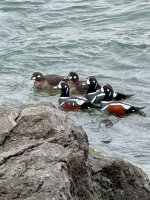
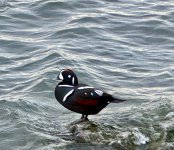
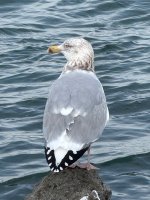
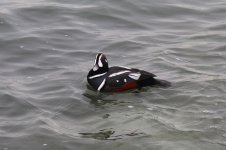
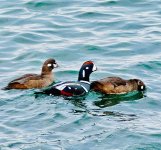
Took a little road trip today to the Jersey Coast to see some of our favorite winter residents.

The harlequins.

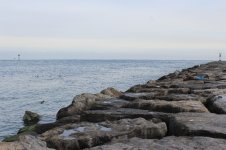
There was snow and ice everywhere but plenty of birds. We logged over 30 species today. Here's just a few of the highlights.
 

Attachments

  • IMG_7946.jpeg
    IMG_7946.jpeg
    676.6 KB · Views: 56
  • IMG_7976.jpeg
    IMG_7976.jpeg
    579.8 KB · Views: 52
  • IMG_8001.jpeg
    IMG_8001.jpeg
    453.6 KB · Views: 53
  • IMG_8006.jpeg
    IMG_8006.jpeg
    525.1 KB · Views: 57
  • IMG_7902.jpeg
    IMG_7902.jpeg
    524.6 KB · Views: 60
Took a little road trip today to the Jersey Coast to see some of our favorite winter residents.

The harlequins.

There was snow and ice everywhere but plenty of birds. We logged over 30 species today. Here's just a few of the highlights.
Jode~

What's all that open water??? We're getting a fresh snowfall today - and down to 10 below tonight.

All great photos! Was glad to see those Purple Sandpipers. Do you get Great Cormorants around the inlets in Winter?

All the best,

SJS
 
Hey Jode,

Thanks for the photos and "scouting" report, made me Smile. For decoy carvers and makers watching the birds ya love is always inspirational. Hope ya took a sketch book along. I like to go back and check the sketches from years gone by, where and when.

Best regards
Vince
 
Jode~

What's all that open water??? We're getting a fresh snowfall today - and down to 10 below tonight.

All great photos! Was glad to see those Purple Sandpipers. Do you get Great Cormorants around the inlets in Winter?

All the best,

SJS
Steve, I traveled much of the mid Jersey Coast. And it was largely , locked in ice. Barnegat inlet has an incredibly strong current that channels between two opposing jetties. That keeps the open water as it flows directly to the ocean.

In addition to Harlis there was common eiders, black scoter, , bluebill, all three Mergansers, double crested cormorants, black belly plovers, Ruddy turnstone, purple sandpipers, gray seal, harbor seal, Oystercatchers, semi palmated sandpiper, Dunlin, mallards, black ducks, Brandt, a dozen loons plus many others. I saw More birds in one day than I've seen in 10 years! It was a great day.

There were several big groups of cormorants. I assume they were all double crested.

But maybe they were others.
 
WOW! Harlis!! and Brant!!!

Very cool thanks for sharing.
You're welcome. If I was a better photographer, I would have pictures of about 30 different species.

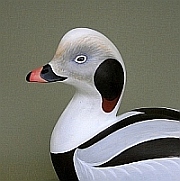
But I watched many of them simply through the binoculars. My daughter did take many good photos of Old squaw for her 2026 federal duck stamp painting.
 
Hey Jode,

Thanks for the photos and "scouting" report, made me Smile. For decoy carvers and makers watching the birds ya love is always inspirational. Hope ya took a sketch book along. I like to go back and check the sketches from years gone by, where and when.

Best regards
Vince
I took a lot of photos. The weather, tide, and spray made it hard to do any drawings. But I'm sure there will be some of that in the future from pictures.
 
Jode

How long has it been since Harlequins were legal in the bag in the Atlantic flyway? Any idea how they are fairing these days?
It's been a long time since they were legal game. Never in my lifetime.

There is about 1500 individual birds in the entire Atlantic flyway.

Barnegat inlet is about as far south as they winter. They prefer a rocky coast lines, but the jetties provide pseudo habitat.
 
Great photos. Those drake harlequins look absolutely perfect.
They were absolutely beautiful! At times, they were no more than 10 yards from me.

I had heard they were around, but it took a little bit of looking to find them. The first group I saw, the trio, actually came out from underneath the rocks beneath my feet.
 
Jode~

What's all that open water??? We're getting a fresh snowfall today - and down to 10 below tonight.

All great photos! Was glad to see those Purple Sandpipers. Do you get Great Cormorants around the inlets in Winter?

All the best,

SJS
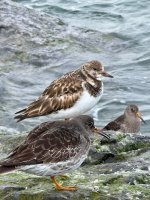
The purple sandpiper is actually were amusing. There was a dozens of them. They would pop up from the rocks like whack-a-mole and almost fly straight up your nose. Then land yelling at you.
 
Took a little road trip today to the Jersey Coast to see some of our favorite winter residents.

The harlequins.

There was snow and ice everywhere but plenty of birds. We logged over 30 species today. Here's just a few of the highlights.
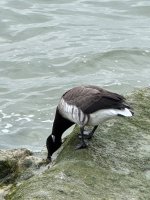
A few more of the pictures
 

Attachments

  • IMG_8024.jpeg
    IMG_8024.jpeg
    481.3 KB · Views: 20
  • IMG_7997.jpeg
    IMG_7997.jpeg
    254.6 KB · Views: 18
  • IMG_7945.jpeg
    IMG_7945.jpeg
    443.4 KB · Views: 17
  • IMG_4458 cool duck again.jpeg
    IMG_4458 cool duck again.jpeg
    242.8 KB · Views: 18
  • IMG_4278.jpeg
    IMG_4278.jpeg
    377.3 KB · Views: 20
Quite a few birds overwinter in Maine, mostly in Penobscot Bay. According to Maine's state Endangered Species desciption, they were listed as endangered in Canada in 1990, but later down graded to special concern there. They went on Maine's state list as a threatened species in 1997. I've never heard anyone talk about their being hunted here, even historically, though I am sure it must have been done. I'd bet it's 50+ years since they were hunted on the Atlantic in the US. https://www.maine.gov/ifw/docs/endangered/HarlequinDuck_38_39_2011.pdf
 
A few more of the pictures

Saw my first standing on that same jetty your pics are from. Really quite a special bird. Thanks for the pics!

We have them in Wyoming (only several dozen pairs) and they are a legal bird, but I've never seen them outside a park or outside of breeding season there.
 
Great pictures, my wife and I didn't get to see harlequins until we went out west to Yellowstone.

Not to promote another website necessarily and you may already know this but if you like to log your sightings on eBird, they introduced a nice feature a few years ago called trip reports. You can select a set of checklists by date and manually filter out ones you don't want to include then it generates a nice trip report page with all the species you listed and photographed or recorded. You can then share this with friends or whoever with a link. All that to say, if you happened to have a trip report for everything you saw, I'd love to see it!

Those kinds of days where you get to see a lot of different birds or large numbers of them are always fun.
 
Great pictures, my wife and I didn't get to see harlequins until we went out west to Yellowstone.

Not to promote another website necessarily and you may already know this but if you like to log your sightings on eBird, they introduced a nice feature a few years ago called trip reports. You can select a set of checklists by date and manually filter out ones you don't want to include then it generates a nice trip report page with all the species you listed and photographed or recorded. You can then share this with friends or whoever with a link. All that to say, if you happened to have a trip report for everything you saw, I'd love to see it!

Those kinds of days where you get to see a lot of different birds or large numbers of them are always fun.
All~
Harlequins are predictable in similar situations along the South Shore of Long Island - I have seen them at Montauk point and at Shinnecock, Moriches and Jones Inlets. They are probably at Fire Island Inlet, too - have not been there in winters, however. The inlets usually have Purple Sandpipers, too - as well as Surf Scoters.

James: Do not hesitate to recommend good sites that provide good information for gunners as well as birders. I commonly get "bird ID" questions from both gunners and birders. I always give them a link along with my answer. The first one is from Cornell (my alma mater) Lab of Ornithology and home to eBird:

https://www.allaboutbirds.org/guide/Harlequin_Duck/id
https://www.audubon.org/field-guide/bird/harlequin-duck

I believe that the season on Harlequins was closed back when I was the DEC duck biologist on Long Island - 1980s.

I have never shot one, but.... When I 15 or 16 my Dad and I had one fly over us - in range. Neither raised our guns because he taught me to "always be sure of your target". Neither of us was certain of the species - so we watched it carefully. It was about the same size and shape as a hen Oldsquaw (Long-tailed Duck) but with a dark belly. I could see the whitish head markings - but not those of a Butterball (Bufflehead) or Whistler (Goldeneye).

Harlequin Hen in flight.jpg

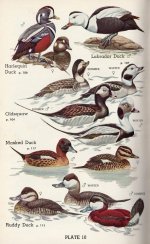
Once we got home, we consulted the Audubon Water Bird Guide - with paintings by Don Eckleberry - a well-worn volume in our house. It was printed in 1946 - long after the Labrador Duck - which even I am not old enough to have seen.


Harlequin - Plate 10 sm.jpg

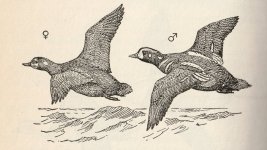
Earle L. Poole did the wonderful line drawings of birds in flight.

Harlequins in flight - dwg Poole.jpg

It continually amazes me how this 72-yearold brain can still see that Hen Harlequin vividly - a belly shot against a grey afternoon sky at the mouth of the Connetquot River in light winds. This grand sport of ours fills us with experiences and images we can enjoy forever.

Which brings me to my final thought. I have always encouraged duck hunters - and anyone interested in the natural world - to learn as much as you can about anything related. Whether it is boats or decoys or the birds themselves, go beyond the narrow confines of the sport itself and learn about history, the natural world, art, et cetera. Any endeavor gives back more if you put more into it.

All the best,

SJS
 
Steve,

Good story about seeing the hen many years ago, and your restraint to be sure of ID. Also your photo of the foursome for reference. They are found in a number of places along the New England coast where scoters are commonly hunted. In some areas there are warnings in the state regulations. While the drakes are so vivid there can be no misidentification by an alert hunter, I think you will agree that the hens are very similar on the wing to a small-ish surf scoter hen/immature. Unfortunately I have seen several hens at the launch which were thought to be hen scoters. I am quite sure that a fair number of hens are taken every year, most without the hunters ever realizing what they shot.
 
Steve,

Good story about seeing the hen many years ago, and your restraint to be sure of ID. Also your photo of the foursome for reference. They are found in a number of places along the New England coast where scoters are commonly hunted. In some areas there are warnings in the state regulations. While the drakes are so vivid there can be no misidentification by an alert hunter, I think you will agree that the hens are very similar on the wing to a small-ish surf scoter hen/immature. Unfortunately I have seen several hens at the launch which were thought to be hen scoters. I am quite sure that a fair number of hens are taken every year, most without the hunters ever realizing what they shot.
SJ, your point is pretty fairly well taken. Back in the day of our local New Jersey duck forums a young hunter posted up a bunch of Bufflehead. Along with the question

"I can't figure out why this one hen is so much bigger than the rest ?"

As you probably guessed he had killed a hen Harlequin.

He was quickly warned of his mis step, but not before one of the local Warden's saw the post. While they didn't throw the book at him, the bird was confiscated and he was fined.
 
Back
Top