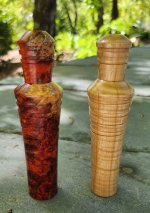
Some of the Reelfoot metal reed calls I've made over the last couple of years

HenryHawthorne

Well-known member
Supporter
Here's a sampling, to get some activity in this sub-forum. I'm not likely to get back on the lathe much before finishing my boat, but will try to add some more calls to this thread from time-to-time just to keep it active until I get back to making them.

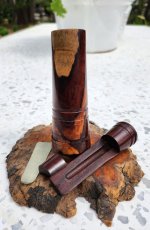
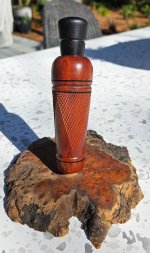
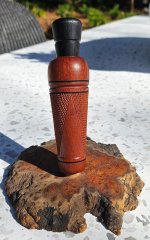
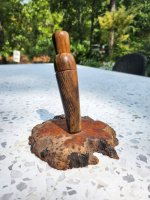
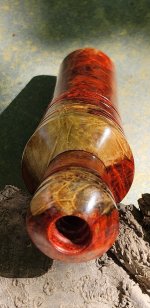
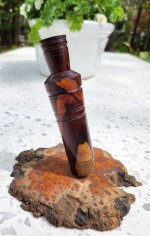
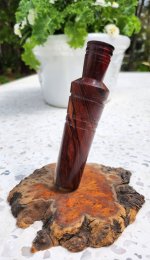
First is my favorite wood, cocobolo. This shape was inspired by an old Rip Fanning call - have just always liked the shape, and this is a shape I frequently turn as a result.
IMG_20230401_142811.jpg

IMG_20230401_142639.jpg

IMG_20230401_142458.jpg
 
Good stuff, Henry!
This is going to be a very cool forum, even for those of us who never used calls much, or havent hunted in a while.
Cant wait to see the artistry. And field results.
 
Given the flat toneboard, is sticking an issue?

Back in the late '80s or early '90s, I hunted an elderly Cajun and his middle-aged son who'd carried on a family tradition of making their own calls, and the father chided his son for being the first of their line to curve his toneboards, instead of putting a curve in his Ace comb (what sounded to my displaced hillbilly ear like "cow. chew dur" and turned out to be "caoutchouc dur"/hard rubber) reeds with the back of a heated pocket knife. And when I asked him about sticking, the old Cajun smiled broadly and said that he'd learned at his grandfather's knee to always spit before reaching for a call.

Am guessing improper curve the rub with a couple of brass-reeded calls I was given as a teen and couldn't get anything out of..
 
Last edited:
Given the flat toneboard, is sticking an issue?

Back in the late '80s or early '90s, I hunted an elderly Cajun and his middle-aged son who'd carried on a family tradition of making their own calls, and the father chided his son for being the first of their line to curve his toneboards, instead of putting a curve in his Ace comb (what sounded to my displaced hillbilly ear like "cow. chew dur" and turned out to be "caoutchouc dur"/hard rubber) reeds with the back of a heated pocket knife. And when I asked him about sticking, the old Cajun smiled broadly and said that he'd learned at his grandfather's knee to always spit before reaching for a call.

Am guessing improper curve the rub with a couple of brass-reeded calls I was given as a teen and couldn't get anything out of..
No, I haven't had an issue with sticking... and, yes, the curvature (amount and location) of the reed is critical. The difference between one that will run regardless of how much pressure you put in it and one that locks up with no sound can be very small.

And thanks Eric and Carl!
 
Is this why my duck calls stop working when it is cold? I try blowing air on the backside to remove moisture but nothing really helps but a warm pocket.
RM
They can definitely get iced up - and some do it worse than others. Some call makers have experimented with fine, shallow grooves in the toneboards with an idea of helping channel moisture away from the reed, but I don't know if that has proven effective or not. I do know that the old school guys I've hunted with over the years made a habit, when it was below freezing, of breathing (rather than blowing) into the exhaust of the call periodically between flights - presumably to put some hot air in them. I found that I'd picked up that habit unconsciously when I started calling. I'd say I rarely experience lock-up due to moisture/icing, but I'm also not in a super cold environment.
 
Henry, it looks like a professional checkering job to me. Did you do that by hand or is there a tool specific for doing that?
 
Henry, it looks like a professional checkering job to me. Did you do that by hand or is there a tool specific for doing that?
Far from professional, plenty of flaws in that one I promise! Yes to both sides of that question - by hand, with specific checkering tools. I use Ullman tools, mainly because they are carbide and last a bit longer. I got better, but it is a slow process to learn and develop some muscle memory - and with a now year hiatus I'm sure I'll have to relearn when I get back to it. I found it largely relaxing, though the intense focus and close work (really need magnifying lenses) meant I could only do it in short time chunks.

 
Judging by the looks of these beautiful calls I am thinking that I would be better off sticking with building duck boats. I really had no idea of the precision necessary to craft a duck call. My hat is off to anyone with that level of artistic ability.
RM
 
Judging by the looks of these beautiful calls I am thinking that I would be better off sticking with building duck boats. I really had no idea of the precision necessary to craft a duck call. My hat is off to anyone with that level of artistic ability.
RM
It's only time and patience - and a spouse who'll tolerate lots of whacky noises along the way. But its a great way to while away those freezing out of season hours.
 
In the last few years, I've been pulled more towards historic call maker shapes and designs... still make some of my traditional shape, but the old stuff (like the Rip Fanning shape) just does something for me.

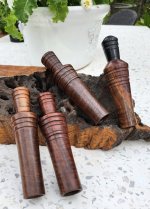
This call was inspired by a Monty Montgomery call I have (it is in the 2nd photo). It was from a cool piece of Jamaican Dogwood someone gave me a long while back - a bit slimmer of a block than I normally use, so my traditional shape would have been tough, but I wanted to turn it and as it went from square to round the Montgomery call came to mind. The checkering is skip-line, so not as tight and without pyramid points.

20230704_105110.jpg

IMG_20230610_115205.jpg
 
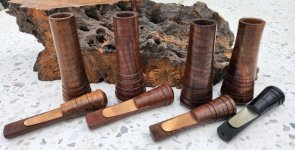
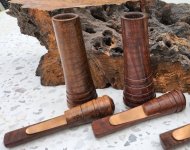
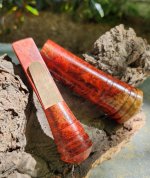
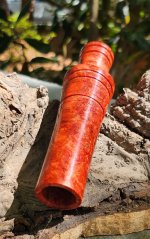
This Fanning-inspired Reelfot call is from one of my favorite chunks of burl. It is some flaming box elder, which I got a good bit of from someone on Woodbarter.com who found a stand of FBE with lots of burl. I still have a good bit of this, and love seeing the colors and swirls every time I turn something from it. The downside to FBE is that the red fades over time (to brown), I think through oxidation. This piece was stabilized, and will hopefully retain its color for a long time. Magical stuff, highly recommend it if you get a chance at any.

The second call in the last picture is curly white ash, from some wood that was sent me by a really talented turkey call makers who wanted a duck call for his son. Also stabilized. Both were polished with tung oil (and very fine grit), then waxed.

IMG_20230411_154059.jpg

IMG_20230411_154001.jpg

IMG_20230411_153710.jpg

IMG_20230411_154601.jpg
 
All I can say is, if you need a place to store all those calls. I will send you an address. I guess in my younger age, I was so busy working trying to survive. Buy crap for the kids, pay bills, vacations. I should have learn more about making duck calls, building boats. I did start making foam decoys at age 63 but would not have done it if it wasn't for our favorite guy Steve. These calls and boat pictures and decoys. I should have found this website 40 years ago. What beautiful work there!!!!!
 
All I can say is, if you need a place to store all those calls. I will send you an address. I guess in my younger age, I was so busy working trying to survive. Buy crap for the kids, pay bills, vacations. I should have learn more about making duck calls, building boats. I did start making foam decoys at age 63 but would not have done it if it wasn't for our favorite guy Steve. These calls and boat pictures and decoys. I should have found this website 40 years ago. What beautiful work there!!!!!
Thanks John. It's never too late to learn to turn!
 
Back
Top