All Things Flocking

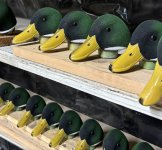
The first redhead is flocked and ready for airbrush, although it would hunt just fine like it is. I always paint the bills by hand with full strength rustoleum in gloss the appropriate color, in this instance it will be a slate blue to start and then airbrush, that will make the paint on the bill stronger. I can still paint gloss on the bill with a hazing technique that give it a more satin look. grandkids are coming today, so the craft room will be occupied with all sorts of fun stuff, so the redhead will be curing for a few days. I'm really liking the red flocking, I've never ventured too far from 3 colors of flocking in the past and with the selection of colors from Flocking Unlimited for waterfowl, it's time for a little more fun. I have some canvasbacks to do and they have a specific red for that which is a little browner I think the canvasback head might be a good candidate for a blended flocking by painting the forehead from the bottom of the bill at an angle past the front of the eye to the top of the head with black rustoleum, then blend it to red rustoleum the rest of the way and flock the whole thing with what they call bull canvasback red and see where that takes me.
IMG_5462.png
 
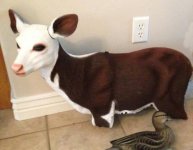
If I remember correctly I think the calf was going to be a predator calling decoy.

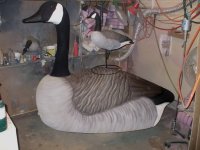
My dad shot some snow geese one time probably in the 40's by walking beside a horse drawn hay wagon into a field of snow geese. I never asked, but always wondered how the ride was in the wagon after the shots were fired, but knowing that neighbor decades later in his old age, I'm sure he was shooting too.

I made some whitetail doe decoys out of big sheets of cardboard about 40 years ago for me and my dad, they were just airbrushed. Both of us shot deer with our bows with those decoys. I let my neighbor with a farm across the road borrow it and he said it worked great for him too, however when the buck was wondering around the silhouette and got end ways he got really weird, kind of like where'd she go. Didn't know anything about flocking other than my dad would flock the scull plate on deer antlers to hang on the wall.
 
Flocking day, I flocked first coats on 16 of these this morning. Here is how I decide on the color for first coats. Whatever flocking I have the most of which is brown and whatever paint I have the most of, which is brown. In other words, it really doesn't matter, the first coat is mainly the layer that's going to help you get a thicker more durable layer after you put on the second coats. I did do a few mallard drakes grey, just because I been playing with some new flocking colors. The light grey mallards I think will be a better late season choice, it's the light feather grey from flocking unlimited and rustoleum smoke grey mixed with white, probably only 1/3 smoke grey. I'll still probably mess around with some of the combinations. I also got some dark feather grey and put it one the goldeneye for a base. I even did that dark grey over black on the back of the hen goldeneye on the January workbench thread.

Another thing I've started doing when I remember is to base coat the bills with full strength rustoleum in a color close like the orange hen mallard, let is dry a few days before flocking. That gives you a little stronger coverage on the bills and you don't have to be all that careful since you will flock up to the edge of the bill later.

IMG_5502.jpg
 
You sure keep yourself busy. I'm going to do a bit more flocking for next year. Those blacks and mallards I did last month are sucking them in. Next up, pintail and gadwall. That should be a challenge.:)
 
You sure keep yourself busy. I'm going to do a bit more flocking for next year. Those blacks and mallards I did last month are sucking them in. Next up, pintail and gadwall. That should be a challenge.:)
Im going to attempt a gadwall. There are tricks for the gadwall, gonna have to get good with paint pens if you want a good gadwall chest.... so I hear. Great post above by Don. Pintail are surprisingly more easy than I expected. Im going to make quite a few more pintail for myself as well.
 
here's a link to black and white oil based paint pens. https://www.amazon.com/dp/B0C81B9J4Z?ref_=ppx_hzsearch_conn_dt_b_fed_asin_title_2&th=1

I did a year of testing with paint pens on some wood duck decoys I put on my water feature. They went out on the last snow of winter and came back in the shop on the first freeze of fall. West side of the house should have dulled them down, but they held up great. Now I use them quite a bit of the decoys like the chest of a gadwall or vermiculation on a wood duck flank. White paint pens to enhance the white bars on wigeon tertials. They are a good tool in the bag if you are wanting to jazz up your paint job over flocking. Painting over flocking is difficult and things like paint pens can really help. this grouse was enhanced with both black and white paint pens. It's fully flocked and some of the areas are just too small to paint with a regular paint brush and flat white rustoleum. The paint pens work well on those types of details. Not sure why my friend wanted the grouse flock, he just likes the looks.

The pens are fairly inexpensive, but don't last a terrible long time, once I start using one it will only last a half dozen decoys or so. The flecking on the head of a wigeon, mallard hen, and black duck, are perfect for the paint pens, I use a brown one on the top of a head of a mallard hen. IMG_3619.png
 
here's a link to black and white oil based paint pens. https://www.amazon.com/dp/B0C81B9J4Z?ref_=ppx_hzsearch_conn_dt_b_fed_asin_title_2&th=1

I did a year of testing with paint pens on some wood duck decoys I put on my water feature. They went out on the last snow of winter and came back in the shop on the first freeze of fall. West side of the house should have dulled them down, but they held up great. Now I use them quite a bit of the decoys like the chest of a gadwall or vermiculation on a wood duck flank. White paint pens to enhance the white bars on wigeon tertials. They are a good tool in the bag if you are wanting to jazz up your paint job over flocking. Painting over flocking is difficult and things like paint pens can really help. this grouse was enhanced with both black and white paint pens. It's fully flocked and some of the areas are just too small to paint with a regular paint brush and flat white rustoleum. The paint pens work well on those types of details. Not sure why my friend wanted the grouse flock, he just likes the looks.

The pens are fairly inexpensive, but don't last a terrible long time, once I start using one it will only last a half dozen decoys or so. The flecking on the head of a wigeon, mallard hen, and black duck, are perfect for the paint pens, I use a brown one on the top of a head of a mallard hen. View attachment 72193
Thanks, I'll try pens. Thought about it a million times trying to paint the tiny feathers on a black duck head. Which flock color do you use on the body? It appears to be a shade of gray?
 
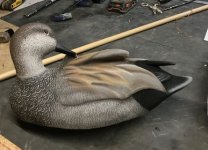
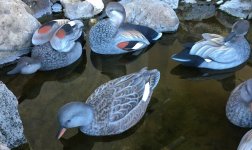
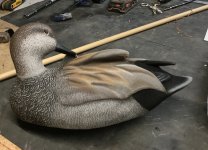
First, I'll go back and talk about the basic flocking colors for the gadwall. A gadwall doesn't have a lot of base color changes, the drake is mostly a medium grey paint and a medium grey flocking. With flocking unlimited, there are like 4 grey flocking colors, I've used them all at this point. The goose grey is a little warmer/browner than the feather grey that ranges from dark to light. I use goose grey for gadwall drakes over a smoke grey rustoleum that is mixed with about half white rustoleum. Then the rump area is black flocking over black. The rest of the color build up is airbrush and for black and white small detail it's hand painting with paint pens. Big areas like when the forewing in showing that need to be black, they need to be black flocking. Make sure your paint pens are oil based, there are a lot of acrylic paint pens that are great for children's projects in the house, but not for working decoys.


This is about the best picture I can find for paint pen use. Grey flocking as described above. You can recognize the paint pen use for the vermiculation and the head "flecking". The top of the grey head was airbrushed with gloss leather brown on top and gloss white through the cheek and neck. I did black "flecking" kind of sparingly , then brown flecking on the dark areas of the top of the head and back of the neck. Lastly white flecking to a lot of the cheek and neck and then some on the lower eyelid, and even rowed up some subtle lines above the eye and trailing back. On those, what I call scallops on the chest I start with the fat end of the paint pen until I get to where it begins to be vermiculation and switch to the fine end. Once that black pen work is over several hours later, I'll use the fine side of the white paint pen to give contrast to the chest feathers and clean them up a little.
IMG_3583.JPG

This photo shows and exposed forewing. The reddish copper is a section flocked brown over brown paint with orange and brown airbrush, the black is black flocking, the rest is just the grey. The white is of course hand painted with flat white rustoleum. You really can't airbrush white and make it white, I don't know how many passes you'd have to make to get it white. Also when you airbrush white, you can't just keep painting and hope it gets whiter, you have to stop, let it dry a bit and come back and do it again. Those white feather edges on the scapulars and tertials were a few passes with the airbrush, then an hour before doing a second pass and as you can tell they aren't as white as the speculum. The vermiculation and chest on this lifted wing bird is before i used paint pens, it was all done with an airbrush. You can see how much cleaner the paint pens worked on the one in the above picture.
401854366_889608459532418_2893822857943525539_n.jpg

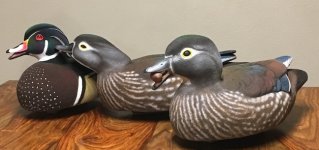
These wood ducks had extensive use of paint pens and hand painted white, it just makes them pop. I used paint pens to enhance the eyelids with some color. I probably have about 40 colors in my oil based paint pens and maybe use 10 of them, but they are inexpensive and make the whole process way easier. Learning to deal with flocking in a more realistic and artistic way was tough and there was no one to ask. I'm always looking for a better way. Who knows what we will learn in the next year. This past year has been a crazy learning experience hasn't it William. It's time to go level up.
IMG_3628.JPG
 
Thank you Don. I need to bookmark this post so I can find it in the spring when my shed warms up enough to work. I'm looking forward to flocking some gadwall, among other decoys.
 
Book marking is a good idea on some of these posts. It' hard to run posts down sometimes. Don't hesitate to ask in the future. On my facebook page it takes me about an hour to just scroll through all the information to find some of the tutorials people ask for. I used to make DVDs of my process for making decoys, painting, flocking and airbrush, but we are in a continual mode of upgrading, so about the time I get a video made the information is not the process I'm using. There are a few that have created youtube channels using our information and showing a process we aren't even using anymore. For William and I it's kind of a continuing education, both for us and those following. Who knows what we might figure out by spring when your shop warms up. William and I have been sharing information and innovation on everything decoy for quite a while now and the collaboration just seems to grow at a break neck speed. What I'm doing this week might be eliminated and upgraded by next week. We know that we are going way beyond what is necessary to kill a duck, but the basic intent is to make better, stronger, more realistic and effective decoys. The fancy stuff is just for fun. I continually get told you don't have to do all that detail to kill a duck and I know that, I just can't help it, I will keep trying to improve till I can make a duck quack.

Interestingly enough, I had a request to install a duck call in a decoy. I had a tube extend into the bottom up into the neck and open mouth of the mallard hen. The clear tubing connected to another clear hose all the way to the blind where the hunter would blow into the call through the hose. I'm guessing it didn't work great, I probably should just ask, but it's been well over a decade ago. I'm sure if it was a show stopper he would have told me. I can almost hear Williams brain spinning on this one. Onward and upward.
 
Book marking is a good idea on some of these posts. It' hard to run posts down sometimes. Don't hesitate to ask in the future. On my facebook page it takes me about an hour to just scroll through all the information to find some of the tutorials people ask for. I used to make DVDs of my process for making decoys, painting, flocking and airbrush, but we are in a continual mode of upgrading, so about the time I get a video made the information is not the process I'm using. There are a few that have created youtube channels using our information and showing a process we aren't even using anymore. For William and I it's kind of a continuing education, both for us and those following. Who knows what we might figure out by spring when your shop warms up. William and I have been sharing information and innovation on everything decoy for quite a while now and the collaboration just seems to grow at a break neck speed. What I'm doing this week might be eliminated and upgraded by next week. We know that we are going way beyond what is necessary to kill a duck, but the basic intent is to make better, stronger, more realistic and effective decoys. The fancy stuff is just for fun. I continually get told you don't have to do all that detail to kill a duck and I know that, I just can't help it, I will keep trying to improve till I can make a duck quack.

Interestingly enough, I had a request to install a duck call in a decoy. I had a tube extend into the bottom up into the neck and open mouth of the mallard hen. The clear tubing connected to another clear hose all the way to the blind where the hunter would blow into the call through the hose. I'm guessing it didn't work great, I probably should just ask, but it's been well over a decade ago. I'm sure if it was a show stopper he would have told me. I can almost hear Williams brain spinning on this one. Onward and upward.
Williams brain isnt going anywhere near that idea! I will say the open mouth, upright hen with a slight turn in the head, close to the bank where im calling has sure helped a bunch. Never call ducks when they are right over, but it seems to make them just a touch less weary when they look down and see ol nasally hen, mouth wide open. Ive tested it a few times, and Ive certainly been busted but im shocked how it has helped. When i made that pose this last summer, that was 100% the intent I had with that decoy. Close to me, mimicking a wiley little hen demanding attention from the birds over head. Its a little nutty to think about all the process changes and it seems its been forever ago when you were still doing things when I first met you... but its only been a year since I caught your attention and wondered if we could do things a bit differently. Its only been a year (almost to the date) when I requested my first non-flocked bird from you because my crazy brain was coming up with a wild idea to make my own from your crazy ability to carve up something so accurate.
 
Williams brain isnt going anywhere near that idea! I will say the open mouth, upright hen with a slight turn in the head, close to the bank where im calling has sure helped a bunch. Never call ducks when they are right over, but it seems to make them just a touch less weary when they look down and see ol nasally hen, mouth wide open. Ive tested it a few times, and Ive certainly been busted but im shocked how it has helped. When i made that pose this last summer, that was 100% the intent I had with that decoy. Close to me, mimicking a wiley little hen demanding attention from the birds over head. Its a little nutty to think about all the process changes and it seems its been forever ago when you were still doing things when I first met you... but its only been a year since I caught your attention and wondered if we could do things a bit differently. Its only been a year (almost to the date) when I requested my first non-flocked bird from you because my crazy brain was coming up with a wild idea to make my own from your crazy ability to carve up something so accurate.
Just imagine, though... build a working call into the duck with a mouthpiece just below the tailfeathers.
 
Back
Top