Copycat

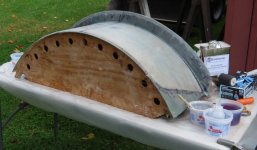
Well, I have the form in place and sent the specs to the epoxy supplier to get a materials estimate. They suggested that it maybe quite heavy. Their technician will get back to me on Monday with some options. Maybe fewer layers of glass and adding some ribbing to the interior. I've seen fibreglass canoes repaired by adding foam ribs and glassing over them. I'll provide an update when I hear back.View attachment 78784
Scott,
What about wood core to save weight and provide a form for fiberglass. Perhaps the same way a strip built canoe is built. Not to question you but just a thought.
RM

 
Scott~
I may have lost the thread here, but.....
I make my spray shields with 2 layers of 1708 with 2 mm Coremat in between.
sm 23 Spray Shield - layup complete.JPG
It is much smaller than your hard dodger, but:
1) It is plenty stiff
2) Compared with my canvas dodgers, it is stronger and not at all flexible.
3) My dodgers usually have a single frame (made from EMT).

Two-man Grassboat - SJS at speed - small.jpg
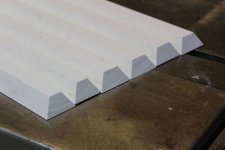
4) If you need more stiffness, I would add "ribs" inside - from either foam or PVC (half-inch) - milled on the table saw to a trapezoidal section.

sm 1 Balabus - intermediate floor frames.jpg

Hope this helps!

SJS
 
Steve

I like the Coremat idea. Laying up all those layers with my first hard dodger took hours. Coremat may save time and weight.

This thread popping back up is timely. A couple weeks ago I started eyeing my Black Brant next to my Broadbill and thought it too needs a dodger. Thomas rarely hunts with me from it anymore since he has his own boat and runs his own schedule. We hunt together but mostly when we are the the hunting property and in one of our blinds. I can now see my Black Brant being used as a one man boat and that lends itself to adding a dodger. Crap, I don't think I have time to squeeze another project in before the season starts!
 
Hi Steve. Funny that coremat came up in my searches. I see a version that cross hatches on one surface to allow it to conform to curves. I think that is a good solution. I will wait until I hear from the technician … he’s back on Monday. I suspect he will propose a similar solution

Thanks
Scott
 
I've been away for a while and have not made much headway. I mentioned that I contacted a local epoxy supplier where I get some of my supplies. I placed an order and the tech looked the order and thought it would be too heavy. This is what they suggested:

"What we would do is at least 1 layer of MAT 1.5oz / 1 layer of Sphere Core 1mm / 1 layer of MAT 1.5oz
This option would be easier to do with the form you have and would likely be less than your 1/4'' thickness and would be much lighter in weight".

I've asked them for a bit of information on the Sphere Core, I found a little info on the net. It seems it is very pliable and conforms to complex shapes. They made a little sample and included a picture of there 235 lb tech standing on it. I will update as I get more info.

PXL_20260824_155457384.jpg.png
 
Scott

Do you think it will bend to your form? If you can jump on this project I bet you will be the FIRST PERSON EVER to run a sneak boat with a hard dodger on Lake America.:ROFLMAO: Call Guinness!
 
I've been away for a while and have not made much headway. I mentioned that I contacted a local epoxy supplier where I get some of my supplies. I placed an order and the tech looked the order and thought it would be too heavy. This is what they suggested:

"What we would do is at least 1 layer of MAT 1.5oz / 1 layer of Sphere Core 1mm / 1 layer of MAT 1.5oz
This option would be easier to do with the form you have and would likely be less than your 1/4'' thickness and would be much lighter in weight".

I've asked them for a bit of information on the Sphere Core, I found a little info on the net. It seems it is very pliable and conforms to complex shapes. They made a little sample and included a picture of there 235 lb tech standing on it. I will update as I get more info.

View attachment 79072
Scott~

VERY interesting! I was at first surprised that they use only mat - no fabric with rovings in it - but then I remembered that MANY 'glass vessels have been built with just CSM (chopped strand mat) sprayed from a chopper gun. All I "know" about the method is that minimizing the resin is key to both strength and light weight.

I look forward to your success!

SJS
 
Scott

Do you think it will bend to your form? If you can jump on this project I bet you will be the FIRST PERSON EVER to run a sneak boat with a hard dodger on Lake America.:ROFLMAO: Call Guinness!
Eric~

I think you and I had the same misimpression. The yellow "board" upon which that little fellow is standing is the sample - the Sphere Core sheathed with mat both sides. It shows the rigidit that results from the sandwich (as I see on my spray shields).

From what I saw elsewhere on the web, Sphere Core is very similar to the CoreMat I get from US Composites. So, it's a "fabric" that drapes quite readily over most curved shapes.

All the best,

SJS
 
Just a quick update. Here are the instructions from the supplier. The material is drapable. You can overlap the sphere core and roll it out with a "bubble buster" aluminum roller. They are saying it works better with polyester resin than with epoxy. My form is corrugated plastic. I covered with polyethylene sheet for a release agent ask I did not want the resin to stick to the duck tape. They are checking to see if the polyester resin might react with the corrugated plastic - I think it will work either way as it is covered with poly and packing tape. The sphere core seems very cheap compared to coremat. They are quoting 5.21 CAD per meters of 1 mm core, and I need 3 meters. It's cheaper than the fibreglass mat that is 10.50 CAD/yard. Total quote is ~300 CAD. Follows are the instructions .


The following is a brief explanation of the procedure to create your part using the Sphere Core:
  1. Prepare the Sphere Core:
    Start by placing the Sphere Core over the mold/form. Make small cuts in the Sphere Core as needed so that it conforms to the round shape of the part. Once the desired shape is achieved, remove the Sphere Core from the part.
  2. First layer of mat:
    Pre-wet the mat with resin and apply it to the part in approximately 1 ft. x 1 ft. sections. Slightly overlap each piece of mat to ensure proper coverage and continuity between the sections.
  3. Apply the Sphere Core:
    Place the previously shaped Sphere Core over the pre-wetted mat.
  4. Wet out the Sphere Core:
    Thoroughly wet the Sphere Core with resin and carefully roll/debulk it to remove any air bubbles that may have formed. It is important to ensure that all air is properly removed.
  5. Second layer of mat:
    Repeat the same process with the mat, applying it in approximately 1 ft. x 1 ft. sections and slightly overlapping each piece.
  6. Finishing:
    Once the laminate has fully cured, the part can be sanded and finished as required. The gelcoat can then be applied.
  7. Demolding:
    Once the gelcoat has fully cured, the finished part can be removed from the mold.
This is a brief overview of the recommended technique and procedure.
 
Late to the party, but people use “go board” to make some boat parts. Believe they make it with cuts so it will curve. It’s pretty cheap at big box hardware and will take poly

Tony
 
Late to the party, but people use “go board” to make some boat parts. Believe they make it with cuts so it will curve. It’s pretty cheap at big box hardware and will take poly

Tony
Tony~

I was unfamiliar with this product....you've got me thinking! It is certainly be worth some experimentation for hatches and such.

All the best,

SJS
 
Back
Top