FWC Mottled Duck vs. Mallard

They tried that for a year or two in CT.....blacks vs mallard hybrids. My concern was shooting what appears to be a black, then oops! mallard. If it's a hen, and you already have two hen mallards, or four mallards total, that's bad juju. I wrote an email to the head state biologist, his response was first to blow me off, when I was persistant he wrote back that the wardens would use common sense. Riiiiggghttt.

Now they flipped 180, most hybrids count as a black. Not as bad, but still leaves room for honest mistakes and subjective disagreement at the launch. For that reason I continue to think obvious hybrids should count as "other".
 
Delaware just lists bag limits and no details.


The daily limit of 6 ducks (excluding mergansers and coots) may include, in any combination, up to: 4 mallards (2 hens); 2 black ducks; 3 pintail; 2 canvasback, 3 wood ducks; 2 redheads; 1 scaup, 6 teal; 6 shovelers; 6 gadwall; 6 wigeon; 6 goldeneye; 6 ring-necked ducks; 6 bufflehead; 6 ruddy ducks; 1 mottled duck; 1 fulvous whistling-duck; 4 total sea ducks (no more than 3 scoters; 3 eiders (1 hen); 3 long-tailed ducks). The possession limit is 3 times the daily limit
 
They tried that for a year or two in CT.....blacks vs mallard hybrids. My concern was shooting what appears to be a black, then oops! mallard. If it's a hen, and you already have two hen mallards, or four mallards total, that's bad juju. I wrote an email to the head state biologist, his response was first to blow me off, when I was persistant he wrote back that the wardens would use common sense. Riiiiggghttt.

Now they flipped 180, most hybrids count as a black. Not as bad, but still leaves room for honest mistakes and subjective disagreement at the launch. For that reason I continue to think obvious hybrids should count as "other".

With the black/mallard debate, I find black ducks are just a whole lot darker. Any sort of hybrid I've seen, as you said, is typically a black duck. I've seen more black ducks with what looks to be a recessive mallard gene, than mallards with a recessive black duck gene. If that is the proper terminology...

They also did a genetic study. A very low percentage of suspected hybrid black/mallard ducks actually were in fact, hybrid. They were mostly 100% black ducks based on the genetic sample. The two outward factors that led them to sampling were the white bars or tips on the speculum and some green in the head. Even WITH the green in the head, they found they were still 100% black duck.

I remember when I first got into waterfowl, I couldn't begin to imagine how you would tell the difference between a hen mallard and black duck. After a year or two, I realized black ducks are in fact very "black" in color. Seeing them against the sun or even on the water on an overcast day, they cast quite the silhouette.

To your point, and probably the same for mottled ducks, they are always going to give you less ducks than more. Being in the eastern flyway/NJ, they are almost always going to notch your black duck or hen mallard limit vs anything else.

 
Delaware just lists bag limits and no details.


The daily limit of 6 ducks (excluding mergansers and coots) may include, in any combination, up to: 4 mallards (2 hens); 2 black ducks; 3 pintail; 2 canvasback, 3 wood ducks; 2 redheads; 1 scaup, 6 teal; 6 shovelers; 6 gadwall; 6 wigeon; 6 goldeneye; 6 ring-necked ducks; 6 bufflehead; 6 ruddy ducks; 1 mottled duck; 1 fulvous whistling-duck; 4 total sea ducks (no more than 3 scoters; 3 eiders (1 hen); 3 long-tailed ducks). The possession limit is 3 times the daily limit

If in reference to mottled ducks, they rarely are ever seen north of SC.
 
This is some of the best clearest guidance I have seen out of any DNR on hybrids & bag limits, which I know from conversations on this site is a problem with black & mallard hybrids in the northeast.
Do other states have similar guidance on black ducks vs mallards?
Is it this clear?

https://myfwc.com/media/zqifltox/mottled-mallard-hybrid-field-guide.pdfView attachment 71175View attachment 71176View attachment 71177View attachment 71178
Carl et al~

Of course, I cannot let this go....

No such thing as "a central tail feather"..... All feathers come in pairs. The central tail feathers are a pair, port and starboard.

I am curious with respect to management implications. Any idea how common hybrids are in the wild population?

BTW: New York counts Mallard X Black hybrids as a "duck" - one of the 6 one can take each day.

All the best,

SJS
 
Mottled duck hybrids can be very common in parts of Florida. Which is why they finally had to issue guidance.
All the mottled ducks I killed in Alabama looked like pure mottled ducks.
 
With the black/mallard debate, I find black ducks are just a whole lot darker. Any sort of hybrid I've seen, as you said, is typically a black duck. I've seen more black ducks with what looks to be a recessive mallard gene, than mallards with a recessive black duck gene. If that is the proper terminology...

They also did a genetic study. A very low percentage of suspected hybrid black/mallard ducks actually were in fact, hybrid. They were mostly 100% black ducks based on the genetic sample. The two outward factors that led them to sampling were the white bars or tips on the speculum and some green in the head. Even WITH the green in the head, they found they were still 100% black duck.

I remember when I first got into waterfowl, I couldn't begin to imagine how you would tell the difference between a hen mallard and black duck. After a year or two, I realized black ducks are in fact very "black" in color. Seeing them against the sun or even on the water on an overcast day, they cast quite the silhouette.

To your point, and probably the same for mottled ducks, they are always going to give you less ducks than more. Being in the eastern flyway/NJ, they are almost always going to notch your black duck or hen mallard limit vs anything else.
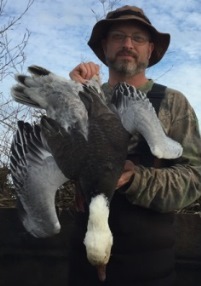
I have always questioned the idea that hybrid black/mallard ducks were a real issue. I am not surprised to learn the genetic info you mention. There was never any clear guidance as I recall here in NJ. And you collectors of old black duck decoys know there was often a thin white line painted under the speculum.

I didn't realize mottled ducks were having this issue. It's good to straighten this out, there are enough duck hunting regulations already.

I lived in South Florida back in the early 80's and hunted at Loxahatchee outside of West Palm and at Lake Okeechobee(would rent a boat at Uncle Joe's Fish Camp!), and got a few mottled ducks back then. A very handsome bird.
 
Carl et al~

Of course, I cannot let this go....

No such thing as "a central tail feather"..... All feathers come in pairs. The central tail feathers are a pair, port and starboard.

I am curious with respect to management implications. Any idea how common hybrids are in the wild population?

BTW: New York counts Mallard X Black hybrids as a "duck" - one of the 6 one can take each day.

All the best,

SJS
Steve, My recollection is that mallards are considered unwelcome in Florida mottled duck country. They were/are swamping the mottled duck genetics. Florida has been trying to reduce the number of mallards breeding in mottled duck areas. Like you, I've been away from this subject for a number of years so my insight might be outdated.
 
I have always questioned the idea that hybrid black/mallard ducks were a real issue. I am not surprised to learn the genetic info you mention. There was never any clear guidance as I recall here in NJ. And you collectors of old black duck decoys know there was often a thin white line painted under the speculum.

I didn't realize mottled ducks were having this issue. It's good to straighten this out, there are enough duck hunting regulations already.

I lived in South Florida back in the early 80's and hunted at Loxahatchee outside of West Palm and at Lake Okeechobee(would rent a boat at Uncle Joe's Fish Camp!), and got a few mottled ducks back then. A very handsome bird.
Greg~

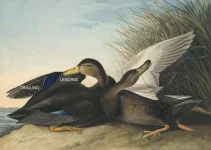
Audubon saw that thin white line, too....(early 1800s).

Audubon Black Duck with TEXT.webp

All the best,

SJS
 
In coastal Alabama, mottled ducks were very wary and would not show up in parks and urban storm water ponds. After the first two weeks of the season we rarely saw them

Here in Tampa, they are all over urban areas. I’ve seen them walking across McDonalds parking lots going from one storm water ponds to another. And mixing with feral mallards on the ponds. There is definitely an issue with cross breeding in urban areas.
 
This is a photo from a Mottled taken this past weekend. Biologist stated there were varying sizes of white lines below, but you should never see a white line above.

The Biologist took a wing, leg and the entire bill for genetic testing. He chuckled when I asked for a bill in return, like a $5, $10 or $20 bill.
 

Attachments

  • IMG_0258.jpeg
    IMG_0258.jpeg
    435.9 KB · Views: 5
I have not spent a lot of time on the Black Duck/Mallard/Hybrid issue. As Jay K. mention there has been a lot of genetic work done on this group (mottled ducks too), and not all is as it seems. I've not followed at the recent work, but I think they are starting to untangle their gentics. A lot of this work has been lead by Phil Lavretsky's lab at UTEP. I've just skimmed the papers as they are a little heavy reading .. what I understand is surprising. Despite high rates of hybridization, gene flow between mallards and black ducks is limited, and mallards and black ducks continue to maintain genetic separation, (Lavretsky et. al 2019a). In Eastern North America there are 2 flavours of mallards: domestic and wild mallards. Lavretsky argues that the release of game farm mallards maybe having detrimental affects on wild North American mallards.

In another paper by Lavretsky real got me thinking about maintaining separate bags for black and mallards. In this paper, Lavretsky concludes:

"Based on ADMIXTURE analyses, we determined that at least ~20% of all phenotypically identified mallards and black ducks were incorrect and possessed hybrid ancestry. Furthermore, only ~60% of phenotypically identified hybrids were true hybrids with ~12% and ~25% of remaining samples being actually “pure” mallards or black ducks, respectively" (Lavretsky et al 2019b)

What this says is 20% of birds that look like mallards or black ducks are actually hybrids, 12% of birds that look like hybrids are actually mallards, and 25% of those hybrid like ducks are actually pure black ducks. At one point I started following this work as it had implications for maintaining separate bags for blacks -- but we removed all the bag restrictions on black ducks in Canada and it became a non-issue. If I were a hunter in the USA where there are still bag restrictions on blacks I'd be asking the federal government to review the current state of knowledge and at least standardize the characteristics that hunters can use to identify what looks like a black duck, mallard and hybrid.
 
Back
Top