The short answer is yes, with 2 caveats. First, if you enjoy it, you'll want to move onto something else sooner than later and be out the couple hundred bucks tou spend. The second is that a cheap lathe will end up being a fraction of what you'll need to spend to enjoy it - and then will have flaws and weaknesses that make it less enjoyable, so you'll end up with a few hundred dollars of stuff you don't use much. On the low end, and even some mid-range, lathes, you'll get cheap tool rests that ding easily, beds that need to be flattened, banjos and tail rests that don't fit quite right, and you might have some alignment (tramming) issues. All these can be frustrating for first-timers trying to get started.
So you can build a realistic budget to determine if you want to give it a go, here's a list of things I'd say are minimum to get started (and a few recommendations):
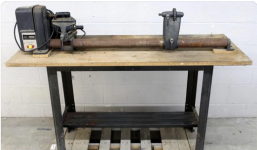
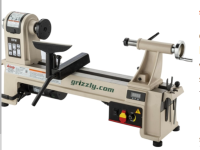
Lathe - I wouldn't buy smaller than a 12" swing lathe - smaller than that you're going to be limited to pens, wine stoppers, and duck calls. If you enjoy turning, you'll want to do more - small bowls, pepper mills, etc. are doable on a 12" lathe. I think the Jet 12x21 variable speed is probably the best value, but you're looking at close to $1k. Jet does make a similar 10x15, but again, there is a good chance you'll want more capacity. Nova makes a 12x16 that is affordable and a pretty good lathe - but Teknatool has had some financial problems and there always seems to be a worry abiut them being around. I have a larger Nova DVR and really like it (it replaced my first lathe, an old Jet 12xsomething variable speed (by shifting belts across pulleys). Rikon used to be recommended, but they've had some real quality issues in recent years. Grizzly can be really good or really bad.
Tools - Carbide tools (like Easy Wood Tools, though there are cheaper knock-offs) are easy to learn and I think have their place (I have and use several), but I honestly believe you'll enjoy turning much more with traditional tools - and learning proper technique with traditional tools yields better results with less sanding. A major advantage to carbide is that the tips are disposable so you don't need a grinder for sharpening. In traditional tools, I'd recommend a small bowl gouge, a small spindle gouge, a rouging gouge, and a parting tool as a minimum to get started. For calls and pens, you'd be turning spindles, but a bowl gouge is quite useful on spindles, in my opinion. If you went with a few carbide tool, you'd still want a roughing gouge and parting tool. High speed steel is definitely preferable for traditional tools - they keep an edge longer. HF does sell HSS tools, but I've found them to be not great. On the inexpensive end, I'd go with Benjamins Best tools - but really nice, well made, quality HSS steel tools (D-way is an example, there are a number of really good small mfrs) are so much nicer to work with - but they'll come with a steep price tag and I wouldn't start there. I've added a few over many years.
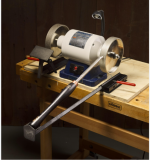
A low speed (1800 rpm) 8" grinder. In theory, a grinder should be a grinder, but to work well you want weight and good balance - both can be a problem with cheap grinders. You can solve weight by making a heavy stand or bolting down to something substantial, and OneWay makes some balancing weights (similar concept to tire/wheel balancing), but by the time you do all this you might as well get a decent grinder. Your best bet may be to keep an eye open for an old Baldor, but Woodturners Wonders usually has decent prices on decent grinders. Initially, standard wheels are perfectly fine - but you'll also need a dressing tool to keep them flat (they wear with use). If you get into turning, CBN wheels become worthwhile (don't need flattening or much if any maintenance, aren't at risk of fracturing, last for many years, sharpen quicker, are cooler), but they are expensive.
Work holding devices - at a bare minimum you'd need a drive center and a live center, and for calls a chuck or two. A Jacob's chuck for drilling from the tailstock and some mandrels and/or collet chucks become desirable after your first few calls, though you can make due by making some from wood. If, after reading all this, you remain interested, pm me your address and I'll send you an old book I bought many years ago on call making to read through - it has good ideas on minimalist approach.
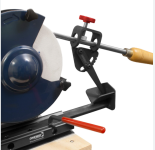
Personally, starting out, I'd also highly recommend a sharpening system for the grinder. The learning curve on sharpening tools is not insignificant and tools are not cheap, and a good system can make this much simpler and quicker. Wolverine is the old standard and quite good, but I'd lean towards the newer Kodiak system as it is more foolproof and repeatable. Kodiak's flat rest is much preferable. Woodturners Wonders carries these, and sells grinder/Kodiak combinations to make setup easy and accurate.
I'd also tell you not to go down this road without a good dust collection system - and these aren't cheap, either. Turning is messy, but mainly lots of big chips and ribbons... but when sanding and finishing you really need to protect yourself. Having said that, when I got started I positioned my lathe in the open door of my garage and had a big old fan behind me blowing out. A you can imagine, I didn't do much turning in the dead of winter or mid-summer.
What I'm getting at is that even trying to start small, you can easily spend well over $1,500.
Having said that, there is a better way, and what I always recommend to folks who ask me about getting started is rather than buying anything, they find the closest woodturning club (start your search at AAW - American Association of Woodturners) and join. Most offer beginning woodturning courses once or twice a year for fairly low cost. Ours is a 6 week course - 3-4 hours one night each week - each week is a different project: basics, candlesticks, plates, bowls, boxes, sharpening. It might cost a couple hundred dollars. Even if you had to drive an hour each way, I'd do it. 6 weeks of turning on decent equipment with decent tools and getting coaching from experienced turners will be enough for you to decide if you like it before making any other investment, you'll be much more skilled much more quickly, and you'll have a much better idea of what you need (and what you don't need). Maybe more importantly, you'll get networked into a community that can help you find good, used equipment and tools and save a lot of money. It is not uncommon as turners age for them to want to pass along their stuff in package deals to newer turners - and clubs themselves often sell older stuff as they upgrade. As an example, our club is in the process of replacing our Jet and Rikon 12" lathes, and we just sold 5 of them for a few hundred each to some new members to help them get started (and our more seasoned guys gave them a good refurb and helped them get set up). I can promise you this will be the cheapest and most enjoyable way to learn to turn, and you'll meet some good folks along the way.