New boat building experience

SJ Fairbank

Well-known member
Supporter
Pretty sure I've lost my mind. An order from US Composites just arrived, rolls of cloth, chopped strand mat, 10 gallons of polyester resin, mold release wax, pigment and other odds and ends. I always told myself I'd try making all glass boats using one of mine as a plug, but was afraid I'd just make a mess. Nothing says commitment more than the aforementioned pile of supplies.

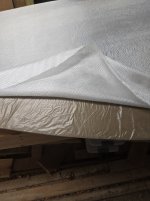
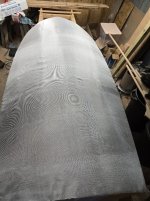
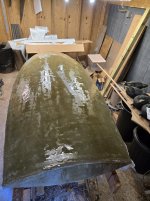
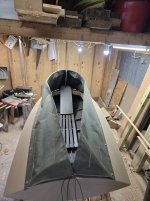
Last year I built this little pond box. It appears to my eye to be pretty simple to copy in fiberglass, maybe I'm wrong? Guess I'll find out. 20251107_104104.jpg

20251101_163322.jpg


20260115_140708.jpg

It's just 9', which I think should make it a little more manageable to mold than a larger craft. It was a great success as a comfortable hide in a spartina patens marsh, as you can see in the third photo. All of the hardware has already been removed in anticipation of this adventure.

My plan is to attempt to use the original as the mold, similar to what someone posted years ago while making a scull boat out of foam insulation, then making the final boat directly on the original. It's the mad scientist in me. :) Worst case (assuming I do the waxing correctly and don't have an adhesion problem) I'll revert to the tried and true method of making a female mold. My suspicion is that the deck coaming will be the biggest challenge, I may leave it out and install wood to finish. My goal is to pop a bottom off this weekend.

Of course, how to join the top and bottom hulls is a question. I want to preserve the feather edge. I'm pretty sure that the glass can be trimmed carefully before removing from the "mold", then the edges sanded parallel to the waterline to make a good mating surface. No doubt there will be lots of trial and error, swearing, beer and likely Scotch. Then a fillet of thickened epoxy all around the inside, and possibly another layer of tape or glass on the outside. I guess it will be a learning experience.
 
SJ,
Wonderful idea and one that I have always wanted to try myself. The scull boat post also piqued my curiosity. Depending on your success I may try the same on my stripper canoe build. The last time I checked it was 3-4 thousand for an ultralight kevlar or carbon fiber canoe.
RM
 
SJ,
Wonderful idea and one that I have always wanted to try myself. The scull boat post also piqued my curiosity. Depending on your success I may try the same on my stripper canoe build. The last time I checked it was 3-4 thousand for an ultralight kevlar or carbon fiber canoe.
RM
Thank you, I'm looking forward to doing this. I have a couple of ideas to test, that might make it easier. Hopefully I dont get hung up with something else this weekend, like fishing or shooting.
 
Really looking forward to following along - and for the WB discount when you go into production!
With luck I'll have photos in a day or two. In all honesty, I'd like to make four. A couple for here, a couple for up north for me and my guests. It doesn't sound like much in discussion, but I'm sure it'll be far more work to build one than I anticipate. I'll probably complete one and swear to never make another.
 
Pretty sure I've lost my mind. An order from US Composites just arrived, rolls of cloth, chopped strand mat, 10 gallons of polyester resin, mold release wax, pigment and other odds and ends. I always told myself I'd try making all glass boats using one of mine as a plug, but was afraid I'd just make a mess. Nothing says commitment more than the aforementioned pile of supplies.

Last year I built this little pond box. It appears to my eye to be pretty simple to copy in fiberglass, maybe I'm wrong? Guess I'll find out. View attachment 76962

View attachment 76963


View attachment 76964

It's just 9', which I think should make it a little more manageable to mold than a larger craft. It was a great success as a comfortable hide in a spartina patens marsh, as you can see in the third photo. All of the hardware has already been removed in anticipation of this adventure.

My plan is to attempt to use the original as the mold, similar to what someone posted years ago while making a scull boat out of foam insulation, then making the final boat directly on the original. It's the mad scientist in me. :) Worst case (assuming I do the waxing correctly and don't have an adhesion problem) I'll revert to the tried and true method of making a female mold. My suspicion is that the deck coaming will be the biggest challenge, I may leave it out and install wood to finish. My goal is to pop a bottom off this weekend.

Of course, how to join the top and bottom hulls is a question. I want to preserve the feather edge. I'm pretty sure that the glass can be trimmed carefully before removing from the "mold", then the edges sanded parallel to the waterline to make a good mating surface. No doubt there will be lots of trial and error, swearing, beer and likely Scotch. Then a fillet of thickened epoxy all around the inside, and possibly another layer of tape or glass on the outside. I guess it will be a learning experience.

SJ~

I have molded several vessels with the "male mold" method. The "hoping it will actually release when planned" gets the blood pressure up and running. Even when just molding spray shields and such, I usually employ the belt 'n' suspenders approach: Several coats of mold release wax followed by a skin of Partall film.

sm 20 Spray Shield - Partall wax and film.JPG

Finally, it is critically important to keep one's fingers crossed throughout the whole process - then hold your breath during the initial prying and popping....

All the best,

SJS
 
I really like that little boat, hides great. Can't wait to watch hour progress. If I can rebuild the deck on my AA Blackjack with no carpentry experience or skills and learn to do the glassing without a major disaster, you can surely build this boat in fiberglass.
 
SJ~

I have molded several vessels with the "male mold" method. The "hoping it will actually release when planned" gets the blood pressure up and running. Even when just molding spray shields and such, I usually employ the belt 'n' suspenders approach: Several coats of mold release wax followed by a skin of Partall film.

View attachment 76972

Finally, it is critically important to keep one's fingers crossed throughout the whole process - then hold your breath during the initial prying and popping....

All the best,

SJS
I applied several coats of Partall #2 tonight. I forgot the PVA when I ordered. I do have a plan however. ...the dreaded .3mm plastic drop cloth over the wax. I recall you saying you've tried it, and that it bubbled. I've cast small parts using plastic sheeting and suffered the resulting spiderwebbing but was able to sand it out. There will be no gel coat and I plan to add some glass to the interior anyway, so I'm going to roll the dice. At least once anyway. If it fails, I'll get a gallon of PVA.
 
I applied several coats of Partall #2 tonight. I forgot the PVA when I ordered. I do have a plan however. ...the dreaded .3mm plastic drop cloth over the wax. I recall you saying you've tried it, and that it bubbled. I've cast small parts using plastic sheeting and suffered the resulting spiderwebbing but was able to sand it out. There will be no gel coat and I plan to add some glass to the interior anyway, so I'm going to roll the dice. At least once anyway. If it fails, I'll get a gallon of PVA.
I have never heard of Partall so I will definitely investigate that thoroughly. For small projects I have had great success with a product my wife uses in the kitchen that is similar to saranwrap called Glad Press and Seal.
RM
 
I applied several coats of Partall #2 tonight. I forgot the PVA when I ordered. I do have a plan however. ...the dreaded .3mm plastic drop cloth over the wax. I recall you saying you've tried it, and that it bubbled. I've cast small parts using plastic sheeting and suffered the resulting spiderwebbing but was able to sand it out. There will be no gel coat and I plan to add some glass to the interior anyway, so I'm going to roll the dice. At least once anyway. If it fails, I'll get a gallon of PVA.
SJ~

Waxed paper works - but can be a job to remove. Cellophane has been the standard - but can be hard to find in sheets.

All the best,

SJS
 
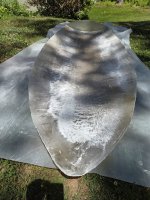
Made great progress. The hull bottom will be removed later today. My friend and I lifted it off yesterday, but decided it needed more glass before final removal. The 0.3mm sheet plastic allows it to pop right off. There is spidering on the inside from the plastic, assuming the plastic doesn't adhere that will be covered with a layer of glass when it gets flipped. On to the top, the ambitious plan is to remove it tonight.

20260620_082903.jpg
The above photo shows the plastic on the boat before the first lamination. Just like planking a complex curve boat, no way the plastic will lay perfectly flat.


20260620_082922.jpg


20260621_063354.jpg

This hull has a total of 5 layers of cloth, one CSM. Next one will be 2 cloth, 2 CSM. It required 2.5 gallons of resin for the bottom and transom, cast as one piece. The transom will get additional interior reinforcement, but is not intended for a motor of any kind. There will be lots of trimming and fitting to get the top and bottom to mate. Still, a heck of a lot less time and effort than building one from wood.
 
SJ~

Great work - AND I have my fingers crossed for you!

That wrinkling in the thin polyethyene is what I got when I learned the hard way many vessels ago.... I had probably used 6 mil at the time so the wrinkles were much more pronounced.

Thoughts re layup: I probably would have tried 1708 (mat side up) with 7.5-ounce twill cloth on the exterior. I usually also add a layer of 2 mm Coremat in between for added stiffness. This is the layup I use for my spray shields - which are probably overbuilt but I think would serve well for a canoe or pond box.

I use a fiberglass/detail roller to ensure full saturation and no bubbles - then remove as much excess resin as I can with a fairly dry foam roller. I roll my final coat on with a foam roller at the green stage.

All the best,

SJS
 
I got sidetracked watching golf, so no top today. The bottom is rough trimmed, I'll wait till I have a top to mate it with to trim it further.

20260621_131251.jpg

This photo shows the wrinkles caused by the plastic. I don't view it as a big deal since I always intended to glass the interior anyway to avoid "growing" the boat. The boat gets larger with each exterior layer when you build from a male mold. The plastic did it's job, there was no resin on the boat, it came free easily when the hull was removed, and didn't adhere to the resin at all. Easy Peasy.

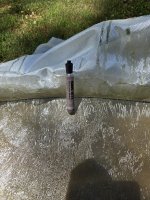
It was simple to mark the chine line with a magic marker, then cut it with a grinder. The actual chine is at the bottom of the magic marker line, rather than top as your intuition suggests. Total time, about 15 minutes. The cut is intended to be parallel with the waterline to allow the two clamshell hull halves to mate. Except for a couple of whoopsies, I left it a touch proud to be sanded later. Sanding will smooth it when fitting the two hull halves together, which will be joined by a thickened resin fillet inside and a layer of tape outside.

20260621_132310.jpg


20260621_133548.jpg

So far the build has been really easy. I suspect the deck coaming will be a challenge, and as mentioned earlier I'm going to make a game time call whether to cast the coaming or build it out of wood.
 
Hallelujah!

Another thought from my (bottomless) Unsolicited Advice files....

As you no doubt know, 'glass hulls can deform anytime over their lifetimes - but especially so in their tender youth. I would build a cradle with probably just 2 cross-pieces - scribed to the hull cross-sections (you may have something from your original build) to retain the shape and symmetry of the hull. Carpet scraps or pool noodles can cushion the potential hard spots.

Steady on!

SJS
 
Pretty sure I've lost my mind. An order from US Composites just arrived, rolls of cloth, chopped strand mat, 10 gallons of polyester resin, mold release wax, pigment and other odds and ends. I always told myself I'd try making all glass boats using one of mine as a plug, but was afraid I'd just make a mess. Nothing says commitment more than the aforementioned pile of supplies.

Last year I built this little pond box. It appears to my eye to be pretty simple to copy in fiberglass, maybe I'm wrong? Guess I'll find out. View attachment 76962

View attachment 76963


View attachment 76964

It's just 9', which I think should make it a little more manageable to mold than a larger craft. It was a great success as a comfortable hide in a spartina patens marsh, as you can see in the third photo. All of the hardware has already been removed in anticipation of this adventure.

My plan is to attempt to use the original as the mold, similar to what someone posted years ago while making a scull boat out of foam insulation, then making the final boat directly on the original. It's the mad scientist in me. :) Worst case (assuming I do the waxing correctly and don't have an adhesion problem) I'll revert to the tried and true method of making a female mold. My suspicion is that the deck coaming will be the biggest challenge, I may leave it out and install wood to finish. My goal is to pop a bottom off this weekend.

Of course, how to join the top and bottom hulls is a question. I want to preserve the feather edge. I'm pretty sure that the glass can be trimmed carefully before removing from the "mold", then the edges sanded parallel to the waterline to make a good mating surface. No doubt there will be lots of trial and error, swearing, beer and likely Scotch. Then a fillet of thickened epoxy all around the inside, and possibly another layer of tape or glass on the outside. I guess it will be a learning experience.
Nice looks like a fun time. I don't remember the name of what the materials called. I guess it's mold release. Brush on three or four coats. It starts out purple then dries clear. It's a lifesaver. Then you can even wax on top of that if you want.
 
Hallelujah!

Another thought from my (bottomless) Unsolicited Advice files....

As you no doubt know, 'glass hulls can deform anytime over their lifetimes - but especially so in their tender youth. I would build a cradle with probably just 2 cross-pieces - scribed to the hull cross-sections (you may have something from your original build) to retain the shape and symmetry of the hull. Carpet scraps or pool noodles can cushion the potential hard spots.

Steady on!

SJS
I just put it back on the hull to cure when I saw your post. Unquestionably, it would warp left unsupported for a few days while green.
 
Nice looks like a fun time. I don't remember the name of what the materials called. I guess it's mold release. Brush on three or four coats. It starts out purple then dries clear. It's a lifesaver. Then you can even wax on top of that if you want.
Yes, PVA mold release is it. I forgot it when I ordered the glass supplies. My big complaint about US Composites is that the ordering system is stone age cumbersome. Been that way for years. My plan was to try the sheet plastic on a male mold anyway, so it worked out fine. So far I'm really encouraged by how easy progress has been, although there are more layers of glass required than I anticipated in order to stiffen the hull.
 
Back
Top