
Question For Dave McCann and Any Other Machinist

Eric Patterson

Administrator
Staff member
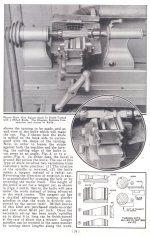
I want to duplicate the pictured set-up on my lathe or come up with something similar. Right now I'm lacking the milled-to-pattern cutter but have a vendor who can supply them. I have the cross slide to mount the cutter to. I don't have the tool holding device nor have I done a lot of metal lathe set-up and could use some help in this arena.

Looking at the tool holding device it appears to utilize the cross slide's t-slot that runs left to right and has a bolt to clamp the cutter in place. The "lugs", for lack of a better term, have a bevel that I assume applies downward pressure to jam the cutter flush on the cross slide's face preventing it from moving. Other than that I'm not real sure. It looks like each lug is attached to its own bar stock that rides in the T-slot and are drawn together with a bolt. I.e. separate left side and right side with a bolt that pulls it all together. I'm not sure how the lugs are attached to the bar stock. Maybe they are milled from a single piece.

Any thoughts on this, or other ideas on how to attach the milled-to-pattern cutter to the cross slide? Maybe the simplest and easiest means is to counterbore the cutter and use a bolt and T-nut to lock it in place.

Thanks.
MilledKnife2.jpg
 
Eric,
I looked at your lathe carriage in last months workbench...
If your top slide with the T slot and micro adjustment is removable and still lets the cross feed function fine , would it be possible to have a tapered (IE the Lugs) bracket, say 6" to 8" long, made that would "clamp" to the top of the cross feed and have it drilled, tapped and doweled to fit a longer milled knife. The "bracket" could hang over the front of the cross feed with dowels protruding below the surface to prevent the bracket from pushing back and being longer the bracket would accommodate more stability and the dowels would lock the milled knife square to the work. I'd have concerns about using the T slot on the compound to hold a milled knife in case something would "grab'. I'm sure Dave can draw a picture...
George
 
I want to duplicate the pictured set-up on my lathe or come up with something similar. Right now I'm lacking the milled-to-pattern cutter but have a vendor who can supply them. I have the cross slide to mount the cutter to. I don't have the tool holding device nor have I done a lot of metal lathe set-up and could use some help in this arena.

Looking at the tool holding device it appears to utilize the cross slide's t-slot that runs left to right and has a bolt to clamp the cutter in place. The "lugs", for lack of a better term, have a bevel that I assume applies downward pressure to jam the cutter flush on the cross slide's face preventing it from moving. Other than that I'm not real sure. It looks like each lug is attached to its own bar stock that rides in the T-slot and are drawn together with a bolt. I.e. separate left side and right side with a bolt that pulls it all together. I'm not sure how the lugs are attached to the bar stock. Maybe they are milled from a single piece.

Any thoughts on this, or other ideas on how to attach the milled-to-pattern cutter to the cross slide? Maybe the simplest and easiest means is to counterbore the cutter and use a bolt and T-nut to lock it in place.

Thanks.

View attachment 72216
Eric,
Do you have an OAL in mind for the profile to be cut?
 
George

Actually, I'm not using my patternmakers lathe for this. I have the same cross slide pictured and intend to mount it on the backside of the lathe in order to eliminate the need to reverse the lathe. I think I have figured out the clamp used int he above picture and intend to make a wood version to carry to a local machine shop to have one made from steel.

I have hit a snag though. The business that indicated they could make the milled-to-pattern cutter emailed me and said they recently sold their machine that made such knives and didn't think they could help. I'm looking for another shop to do the work. Been down this road before and typically run into businesses that only cater to large industry and government contracts.

Brian

The knife needs to be about 3 1/2" wide and shape an object with radiuses from 1 1/2" to 5/8".

Richard

Yes. The picture is from an old Delta publication. You can find that cross slide on ebay for about $400.
 
I think I have figured out the clamp used int he above picture and intend to make a wood version to carry to a local machine shop to have one made from steel.
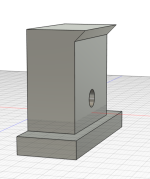
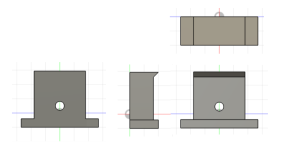
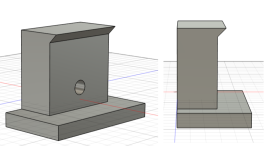
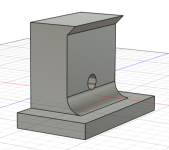
Quick sketch, no scale, no dimensions.
Machined from solid block of steel.
1768240481423.png1768243167878.png
Base of the clamping lugs, could be extended as shown to increase the surface area within the cross slide. Limiting factor is width of the profile cutter blade.
1768243510671.png

Fillet allowed on one inside corner to increase strength. (optional)

1768243941593.png
 
Last edited:
Eric,

I zoomed in on the photo and it appears the swivel slide is rotated 180 degrees and there were two studs inserted into either side of the top slide. I think the beveled clamps are t shaped to aid in alignment with the side and top of the top slide casting. I am basing my guess on the location of the stud. It appears that the bars would have interference with the stud. There is a stop installed on the rear of the casting to adjust for the milled cutter depth.

Quick sketch of beveled clamp


Rick Lathrop


MilledToPattern.jpg
 
George

Actually, I'm not using my patternmakers lathe for this. I have the same cross slide pictured and intend to mount it on the backside of the lathe in order to eliminate the need to reverse the lathe. I think I have figured out the clamp used int he above picture and intend to make a wood version to carry to a local machine shop to have one made from steel.

I have hit a snag though. The business that indicated they could make the milled-to-pattern cutter emailed me and said they recently sold their machine that made such knives and didn't think they could help. I'm looking for another shop to do the work. Been down this road before and typically run into businesses that only cater to large industry and government contracts.

Brian

The knife needs to be about 3 1/2" wide and shape an object with radiuses from 1 1/2" to 5/8".

Richard

Yes. The picture is from an old Delta publication. You can find that cross slide on ebay for about $400.
So long ago I may have rattled around a B&S screw machine shop.
If your having M&P machine shop fab it, then some good design features should be borrowed, ie wedges to fine tune centerline on a profile that long.
Just 2 more cents
 
If your having M&P machine shop fab it, then some good design features should be borrowed, ie wedges to fine tune centerline on a profile that long.
The tool profile does not cut in relation to centerline. The top profile of the tool cuts tangent to the diameters. The height (thickness of the cutter at the different profiles) determines the diameter of the finished workpiece. It's a "one cut and done", operation.
1768244781076.png
 
Dave, Brian, and Richard

Those drawings are great and it's amazing how some of the things you guys bring up I've been chewing on the past day or so. You guys are right on track with the design needs. I think the larger bevel Richard drew is called for in order to allow a larger range of cutter thickness. If the top of the cutter sits below the bevel there will be no downward pressure on the tool when the draw bolt is tightened. Dave nailed it that extending the clamping lugs gives better purchase and alignment in the t-slot as the draw bolt is tightened. Brian's skiving tool holder has clever ways of aligning the cutter and elevating it with built-in wedges.

I'm still trying to find a shop that can do the EDM work needed to make the cutter. I say EDM because I understand that is the method used these days to make such cuts in thick steel.

More to come...
 
Dave, Brian, and Richard

Those drawings are great and it's amazing how some of the things you guys bring up I've been chewing on the past day or so. You guys are right on track with the design needs. I think the larger bevel Richard drew is called for in order to allow a larger range of cutter thickness. If the top of the cutter sits below the bevel there will be no downward pressure on the tool when the draw bolt is tightened. Dave nailed it that extending the clamping lugs gives better purchase and alignment in the t-slot as the draw bolt is tightened. Brian's skiving tool holder has clever ways of aligning the cutter and elevating it with built-in wedges.

I'm still trying to find a shop that can do the EDM work needed to make the cutter. I say EDM because I understand that is the method used these days to make such cuts in thick steel.

More to come...
Would a company that makes cutters for shapers like the Williams and Hussey be able to make these?

Rick Lathrop
 
Would a company that makes cutters for shapers like the Williams and Hussey be able to make these?

Rick Lathrop
I haven't contacted them. Ground to pattern suppliers, like W&H, are easy to find. Mill to pattern seems to be an ancient technology. I'm not sure why. In a rotary head they run miles and miles of stock and are sharpened simply by touching up the bevel.
 
The tool profile does not cut in relation to centerline. The top profile of the tool cuts tangent to the diameters. The height (thickness of the cutter at the different profiles) determines the diameter of the finished workpiece. It's a "one cut and done", operation.
View attachment 72247
Yes, and typically the stock is burnished as the tool passes center resulting in very low rms surface finishes, on metal of course.
Just 2 more cents🤣
 
Richard

I'm sure that is so in a lot of cases, but I've never heard of CNC being used to T&G flooring. I'll try and get some pictures of some cutterheads I have that are mill-to-pattern and I think you'll see CNC would not be practical. But for the problem I'm working on now you are probably correct. Also back knife and rotary lathes could very well do what I'm trying to do but I don't want to buy another machine. If I can get a cutter made at a reasonable price I'll be able to make more than the occasional duck call on equipment I already have.
 
I think the larger bevel Richard drew is called for in order to allow a larger range of cutter thickness.
Negatory; I would design the cutter blade and clamping lugs, such that the height of the "clamp bevel" is independent of the height and width, of the cutter blade profile.
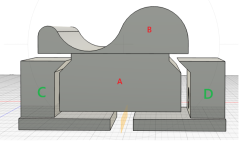
(1) "A" and "B" are one solid block of tool steel material
(2) clamp lug "C" is one solid block of material
(3) clamp lug "D" is identical to "C"
(4) the "A" profile and dimensions remain constant for all cutting blades
(5) the "B" profile is designed to accomplish the desired profile for that particular cutter
(6) again: "A" & "B" are one solid piece

NOTE; The cross slide is not shown. The proportions are NOT to scale. Just illustrating the concept of a consistent clamping height and width for all cutters, regardless of cutter profile, height or width.

1768264186858.png
 
Dave

That helps out a lot. With this set up how would I adjust the final height of the cutter, hence the diameter(s) of the turned part? Make "A" slightly shorter to begin with and then shim under it to final diameter? It looks like you have drawn it with a bit of room available to shim. Also, is part B cantilevered over part A or are they the same length front to back? Thanks.
 
Dave

That helps out a lot. With this set up how would I adjust the final height of the cutter, hence the diameter(s) of the turned part? Make "A" slightly shorter to begin with and then shim under it to final diameter? It looks like you have drawn it with a bit of room available to shim. Also, is part B cantilevered over part A or are they the same length front to back? Thanks.
That is both the blessing and the curse, The cutter thickness determiners the diameter of the turned part, there is no adjustment, therefore every time the cutter is installed, it produces the same turned diameter. (as per the original design you show)

Yes area "A" would be much shorter. Needs to have room for the cross slide, which the cutter is pulled down tight against. Yes it could be designed to be "short" with shim added for final diameter. The bevel height and length would need to be designed to allow for this. (as shim is removed, the clamping lugs would move closer together)

The upper portion (B) could be longer, shorter or the same as the lower portion (A). For simplicity, I'd suggest "A" and "B" be the same length to begin with. The entire profile (A+B) could be wire cut using an EDM, followed by cutting the end bevel to generate the actual cutting edge. Material could be removed from "A" under the cutting edge, rather than run the cutting bevel all the way to the bottom of the block. Thus yes, the actual cutting end would be cantilevered somewhat. You do want to maintain support to the cutting forces and reduce strength requirements to the clamps. More cantilever, equals more load on the clamps.

I just threw the drawing together with out a lot of regard to proportion.

PS; you are making my head hurt,,,,,,,,,,,,,, I'm retired from this ya'know! :oops: :ROFLMAO:
 
Last edited:
Back
Top