Saskatchewan Follows Manitoba

I can only speak for myself, but hunters that choose an outfitter are not only the rich and famous, as seems to be the stereotype here. Our clients are a mix of the economic spectrum; some dentists, some firefighters. To be fair, we are at the lower end of the price range in the province. There are definitely some that only the wealthy could afford. Wealthy or not, they choose outfitters partly because they tried freelancing and prefer to pay someone else to do the scouting while they shoot. They can get more hunting in a shorter period of time. Plus our cooking is better than you'll get at any restaurant!
Their dollars spent here contribute to the economy just the same as a freelancer's.
I promise this is my last response to this thread.

I won't argue with your points on the client mix. Nobody is seriously arguing outfitters don’t provide value or that their clients are all wealthy. The choice itself is legitimate either way. Some hunters prefer having someone else handle the scouting, logistics, and cooking. Others see all of that as part of the hunt: the scouting, asking landowners for permission, putting out a viable decoy spread, reading the birds, calling them in, and then processing your harvest. Both groups exist, and that’s fine.

What I’m talking about is the mechanism and the timing. Alberta limits license length and huntable zones. Manitoba caps nonresident license numbers. Saskatchewan is moving to short-term licenses. All of these changes reduce how long nonresidents can hunt and how much ground they can cover. Those regulations aren’t driven by biology. Migratory bird harvest is managed at the flyway, national and continental levels. If the concern were resource protection, the tools would be bag limits or season timing. Instead the focus is on who can hunt, for how long, and where. That’s access policy.

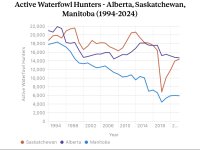
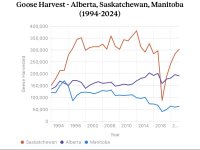
The timing of these changes is telling. These restrictions are being implemented after years of declining resident participation – there are 50% fewer Canadian hunters now than 30 or 40 years ago – and freelance nonresident hunting has increased. Goose harvests climbed while hunter numbers fell. That’s not a resource being overharvested by freelancers. Fewer hunters were simply hunting more effectively under liberal bag limits. Bag limit restrictions or limiting season dates would have been imposed if there was an overharvest concern. Manitoba’s nonresident license numbers barely changed over 45 years. Their share of the duck harvest went from 10 percent to over 50 percent because Canadians stopped hunting, not because more Americans came. If hunter pressure were truly the concern, these caps would have come decades ago.IMG_4689.jpegIMG_4688.jpeg

Restrict freelance access enough and some of those hunters become outfitted clients. The rest either stop coming to Canada altogether or hunt within the restricted license timeframes. Either way, the outfitters face less competition for clients and less competition for access. That’s the intended outcome, and it benefits a specific segment of the industry. Follow the money.

Both freelancers and outfitted clients bring money into rural Saskatchewan, Alberta and Manitoba. But freelancers spread it more broadly: more towns, more motels, more fuel stops, more small businesses across a wider area. Restrict that and you haven’t protected the birds or fairly managed access to the land. You’ve redirected rural spending from small businesses across the landscape to outfitting operations.
 
I promise this is my last response to this thread.

I won't argue with your points on the client mix. Nobody is seriously arguing outfitters don’t provide value or that their clients are all wealthy. The choice itself is legitimate either way. Some hunters prefer having someone else handle the scouting, logistics, and cooking. Others see all of that as part of the hunt: the scouting, asking landowners for permission, putting out a viable decoy spread, reading the birds, calling them in, and then processing your harvest. Both groups exist, and that’s fine.

What I’m talking about is the mechanism and the timing. Alberta limits license length and huntable zones. Manitoba caps nonresident license numbers. Saskatchewan is moving to short-term licenses. All of these changes reduce how long nonresidents can hunt and how much ground they can cover. Those regulations aren’t driven by biology. Migratory bird harvest is managed at the flyway, national and continental levels. If the concern were resource protection, the tools would be bag limits or season timing. Instead the focus is on who can hunt, for how long, and where. That’s access policy.

The timing of these changes is telling. These restrictions are being implemented after years of declining resident participation – there are 50% fewer Canadian hunters now than 30 or 40 years ago – and freelance nonresident hunting has increased. Goose harvests climbed while hunter numbers fell. That’s not a resource being overharvested by freelancers. Fewer hunters were simply hunting more effectively under liberal bag limits. Bag limit restrictions or limiting season dates would have been imposed if there was an overharvest concern. Manitoba’s nonresident license numbers barely changed over 45 years. Their share of the duck harvest went from 10 percent to over 50 percent because Canadians stopped hunting, not because more Americans came. If hunter pressure were truly the concern, these caps would have come decades ago.View attachment 76371View attachment 76372

Restrict freelance access enough and some of those hunters become outfitted clients. The rest either stop coming to Canada altogether or hunt within the restricted license timeframes. Either way, the outfitters face less competition for clients and less competition for access. That’s the intended outcome, and it benefits a specific segment of the industry. Follow the money.

Both freelancers and outfitted clients bring money into rural Saskatchewan, Alberta and Manitoba. But freelancers spread it more broadly: more towns, more motels, more fuel stops, more small businesses across a wider area. Restrict that and you haven’t protected the birds or fairly managed access to the land. You’ve redirected rural spending from small businesses across the landscape to outfitting operations.
I don't know how many times I need to say it on this forum, but protecting bird populations is not the reason for these changes. And the idea that us outfitters exert some kind of influence over our government in order to boost our profits is complete nonsense. We have about 175 members paying a few hundred bucks each a year for memberships. I'll leave you guys to your echo chamber. Good hunting.
 
I don't know how many times I need to say it on this forum, but protecting bird populations is not the reason for these changes. And the idea that us outfitters exert some kind of influence over our government in order to boost our profits is complete nonsense. We have about 175 members paying a few hundred bucks each a year for memberships. I'll leave you guys to your echo chamber. Good hunting.
Adam,
If it's any consolation I don't blame outfitters but rather governments seeking to broaden their tax base and wildlife agencies abdicating their role in wildlife enforcement. Outfitters are only doing what the law allows them to do. Governments now benefit from license sales as well as taxes on outfitters. Wildlife agencies correctly opine that it is easier to pass on enforcement to guides who accompany hunters under the threat of losing their license. In the end we all lose, not just freelance hunters. Limiting access will have a detrimental effect on conservation from reduced charitable contributions and money collected from the Pittman-Roberson Act. Obviously, protecting waterfowl populations was not the reason for these changes; for if it were, they never would have been implemented.
RM
 
Back
Top