Squaring off trailing edges ??

This is great I have to be sure not to catch up to Charlie he is always a few steps ahead and asks the questions I will need answers for soon.
 
Charlie,
She will spend this season with a 15hp mercury two stroke on her. After that I will consider what size to go to if necisary. I will stick with mercury though the forward reverse on the tiler is so nice. Our rental boats at the resort use mercury and I like it a lot. In fact the 15 I am using is from the rental boats. I am also looking for a 18hp long tail for the early season but not that serious about finding one.

How about you?
 
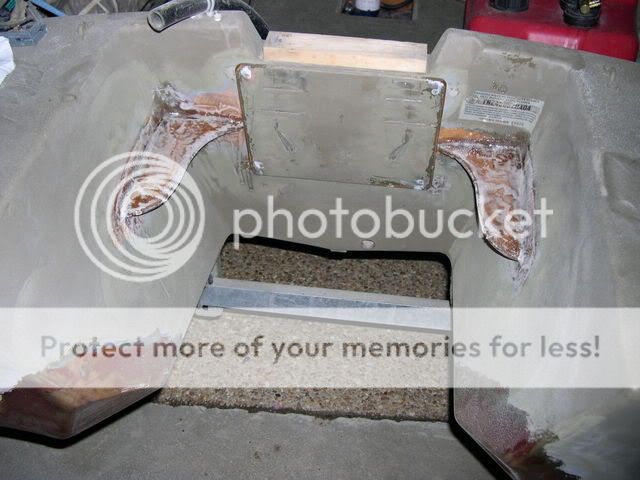
Charlie, Square off the bottom of the motor transom, the bottom edges of the sides of the sponsons on both sides of the motor and the bottom aft edges of the sponsons them selves in that order of importance. You should be trying for a 1/8" or so radius.

I would use cabosil and epoxy mixed to a stiff non sagging consistency.

The cabosil mix will be tough to sand but tough is good in that area.

Eric
 
Hi Eric, Shoot any seals lately? :)

I've been thinking of doing the same thing to my sponsons and motor well. I am a bit concerned about how the epoxy/cabosil will hold up vs a reinforced edge. By reinforced I'm thinking along the lines of an aluminum strip bedded in epoxy. Do you think that is overkill? It seems to me that getting a fair edge would be so much easier with bedded aluminum vs raw epoxy.

Pete
 
Pete,

In regards to the bedded aluminum strip you mentioned, whats your thoughts regarding possible separation of the strip from the hull? Do you think thermal expansion differences would be enough to break the bond especially when bonded on one side only? ( I am assuming that the strip would flush with the epoxy yet, exposed on the outer face and trailing edge.)

I'm just kind of wondering out loud because I had thought the same ( about a strip) but wasn't sure it would work. Off hand with out making a side by side test, I'd lean towards an epoxy mix blended for abrasion resistance.
 
Dave,

That is a concern. I have no idea how close the coefficient of thermal expansion of aluminum is to epoxy. Here's another idea.........bed the aluminum strip in 5200 instead of epoxy. No more issues with thermal expansion because the elasticity of 5200 would compensate. Hmmmm sounds much easier and quicker. I'm trying to get away from glopping on epoxy over my head as I'm laying on the ground and then trying to get a fair edge. THAT sounds like a real frustrating day and I'd probably have to cut the rest of my hair off when it got full of epoxy.

Pete
 
Pete,

For what it's worth, I used maple flour and epoxy to go from a 3/8" radius to an almost square angle on the bottom of my BB2- no wear on the paint, much less the actual edge material. Now that I'm running the boat in areas with gravel, clams, and barnicles (instead of pure Mississippi mud), this may change. Folks tell me running up on barnicles is hard on boats.

-Bill
 
[font=Verdana,Arial,Helvetica]
I'm trying to get away from glopping on epoxy over my head as I'm laying on the ground and then trying to get a fair edge.
Pete,

You could always flip the boat over. That way you can kill two birds with one stone. (A) You can square up the edges. (B) You can clean out the boat.

Speaking of flipping a boat. I never liked the idea of rolling a boat over by rolling it sideways. If any weight is still supported by the hull when rolling (rather than being supported by man power) the weight is concentrated in one spot. I've always flipped my boats over by tipping the bow up and rolling the weight onto the transom. I'll stack up supports on either side of the motor area and roll the boat on these supports. The transom is the strongest panel in a boat and I've had no issues with using it to support the weight when flipping.
[/font]
 
Dave,

Boats already cleaned out last week. No way I'm flipping that boat over now. I have a built in gas tank, secured battery, heavier than crap motor - no way.

Rolling side to side seems counter intuitive but I did it several times by myself without any catastrophic problems. The epoxy construction of these boats is incredibly strong. I usually rolled onto a chunk of carpet so I wouldn't scratch anything and I had the fore and aft steadied with ropes to the rafters but all the weight was indeed on one spot on the shear.
 
Bill,

What performance changes did you see after squaring up the edge? If all I got was no more water bubbling up in the motor well it would be worth it. Additional performance advantages would be a bonus.

Pete
 
Charlie...

I recently squared off the transom/hull edge. For 5 seasons I suffered from rooster tailing water up and splashing into the boat.

Very simple... Assuming your boat is upside down on the cradle.

where the transom meets the hull, you radiused that bond (rounded it off) and applied the tape and then the hull fiberglass... All you have to do is mix more epoxy into a fillet consistency (peanut butter) and "square off" the edge where the transom piece meets the hull piece... i.e. make it look like the way it did BEFORE you radiused the hull before you sanded it down.

You'll see, it's really easy and it'll keep water from rooster tailing up and into your boat.
 
You can do it with a plastic mold strip that is removed afterwards, or you can cut a plastic angle same as your hull/transom and use it to spread the epoxy. Cabosil and milled fiberglass would probably make the strongest compound.
 
Pete,

Unfortunately I have no idea what squaring the edges did to my boat. I only squared the trail edge of the sponsons, and honestly, it was an aftethought while installing wedges (built the edge back up after after putting a nice radius on the wedge). The rest of the boat joints have about a 3/8 radius. I had no problem with foam or spash from the the engine well until I switched from the stock prop to a bigger diameter stainless. I then added these "wing-dings" to keep water from climbing up over the transom. They have been working great, and probably help when taking a wave from the rear, too.

DSCN1846.jpg


While dialing in the engine mounting postition, through shimming the engine up and down I did find that transom heigh made a big difference in the speed of my boat.

-Bill
 
Bill,

Not to highjack the thread but is that plate on the transom to protect it from damage from the motor mounting?

I have been considering if I want to put something like that on my boat so I am not mounting (screwing down ) the motor right to the fiberglass.


I like the wings also. I wanted a splash well on my boat but left it out since size of the cockpit was becoming an issue for me. I may do them to help keep wave splash out.
 
The old timer did give me a recipe for soap using the afore mentioned for the base though. I don't think I will try it out anytime soon.

I worry about the ability of the aluminum to stay bonded to the epoxy in the extremes you face in the real world. Here it stays about the same temperature all the time so we don't see some of the problems you would.

I made my own drain tubes by wrapping epoxy saturated tape around an aluminum mandrel (1" and 3/4" round stock) and worried I would not be able to remove them even with wax release. I went so far as to heat the round stock through the cure cycle initially. Threw it in the freezer and it almost fell off when it was cold. I didn't worry about heating the stock with my smaller motor well drains and found no problems with removal when frozen. Mind you I polished and waxed the aluminum well so there might be better bonding with a properly treated surface.

You could always follow the example provided by some of my customers who came from the old country, saftey glasses and a bread bag on the head and giv'er. OK, I made the safety glasses thing up, but the bags worked well! With enough cabosil the sagging isn't too bad. Just don't try to do it all in one shot, or hot melt glue an edge to screed to.

I think Kenmack's idea of adding milled fibre would be a natural with an edge to screed to.

I don't have our big boat ready yet so I sent my son and his friend from Holland out in the Bluebill to set the crab trap, watch the bears (she likes the bears) and generally bomb around the harbor. That has given me an opportunity to see where the splash is when the boat is running. I really have to look at the turbulence caused by the keel in front of the motor. I think I left it a bit square and will look at streamlining the aft end a bit better. That should give me a cleaner flow to the lower unit and reduce the spray there.

Eric
 
I don't know but wouldn't plastic corner strips used to keep wall paper from being rubbed of a corner work to square an edge? Cut them to length and then epoxy them on then fillet smooth but being as thin as they are, may not need to fillet them. Seems that would be easier than trying to get fillet material to maintain a square edge while drying.
 
[font=Verdana,Arial,Helvetica]
or hot melt glue an edge to screed to.

Ding ding ding!! I think we have a winner!

Eric, I like your idea with the screed edge and hot melt. Hot melt would be the ideal temporary fastening method. I racked my feeble brain for a method to hold a "form" or edge to help in shaping the epoxy and I think you have hit on the perfect solution. The form edge could stand slightly proud of where you wanted the finished epoxy edge to be, thus allowing for some final finish sanding. One could leave the epoxy proud (before finishing) and do a test run if you felt a small "wedge effect" would help out boat performance.
[/font]
 
Back
Top