Works in progress

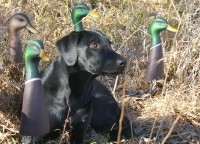
oh wow, thanks for the detailed explanation! We are getting ready to take the plunge in a couple of months and I really want to do it right with new pup/family member. I love the concept of starting them very very young and assumed you were doing something like that from the pic... but I was thinking more of the "hunting environment" opposed to the daily life examples you gave and the dogs will be exposed to way more than hunting scenarios. I have some seen some of those good hunting dogs with terrible house/public manners which leave me less impressed overall at their abilities in the field.
 
We are getting ready to take the plunge in a couple of months and I really want to do it right with new pup/family member. I love the concept of starting them very very young

That will be a fun time for you!

Lots of good information out there for you to make a plan. Best advice I can give is start now to find something by a successful field dog trainer that makes sense to you and stick with it. Repetition, patience, and consistency.
And when things seem to stall- back up a few steps. And for goodness sake if somewhere down the line you decide to use an e-collar or not, please understand that it is NOT a teaching tool.

Above all remember that you're dealing with a pup that needs to be taught and understand - and that can happen at different rates for different dogs. If I find myself getting frustrated, I try to remember that I need to keep my cool and figure out what the pup is thinking.

Good example: yesterday evening, I put scooter in an EZ (Mendota) heeling lead, and you would have thought there was a pissed-off wild mustang on the other end of it! Took a good 20 minutes of me staying calm and doing lot of coaxing before she figured it out. After that, she spent the rest of the session calmly walking at heel, and making right and left turns following my lead. Quit on a positive note with lots of praise. Now, next time, I'm hoping I get complete compliance, but I could get a repeat of the same routine for a while. One thing is for sure, if I lose my temper, I'll triple the time it will take to get back to square one.
 
Bob ,
I really like your obedience training program , the wild stallion on the lead is not new as you know , just a thought , you might want to start a training lead of say 6 ft, leave it on the dog at play time & working time & see the results .
I certainly donot want to take over this thread , but here is some thought , we are breeding tremendous retrievers today that do not need any coaxing to retrieve , or be birdy,so why not spend more time in the early stages working on obedience , it will certainly pay huge dividends whether you are field trialling , hunt testing , or a well trained hunting dog,
All the best Bob
 
Bob ,
you might want to start a training lead of say 6 ft, leave it on the dog at play time & working time & see the results .....
we are breeding tremendous retrievers today that do not need any coaxing to retrieve , or be birdy,so why not spend more time in the early stages working on obedience , it will certainly pay huge dividends whether you are field trialling , hunt testing , or a well trained hunting dog.

Sounds like some of Bill Hillman's stuff there, John. We are doing the 6 ft. lead and the excitement before obedience as he suggests. Bill seems to be a real common sense dog man, and there's no denying his accomplishments. ;-)

You are spot on in your observation on rushing to throw far too many marks at the cost of the obedience work.
 
Yes it is Bill Hillmans program, you don,t miss a thing do you ,he he ! His program is relatively easy to apply and yields excellent results Amen!
 
Kyle, Vic Barlow once talked of getting some T-shirts printed that said, "Fun bumpers, just say NO!"

Bob's advice is actually quite specific to building the core foundation behaviors that a well rounded field retriever should display. All of it is centered on the dog being developed into a steady companion in both the blind, boat, and truck...no charging across several layout blinds when a bird falls in the decoys; no pushing through your legs to be the first one through a doorway; no running the length of the boat to leap in the decoys for a fallen bird; and no jumping into the truck or out of it until directed to do so by a command. After I get a puppy retrieving to hand, the number of retrieves it gets in a training session falls drastically,particularly if I am working the dog in a cover it is familiar with.

Kids and dogs are a great combination. Dog training with children is a very different story. You would be well served to sit-down with your kids and explain the commands you intend to train the puppy to obey, making sure they understand that after the behavior is embedded in "Arfy", one repetition of the command should get the dog to illicit the requested behavior. If you have eye contact, you have mental contact with the dog...one repetition, particularly for a dog older than a year, is all that is needed to convey what behavior you are requesting of it. Wait the dog out and hold eye contact with it...very mild, simple pressure to get it to comply. Standardizing how you train not only speeds the learning process' progression for a pup, it also improves the dog's understanding of its place in the "pack". Just read the Dog Advice thread to see an example of a dog that was either separated too early from its litter mates or very poorly socialized while it was with its litter. Its owners can't figure it out, so no beneficial correction will likely occur to make the dog a better member of its human pack.

I would encourage you to train your pup to obey hand signals and whistle commands, introducing these immediately after you have it obeying voice commands. Domestic dogs developed from the most pliant members of wolf packs. They "read"voice intonation, body posture, and gait extremely well. A whistle or a hand signal doesn't carry any ancillary "message" other than the request to obey the command-very useful when you are annoyed or angry with the dog's behavior.

Remember, dogs are very sight oriented in their behavioral learning process. The "picture" they see when asked to sit, stay, come, heal, as well as make a retrieve gets stored and associated with your reward of praise for successful completion of the requested task. Successful completion and compliance with these commands in a variety of background settings and terrains on water, land, and in a boat broadens their understanding that compliance with the command is what you want, not simply obeying the command when you give it in the back yard or a vacant field. This is one of the reasons I have found that using sight, trailing and circle memory training not only improves marking ability, but also helps maintain steadiness
 
Back to the vet today for last round of puppy shots.


Transitioning the "place" command learned during place-board work to being out in the family room on her assigned place. Baby steps ;-)

These two shots are fantastic. First of all, Scooter is turning out to be a fantastic looking black lab. Secondly, those fundamental steps you are taking in her learning process are the key to success in the field as well.
Al
 
Rick, that was a interesting read, If you don,t mind I,m going to ask (Fun bumpers just say No ). Why is that?
.Now my next ? What is circle memory training ? Would that be , the wagon wheel lining drill !
You see I have a lab pup , that is now 14 months , this boy is probably the quickest learner I,ve had the good fortune of training .using Mr. Hillmans puppy training, we have a solid sit with & without whistle, thru the use of Happy Bumpers, tremendous e collar conditioning using Happy Bumpers, he has gone thru pattern blinds also using Happy bumpers ,force fetch again using Happy bumpers, Swim -by again using Happy bumpers , I don,t think I need to continue.
What I believe to be the secret to good training , is what I learned in the Canada &U.S. FT game quite some time ago, think like a dog & Consistency in your methods whichever program you choose to use . Well this has gotta be my longest post ever ,my one finger is getting pretty darn sore!
Thanks for letting me express my opinion!
 
Al,as you know well, every dog is vastly different personality. The one constant in getting a working retriever that is also an excellent companion lies in building a solid pack bond with the dog, lessening or alleviating social anxiety and accelerating their skill learning rate. Even at this early juncture, we are already noticing some very marked differences in Kane (3+) and our new pup, Flynn. They are half-brothers. Add-in that Flynn's, maternal grand dam is Kane's dam and you realize how similar the two are genetically. Interestingly, Kane, even though he has a excellent nose, was a sight hunter primarily as a puppy. It took him nearly six months to learn to rely on his nose to find a bird. Flynn is the exact opposite; scent trailing Kane and Karen when he is off-leash. Kane received focused drills on following scent to find a bird during his early training. With Flynn, we will do the opposite, training him on dummies that are visible for most of his first year.

Its interesting to watch the puppy test his current "pack status" by trying to train us. As you said he was quite sure he was on his way to Alpha male status...one reason to switch over to the healing lead.
 

We agree on one point, field trials are a "game". Sadly, they reward the handler far more than the dog for the acquired set of skills. Their, at best, secondary emphasis on the dog's innate ability to hunt a scent and retrirve to hand what it captures runs counter to how most folks hunt waterfowl. This holds even more true for upland game hunting with a flushing dog.

My dogs are very ragged at lining, since I teach them to quarter through cover via hand signals and whistle commands. I also teach them to limit their cast distance to thirty yards or so, by whistling recall every time they quarter out that far while trianing.

Consequently, I lost interest in field trialing seven dogs ago...way too much testosterone floating around in the air. Four dogs ago we switched over to British Line labradors, well actually our dogs are Irish line. I grew very disappointed with searching through scores of field trial champion line ads. trying to find a dog that was tolerable to be around off-season use an e-collar to correct a dog for unwanted behavior or something I managed to condition-in in their first year that I can't train out, as well as via our Invisible Fence. In training, zero sticks, zero force fetch training, zero e-collar use. Hillman and I part ways in how we define the upper end of the pressure continuim. I work to get a biddable dog first, after its initial retrieve training is reinforced; no incessant barking, no whining, no jumping off or on tail-gates for their first year to protect their joints until fully formed. Why? I love my dogs more than most human beings I know
 
Hi Rick,
I,m assuming your last post was intended for me , not sure. Anyhow I agree with you that field trials are a game, & it's quite true that there are a lot of very high dogs , but to say there aren,t any breedings to make nice , biddable hunting dogs from breedings here on this side of the pond ,well all I can say is sorry don,t agree. Even though I no longer participate in field trials , my training using some of the methods from trials makes for some tremendous waterfowl dogs & upland dogs, so people tell me that I have guided for and friends that hunt with me. I might add that they are very happy animals who are in tremendous physical shape & mental well being. the bottom line is use what ever training program works for you but I think it's wrong to say only British dogs are The only biddable hunting dogs .
All the Best , John
 
Actually, I didn't say or infer that there weren't ANY decent labradors on this side of "the Pond". I said it became very difficult to find a dog that was what I wanted-genetically and socially "sound". I also didn't say that the only worthwhile labradors are British variety dogs. I walked away from Wildrose Kennels because both my initial dog and his replacement were not physically sound. To his credit, Mike Stewart has improved his genetic screening among his brood stock. I think he is a very good trainer. That said, I won't buy a dog from him again. What I did say/infer is that the breeding programs of the two varieties of labs. are entirely different. Why? The two continent's field trial set-ups are entirely different. British and Irish field trials are actually hunts; with anywhere from a handful of birds to somewhere around twenty-five to fifty (Irish) dropped by the gunners prior the judges picking dogs from the line to be handled to specific birds to retrieve. A dog that acts-up, whines, fidgets, barks, etc. in the line is dismissed. The test's emphasis is on determining and rewarding the dog's ability to find the bird after it is handled to the mark: outright failure to locate the bird, or the judge's dismissal, sets the stage for the next dog sent to pick-up additional points, should it succeed in finding the bird and retrieving it. Since the game is sold into the local commercial market, hard mouthed dogs are not rewarded. No "style" points, no near-total focus on handling the dog to the same "mashed" birds time after time. Blinds? How many marks do you think a dog can mentally retain in a similar situation? Multiple marks? Yes. Distractions? Yes. Diversion birds? Yes, numerous birds, including cripples.

Bob Furia did an excellent job side-stepping your initial entreaty. I grew-up as the youngest son of the deputy chief of police in a city in southern Michigan. Frequent " "confrontations" during my formative years have conditioned me to be a great deal more blunt. I admit, "my bad".

I did not say better. I said different. Again, for what I want out of a hunting dog, the choice works for ME. I think British variety dogs are actually more difficult to train, because they acquire traits (good and bad) so readily.

My advocacy of standardized training is Bill Hillman's advocated consistency training; doing everything from loading the dog to go train, to each command; voice whistle, hand signal the same. Where we differ is on his advocacy of jazzing a dog up, the overall value of happy bumpers, and e-collars as a traoning tool. Much of Hillman's "revolutionary training technique" is as old as Richard Wolters' "Gun Dog"- actually a training manual that is still quite relevant(just ignore his timetable of progression and take the dog along at ITS own pace) and far cheaper. Now throw-in a little Mrs. Woodhouse positivism and The Dog Whisperer wolf pack social order/ dog psychology techniques. To be honest, I feel that Hillman's program and techniques go well down the road toward creating a dog that is hard mouthed; another thing not judged in hunt tests (Yes, I admit I took Kane to some.) or field trials...

I have seen four retrievers badly injured while hunting, one of which subsequently died; two on aerial water entries, two on fence collisions. One of the fence collisions could have been far worse since it was a barbed-wire fence remnant segment he plowed into. A misty rain was falling and the dog was wet. Also,we were near a veterinary facility in NoDak. All these dogs where conditioned to expect to retrieve every bird. The two "aerialist" handler/trainers were big advocates of "style" points on water entries. From MY perspective...their dogs were all too 'hot".

Then there was the "trainer/outifitter, JT, who did commentary for field trials...whose dog that "wandered" off his duckboat while it was underway and got chopped to shreds by the propellar. Gee, all he did was train the dog to sit in the bow.
 
1.).....the breeding programs of the two varieties of labs. are entirely different.

2.)Bob Furia did an excellent job side-stepping your initial entreaty.

3.) for what I want out of a hunting dog, the choice works for ME.

4.) Where we differ is on his advocacy of jazzing a dog up, the overall value of happy bumpers, and e-collars as a training tool. Much of Hillman's "revolutionary training technique" is as old as Richard Wolters' "Gun Dog" To be honest, I feel that Hillman's program and techniques go well down the road toward creating a dog that is hard mouthed

5.)I have seen four retrievers badly injured .... All these dogs where conditioned to expect to retrieve every bird.

Rick,

Would like to reply to some of the points you made in your reply to John.

1.- Intent of breeders is certainly something to consider, and it is my opinion that the Kennels who have jumped on the British lab bandwagon are rapidly turning into "marketing monsters" who are producing vastly overpriced dogs and playing heavily to the "Orvis equipped sportsman" mentality. After my investigation of Milner's Duckhill Kennel in TN. I concluded that it's pretty much a high-priced puppy mill, run by local amateurs following John's program, with the whole operation hiding behind an English 'accent' ;-). Couldn''t get timely (or any) responses to the simplest questions about their planned breedings. The attitude & message that came across was pretty much: We have ENGLISH Labs; they are superior; we have created a demand; here's the price; that's all you need to know.

I do feel that there are many responsible breeders raising dogs from field trial &/or Hunt Test stock. As you said , one must be patient and do some homework before choosing


2.- Wasn't side stepping anything John mentioned. Just acknowledging his referring to some very sound methodology by a hugely successful pro. I have no interest in AKC field trials. Matter of fact, I consider them totally unrealistic in terms of the marks, white coated gunners out in the field, insistence on unwavering lines to and FROM a blind. etc....HOWEVER the training and control that Bill Hillman advocates and his methodology/logic which can be adapted to training any retriever is tremendously sound.

3. - Here is the crux of anything that any one of us has to say about dog training, be it me, John, or yourself. When you talk about what you perceive as raggedness in your dogs lining due to what you have conditioned them to do as upland hunters is the opposite of what I need my lab to do when duck & goose hunting. Nothing wrong with that if it suits your needs as a hunter.

4.- Hillman only advocates "jszzing a dog up" (esp. a puppy) as a brief precursor to the routine, daily repetition of basic obedience work. His reason for doing so is to develop what he refers to as the 'ON/OFF switch.' In other words, he wants to condition the pup so that in times of extreme excitement it will responds to it's master's directives immediately. As time, understanding, and maturity unfolds, appropriate distractions are used all throughout a patient teaching process. This ties directly into point 5.- Hillman is training for a retriever that WILL get every bird, but has been deliberately conditioned NOT TO EXPECT that it will get sent to retrieve every bird. I think that the use of "happy bumpers" is the equivalent of what all the 'positive training' advocates (and Hillman IS one of them to a great degree) are referring to as a "high value reward" when a lesson is performed well. Nothing wrong with that!

By the way, Hillman's explanation of collar conditioning and the positive use of the e-collar is one of the best and most clearly expressed explanations of this subject that I have heard.
 
Last edited:
My base training experience prior getting into labrador training and trialing was three years working with a group of amatuer field trian competitors who ran field springers. Two of them were quite successful, competing in both the ammature and professional ranks. When I asked Mark S. what he dogs sell for, he said a puppy would cost $2,500 to 3.000, based on its pedigree. This was in the mid-1980s, when a good labrador retriever sold sold for far less.

Bob, you sketch out a real-world example of simple supply and demand in operation. I would also include Wildrose Kennels in its first decade with your assessment of high priced puppy mills. But, to be honest with you, you state your conclusion without actually mentioning your assessment criteria beyond dog price and "Orvis Endorsement". Were you looking for a puppy that was EIC and PRA clear, as well as OFA good or better? Were you looking at pedigree listings? I am truly curious.

We can "chew" the whole dog price issue forever. I opt to divide the total cost of a dog by their potential years of service, having had one ten year "mistake".

Robert Milner sold Wildrose Kennels to Stewart, watched him apply the model you partially outline quite successfully, and followed suit by founding Duck Hill Kennels to replicate it. We were on a waiting list for a yellow male. My first(Dugan) full UK labrador's sire was one of his first Irish imported dogs. He is the yellow labrador on the timber shooting treestand in the Avery commercial. I don't dispute your point. However,from your statements, am I to conclude that leveraging the pricepoint of a dog is unique to UK line labradors? As you also stated, you still have to do your homework well for a puppy choice in either labrador variety "arm". What I have come to appreciate most about the UK Labrador breeding philosophy practice is that their practice breeds out what we have trained out in our domestic labrador retriever lines for decades. I domestic labradors, a process I contend has served to broaden the application of e-collar use by both inclination and necessity. Once I thought that heritability of behavioral traits was so much B.S. That said, I made a point of looking at some UK variety lab. kennels in Wisconsin. I was quite impressed. Actually, I was completely won over.

Then, while watching a documentary that attempted to trace not only the timeline from wolves to domestication of dogs, but where this likely first occurred via genetic analysis, I heard the researchers, outline that this occurred at a far greater pace (shorter time interval) than they expected via natural selection operating. They concluded that the most behaviorally pliant wolf pack scavengers were the core subset at the split between domestic canine breeds and wolves. This thesis was repeatedly supported by their data, essentially supporting the argument that canine behavioral traits do have a genetics driven basis.

I maintain that enthusiasm can be built-in, not layered on. Consequently, training-in an "on/off "switch is uneeded

One point I would ask you to note within all my comments, I have never advocated the kennel I purchase my UK dogs from. Why? It is my course of action...not much of a "herd" guy, nor do I advocate my choice as a universal approach. I am in the camp that also contends that a labrador retriever should actually look like the breed standard.

Mr. Hillman, as you state, is quite successful. I am assuming your criteria to gauge his success is the volume of $150 a pop DVDs he has sold, since you discount the overall value of field trials. The methods he uses are not new, or novel,or revolutionary. ANY trainer at his level, worth her or his "salt" should be doing everything possible to not introduce or reinforce untoward behaviors by standardizing how they approach an individual dog's training. I don't think e-collars are or should be a routine tool in retriever training, particularly for the average person training his or her dog. Since I firmly hold that perspective, whether he does a wonderful job teaching their application is superfluous; he is still advocating use of a device that, from my perspective and observation only teaches a dog to manifest the e-collar ingrained behavior(s) while it or a dummy collar are on the dog. Your comments about Milner's operation can also be appropriately applied to Mr. Hillman's enterprise, they are extensively "hyped" via endorsements and far more expense than the handful of training articles, experience born from practice and application and a copies of Richard Wolter's initial book, as well as Vic Barlows. I would estimate my "program" coast at about $60, with most of it in a pigeon trap/cage. Again, no $150 each Hillman DVDs, no e-collar, no field trial participation.

I encourage any e-collar user to remove it and continue to train their dog for HALF the interval they have had it in use as a training tool. Now, assess the dog's behavior in the filed, truck, and kennel.

As I stated, a path I have no interest in...

 
Last edited:
Rick, I should know better but here goes albeit the last on this subject.
You say you are in the camp that say a lab should look like the breed standard, Well show people worked on that and produced dogs that could not retrieve their food bowl if they were starving need I say more !
As your comments about Mr.Hillman & his success , are nothing but ( British words )Pure Rubbish, .Bill Hillmans record speaks for itself , I.m truly sorry to say this but yours doesn't . He has capitalized on his accomplishments to produce DVDs that well seasoned trainers can use some or maybe all of his ideas, but more importantly new dog people can get a proper start with their dog! It's been my experience Rick , that successful people can make others very jealous of their accomplishments therefore they like to slam them with verbal diarrhea .
I like to believe and try ,to continually learn with a open mind. I am not telling you how to train you're dogs you do what's best for you & more importantly Good Luck on how you go about it.
 
That is quite a series of sweeping statements, John! I never, repeat never said anything questioning Mr. Hillman's success, as a field trial participant or selling his approach. I did imply that the price of his approach: DVDs, e-collar, etc. was quite steep, particularly contrasted against other quite sound retriever training approaches. Again, what I said is that his approach is not unique, revolutionary, ground-breaking. You stated that field trials are a "Game". Bob made a statement discounting their worth as well. What I asked in response was a clarification on what constitutes success. No, I am not a disciple; consequently, I am not an advocate.

Where I would absolutely disagree with you is your statement regarding bench versus field dogs. How do you erase a genetically induced trait in a retriever? Breed strictly for a very small set of desirable traits on a grand scale. I wonder where this is most predominant within the labrador retriever world?

What I have said, repeatedly, is that there are alternate means to get to the same endpoint: a trained retrieving dog, capable of being a good companion and hunting partner.

One more time, there is no end-all or be-all. Your post touted the Happy bumpers and e-collar conditioning repeatedly from the get-go without actually every asking me to define or clarify my comment. Actually, a quote from a guy who writes for the Retriever Journal.

Did I disparage what you have accomplished with your current dog? No. Did I call you names? No. Did I call Mr. Hillman a fraud? No. Did I imply or state that his approach doesn't work? Again, No! Am I an Anglophile? Nope, not even close to one! It must be my wife's influence, since her grandmother is French Canadian/Irish. Nope.

Where Mr. Hillman and I deviate is building a training program on use of an e-collar. Do you find anything odd in which arm of the labrador retriever breed its use dominates in training dogs? Does that give you pause? Probably not.

If you are so confident with what you have accomplished via training your current dog, drop the collar for four months and continue your program, no dummy collar.

Interest approach to a disagreement, sir! Kill witch, burn the outlier! New, novel, unique approach? Again, No.

There are many ingredients that can be used in making sausage, meat choices, spices/seasonings, casings, curing, smoking, etc., the end-product is still called sausage.
 
Where Mr. Hillman and I deviate is building a training program on use of an e-collar.

Nuf said, Rick. That tells me that you don't grasp the core of Hillman's program, or just have a very superficial understanding of it.

My statement on AKC trials was: "I have no interest in AKC field trials. Matter of fact, I consider them totally unrealistic in terms of the marks, white coated gunners out in the field, insistence on unwavering lines to and FROM a blind. etc " Note those are all "I" statements, as in: "I"need to train a retriever to respond well in the situations "I" am going to see." My intent was not to disparage AKC trialing or what it takes to earn any of the "FC" designations.

I would have said it better if I'd stated: "I have neither the time, ability, interest, energy, or resources to train a dog to that level and keep it there." But that's not to say that we don't owe a good deal of thanks to people involved with AKC trialing for what they have contributed to the excellence of the sporting-dog side of many breeds.

I did find HRC tests to be a very good set of standards for the average hunter who trains his own dogs. Very much an effort to put the handler in an actual hunting scenario. I must say that I met some skilled trainers who I admire greatly while active in local HRC clubs.
 
Last edited:
Yesterday served to underscore the old Chinese proverb: "May you live in interesting times!" I am glad I hedged conservatively when I looked at the margin of error on the "Brexit" Leave or Stay polls.

Bob,let's do a plot of e-collar sales in the U.S. over the interval since they were introduced. Now, do a similar plot of the number of competent (successful based on titles in hand via their dogs.) Either these ladies and gentlemen purchase a mountain of e-collars per individual, or the army of "unsuccesful" dog trainers who have them in application are not well-versed in their proper use. One nano-second of anger that results in a button push carries the potential to undue so much effort.

I admit I side-stepped this earlier. Mr. Hillman's halting, plodding, delivery style just makes me run away before I start climbing the walls screaming, "Please get to the ever-loving point!". My first thought while watching him on youtube was, "Is that a pregnant pause or cerebral infarct?" So, what about the individual who concludes more is better...? How do you go wrong with this personality type when your base training position is none?

Even though you still never opted to mention your assessment criteria for the puppy mill statement. I should mention that I forgot to say,no, I own nothing purchased from Orvis. Stewart's Orvis endorsement occurred after we parted company. Again, he is a very good trainer, partially because he came over from a pointer training base (my biased assessment).

If you want to see what good looks like, look at the breeding program that is in use at the facility where Steve Sutton just purchased his puppy-well thought-out, with focused long term goals.
 
Rick,

I see e-collars everywhere. In addition to being found in copious numbers at Bass Pro, & Cabelas, they line the shelves at Menard's, WalMart, Tractor Supply.... I've even seen them at my local Harbor Freight Tool outlet. No doubt this has been a HUGE contributor to the creation of an .."army of 'unsuccesful' dog trainers who have them in application and are not well-versed in their proper use." I'm sure the vast majority of collar sales are made to folks who see them as a "trainer in a box." Not unlike people who just KNOW if they buy the right brand of paint or carving knife, they'll soon be Keith Mueller.

That doesn't refute the fact that with the proper conditioning and use e-collars can be effective and humane. An angry outburst while teaching a pup to walk on lead can undue a lot of progress and undermine trust as well.
Does my belief that e-collars can be used correctly mean that I must automatically default to the use of one?
Does my inability to endorse collar training mean that I will adamantly refuse to properly use an e-collar when i hit a stone wall at an important juncture in training?
....all very different questions and answers.

Yea, Bill Hillman's delivery can be a bit dry to say the least. Buy I can find myself having that "Please get to the ever-loving point!"moment in church as well.....used to have them in faculty meetings all the time. But you can miss out if that alone causes you to disregard the message.

Current dog came after an extensive search where we cast a pretty wide net and then narrowed it down. As I pared down the options, I relied heavily on retriever people I consider trustworthy friends, as well as utilizing my knowledge of the background I saw in 5 generation pedigrees. Saw, in person, parents of the litters we considered seriously whenever possible.
Decision to go with the litter that Scooter came from came after I was recommended to the breeder by Mary Howley of Candlewood Kennels.
The sires of the last two Labs we owned were out Candlewood dogs, and the excellent experience we had with those dogs was why I contacted Mary after we were a good way into our search and had come up less than satisfied with the prospects to date.
This particular breeding was being done as part of an effort to put Labs from outstanding field trial bloodlines into the hands of Search and Rescue/ cadaver-dog handlers. I liked the idea that dogs chosen for their ability in the field as well as being tractable in S&R situations were being bred. (The 37 assorted FC, AFC, NAFC champions in the 5 generation pedigree, and the clear connections to my prior dogs' genetics were a windfall).
Our pup came to us with copies of all the proper OFA screening certification on her parents who were also OptiGen screened for PRA and had additionaly been screened for EIC - something that is not routinely done. In fact, my vet was pretty impressed that the EIC screening info was there.

My dissatisfaction with the Milner operation was the result of being pretty much ignored on any communication I sent + their not returning calls. When you can't get routine questions answered while trying to make a wise decision about spending a substantial amount for an 8 week old pup it raises serious concerns that quickly eliminated them from the list. In addition their policy regarding refusal to remove dewclaws wouldn't have flown with me.
 
Back
Top