Zack Taylor widgeon

Aaron thomson

New member
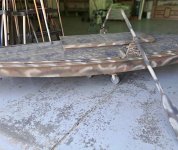
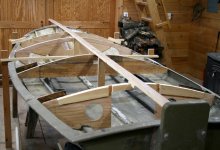
I’m on the west coast and thought I wanted a jon boat. About a month ago while researching, I came across the words “sneak box” and started asking fellow hunters I know, what they knew about them. None of them had a clue or any answers, but the more I researched, the more fascinated I became by this “sneak box” boat and set my mind on the notion that a sneak box was the boat for me, not just because of its design and apparent efficiency, but also the rich history it holds in the waterfowl world. I came across this Zack Taylor widgeon. Listed for 500 dollars and reached out. An older gentleman owns it and said his friend built it over 30 years ago and then let it sit and rot, the guy was going to chop it up and burn it. So he took it and restored it and hunted it for a few years and since it has sat in his shop. Needless to say I’m now the owner of this piece of art, and feel honored to keep the sneak box tradition alive and be one of the few to do so from my knowledge, here in the salt marshes of far Northern California. The boat also comes with with and autographed copy of Zach Taylor’s “ successful waterfowling”
Needless to say these are already, two of my most prized possessions.
 

Attachments

  • IMG_3230.jpeg
    IMG_3230.jpeg
    310.6 KB · Views: 33
  • IMG_3229.jpeg
    IMG_3229.jpeg
    253.4 KB · Views: 32
  • IMG_3228.jpeg
    IMG_3228.jpeg
    306.9 KB · Views: 32
  • IMG_3256.png
    IMG_3256.png
    815.2 KB · Views: 31
Thankyou and thanks for having me. The history behind these boats really scratches an itch in my brain. I will definitely make sure to! Any advice on making a motor mount and grassing it would be highly appreciated. I am now in Siskiyou county near Tule Lake and plan on hunting it there. But Grew up in Humboldt 3 hours away next to Humboldt Bay and will be making trips there most weekends to explore and get to the spots in the Salt Water marshes and tidal sloughs that were inaccessible even to the jon boats and me hunting public land on foot. Another hunting history in the waterfowl world also lies in Humboldt bay! The Humboldt Bay scull boats! Which I hope to acquire a true one of those someday. Pretty fascinating history there as well.
 
Last edited:
I’m on the west coast and thought I wanted a jon boat. About a month ago while researching, I came across the words “sneak box” and started asking fellow hunters I know, what they knew about them. None of them had a clue or any answers, but the more I researched, the more fascinated I became by this “sneak box” boat and set my mind on the notion that a sneak box was the boat for me, not just because of its design and apparent efficiency, but also the rich history it holds in the waterfowl world. I came across this Zack Taylor widgeon. Listed for 500 dollars and reached out. An older gentleman owns it and said his friend built it over 30 years ago and then let it sit and rot, the guy was going to chop it up and burn it. So he took it and restored it and hunted it for a few years and since it has sat in his shop. Needless to say I’m now the owner of this piece of art, and feel honored to keep the sneak box tradition alive and be one of the few to do so from my knowledge, here in the salt marshes of far Northern California. The boat also comes with with and autographed copy of Zach Taylor’s “ successful waterfowling”
Needless to say these are already, two of my most prized possessions.
Good morning, Aaron~

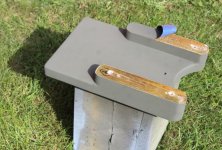
For a number of reasons, I like to install motor boards with "standoffs". They minimize the area in contact with the transom - so avoid moisture trapping and subsequent rot. the board can also serve as a strong lifting handle when there is not motor on the vessel. All edges are rounded ver for both comfort and maintaining an intact epoxy coat over the board.

The mating surfaces are unpainted to allow the 3M 5200 adhesive caulk to bond directly to the epoxy.

sm Balabus - Motor Board primed.jpg


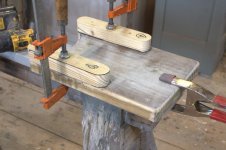
Here is one being glued up. I use 2x10 treated (SYP = Southern Yellow Pine)) lumber - that is good and dry. The board itself is 'glassed on both faces and the whole thing gets 3 coats of epoxy to seal out moisture.

sm Motor Board - clamped up.jpg

Height above the bottom of the hull is critical. I will take a look at Successful Waterfowling (one of my Top Ten volumes!) to see if Mr. Taylor built rake into his motor board. The standoffs could serve that purpose if needed.

Here is one on a South Bay Duckboat - which has a notched stern.

sm Motor Board - aft.JPG

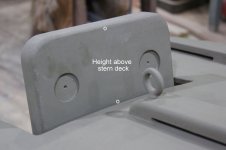
Shallow sockets prevent twisting of the outboard. The 3/8-inch eye-bolt through the deck (and backed up below) is for a safety chain/cable from the motor.

sm Motor Board - fwd - Height above stern deck.JPG

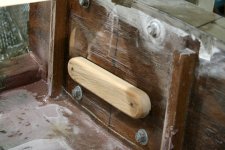
If the transom is sufficiently strong, I add a softwood "bumper" to protect the gas can from chafe (from the mounting bolts).

4 Bumper.jpg

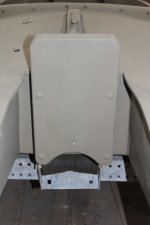
If the transom is light, I add a half-inch plywood backer board - and always use s/s fender washers. Note cutout for transom drain - which I advise you to add if you do not have one.

Motor  Board backer.JPG

The motor board on my Barnegat Bay sneakbox RED-LEG has stand-offs - because of the molded lip on the decks.

sm Motor Board on RED-LEG Frames in temp.jpg

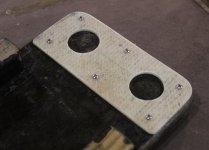
Rather than bore into the motor board itself, I now apply a piece of 1/8-inch 'glass - which I mark and cut out for individual outboard models. This makes future modifications easy if you change motors.

sm 2 Motor Board Keeper - marking clamp pads.JPG

The 'glass piece is bedded in a window caulk - NOT 3M 5200 - so it can be readily removed if needed.

sm 3 Motor Board Keeper - installed dry without motor.JPG

BTW: I read Zack Taylor when he was the Boating Editor of Sports Afield - and I was about 12 or 13. I envy you your signed copy!

Hope this helps!

SJS
 
Good morning, Aaron~

For a number of reasons, I like to install motor boards with "standoffs". They minimize the area in contact with the transom - so avoid moisture trapping and subsequent rot. the board can also serve as a strong lifting handle when there is not motor on the vessel. All edges are rounded ver for both comfort and maintaining an intact epoxy coat over the board.

The mating surfaces are unpainted to allow the 3M 5200 adhesive caulk to bond directly to the epoxy.

View attachment 78674


Here is one being glued up. I use 2x10 treated (SYP = Southern Yellow Pine)) lumber - that is good and dry. The board itself is 'glassed on both faces and the whole thing gets 3 coats of epoxy to seal out moisture.

View attachment 78675

Height above the bottom of the hull is critical. I will take a look at Successful Waterfowling (one of my Top Ten volumes!) to see if Mr. Taylor built rake into his motor board. The standoffs could serve that purpose if needed.

Here is one on a South Bay Duckboat - which has a notched stern.

View attachment 78676

Shallow sockets prevent twisting of the outboard. The 3/8-inch eye-bolt through the deck (and backed up below) is for a safety chain/cable from the motor.

View attachment 78677

If the transom is sufficiently strong, I add a softwood "bumper" to protect the gas can from chafe (from the mounting bolts).

View attachment 78678

If the transom is light, I add a half-inch plywood backer board - and always use s/s fender washers. Note cutout for transom drain - which I advise you to add if you do not have one.

View attachment 78679

The motor board on my Barnegat Bay sneakbox RED-LEG has stand-offs - because of the molded lip on the decks.

View attachment 78680

Rather than bore into the motor board itself, I now apply a piece of 1/8-inch 'glass - which I mark and cut out for individual outboard models. This makes future modifications easy if you change motors.

View attachment 78681

The 'glass piece is bedded in a window caulk - NOT 3M 5200 - so it can be readily removed if needed.

View attachment 78682

BTW: I read Zack Taylor when he was the Boating Editor of Sports Afield - and I was about 12 or 13. I envy you your signed copy!

Hope this helps!

SJS
Aaron~

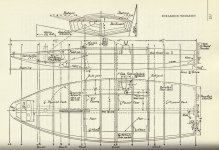
I just consulted Successful Waterfowling.....

sm Zack Taylor WIDGEON plans p. 132.jpg

I see that WIDGEON is built as a displacement hull. So, low horsepower (3 or 4 HP?). You can use 1-inch White Oak as he suggests - or something similar: treated lumber or Philippine Mahogany, etc.

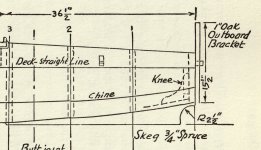
Because the "run" tucks up as it nears the transom, you probably need not bother with raking the transom/motor board. The upside is that she'll row and pole better than a planing hull. In any event, secure the board with throigh-bolts and at least s/s fender washers.

INSET Zack Taylor WIDGEON plans p. 132 - stern details.jpg

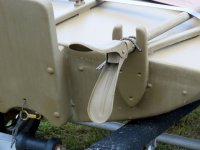
On the JAMES CAIRD, the standoff motor board doubles as a lifting handle - so I could use the transom space for other things - like a chock to hold my push pole:

sm CAIRD - pushpole head.JPG

All the best,

SJS
 
Aaron,

Welcome aboard. I have my Widgeon build documented on the site. How much does your boat weigh? Curious since mine seems a heavy boat.

Rick
I’m not sure as I havnt picked it up yet but am going to get it in the next week or so to bring it home. I will let you know as soon as I do. I’m also curious what outboard you would recommend for this boat.
Thanks - Aaron
 
Steve,

I only sail my Widgeon. I am guessing a 3-5. I think a Duck Twin would look period correct for this boat.

This forum shows a Widgeon owner using a 9hp and mentions that the Mighty Layout Boys Widgeon is rated for 5hp.


Rick Lathrop
Indeed! I have a Duck Twin that I had planned to put on the "Model 19" - the sweet 'box that Josh Schwenger gave me a few years ago. The vessel is now in the hands of Lou Ureneck on Cape Cod. The Duck Twin resides in my shed - with an uncertain future.

SJS
 
Indeed! I have a Duck Twin that I had planned to put on the "Model 19" - the sweet 'box that Josh Schwenger gave me a few years ago. The vessel is now in the hands of Lou Ureneck on Cape Cod. The Duck Twin resides in my shed - with an uncertain future.

SJS
Would you be willing to part with it by any chance?
-Aaron
 
Good morning, Aaron~

For a number of reasons, I like to install motor boards with "standoffs". They minimize the area in contact with the transom - so avoid moisture trapping and subsequent rot. the board can also serve as a strong lifting handle when there is not motor on the vessel. All edges are rounded ver for both comfort and maintaining an intact epoxy coat over the board.

The mating surfaces are unpainted to allow the 3M 5200 adhesive caulk to bond directly to the epoxy.

View attachment 78674


Here is one being glued up. I use 2x10 treated (SYP = Southern Yellow Pine)) lumber - that is good and dry. The board itself is 'glassed on both faces and the whole thing gets 3 coats of epoxy to seal out moisture.

View attachment 78675

Height above the bottom of the hull is critical. I will take a look at Successful Waterfowling (one of my Top Ten volumes!) to see if Mr. Taylor built rake into his motor board. The standoffs could serve that purpose if needed.

Here is one on a South Bay Duckboat - which has a notched stern.

View attachment 78676

Shallow sockets prevent twisting of the outboard. The 3/8-inch eye-bolt through the deck (and backed up below) is for a safety chain/cable from the motor.

View attachment 78677

If the transom is sufficiently strong, I add a softwood "bumper" to protect the gas can from chafe (from the mounting bolts).

View attachment 78678

If the transom is light, I add a half-inch plywood backer board - and always use s/s fender washers. Note cutout for transom drain - which I advise you to add if you do not have one.

View attachment 78679

The motor board on my Barnegat Bay sneakbox RED-LEG has stand-offs - because of the molded lip on the decks.

View attachment 78680

Rather than bore into the motor board itself, I now apply a piece of 1/8-inch 'glass - which I mark and cut out for individual outboard models. This makes future modifications easy if you change motors.

View attachment 78681

The 'glass piece is bedded in a window caulk - NOT 3M 5200 - so it can be readily removed if needed.

View attachment 78682

BTW: I read Zack Taylor when he was the Boating Editor of Sports Afield - and I was about 12 or 13. I envy you your signed copy!

Hope this helps!

SJS
This was extremely helpful. Thankyou! I took some scraps of red cedar local to this valley a friend of mine milled up and plan on building one from that. I will post pictures of the process when I do.
-Aaron
 
Back
Top