I'll have to recheck to tell you for sure, but given the fairly small slope back there it is likely a inch or two. I'll let you know when I get back there - its easy to flip the sliders on my jig and get a measurement.How much wider than 48" would you need - just curious? I looked at mine and it looks like 48" or so, but I can't really tell because it is faired pretty well and the junction are well hid. I stuck my phone in there and the grain on the face ply is running front to back, so 48" was it. I don't remember if I was able to have a full taper at max width, but I think I did. I for sure wasn't short and I didn't extend it.

You are using an out of date browser. It may not display this or other websites correctly.
You should upgrade or use an alternative browser.
You should upgrade or use an alternative browser.
2025 Devlin Snow Goose Thread
- Thread starter HenryHawthorne
- Start date
BTW 2 and 3 inches.I'll have to recheck to tell you for sure, but given the fairly small slope back there it is likely a inch or two. I'll let you know when I get back there - its easy to flip the sliders on my jig and get a measurement.
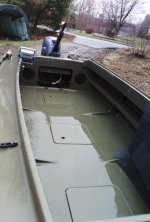
I went back and forth on it, and rather than pick up an extra piece of plywood I went ahead and cut what I had to see where the 48" fell. I still have a few tweaks around the cutouts to make that will get the sole totally flat, but once done at the outer edges the sole will just kiss the hull or float slightly. As I said earlier, I can only guess my bulkheads are a little tall at the bottom (and keelsons match).
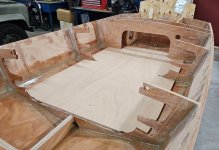
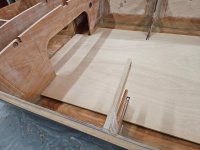
I experimented a little with trying to plane and sand down the keelsons and bulkheads, but that will take a lot of time to get 1/4"-1/3" so I took a break to consider my options.
1 is to buy a couple sheets of plywood (I'm fortunate to have a local source) and make a 3-piece sole, cutting longways so I can get the roughly 52" I'd need side to side.
A simpler option might be to cut some strips to fit outside my current sole. Tapered or even notched on the edge to slide just under the sides of the sole, and sized to effectively run to the hull/sides joint. That would create a slight inward slope all around. The following picture might help visualize the idea (though it obviously doesn't fit as I described - its just a random scrap).
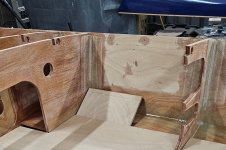
Interested in any thoughts on these options (or any others you may have).

When I fit my sole I planed the bottom along the perimeter to match the angle it met with the sole. This way there is no lip. I determined this width every foot and then bent a batten connecting the dots. From there I went at it with a block plane until it sat flush around the perimeter. It kind of looked like I was making a scarf joint all the way around. The angle on a BBII is pretty shallow except for the front. If it was off a bit I ended up fairing with thickened epoxy.

RM Anderson
Well-known member
Luan is cheap and makes a great template material. RM

BTW 2 and 3 inches.
I went back and forth on it, and rather than pick up an extra piece of plywood I went ahead and cut what I had to see where the 48" fell. I still have a few tweaks around the cutouts to make that will get the sole totally flat, but once done at the outer edges the sole will just kiss the hull or float slightly. As I said earlier, I can only guess my bulkheads are a little tall at the bottom (and keelsons match).
View attachment 71506
View attachment 71507
I experimented a little with trying to plane and sand down the keelsons and bulkheads, but that will take a lot of time to get 1/4"-1/3" so I took a break to consider my options.
1 is to buy a couple sheets of plywood (I'm fortunate to have a local source) and make a 3-piece sole, cutting longways so I can get the roughly 52" I'd need side to side.
A simpler option might be to cut some strips to fit outside my current sole. Tapered or even notched on the edge to slide just under the sides of the sole, and sized to effectively run to the hull/sides joint. That would create a slight inward slope all around. The following picture might help visualize the idea (though it obviously doesn't fit as I described - its just a random scrap).
View attachment 71508
Interested in any thoughts on these options (or any others you may have).
Dunno know what I'd do at this point. You know how I did mine (which is the same as what eric explained) and I like that wide angle for bonding, but having what you have at the point that you do I'd be tempted to try to make something work like spacers or extensions. Then again, going 3 piece wouldn't take all that long since you already have the measurements taken and a pattern you can use. I'd say it is just money. Also, the time to extend it would probably exceed starting over with a three piece solution. You really want that sole bonded in well whatever you do.
I forget how you are approaching the sole as far as access and draining... I like being able to take a look down there and clean out under it, but stuff drains into mine and isn't sealed. If it was more sealed, that wouldn't be such an issue, but I'd still want to be able to get into there to roust any mouse families that get in there.
Last edited:
After sleeping on it, I decided to just go ahead and get a couple more sheets of 1/2". I hate wasting wood, but my scraps are big enough I can put them to use in future projects - and the result will be cleaner and less time-consuming than trying to fit outer spacers. You're right, Tod... I have the bottom measurements and with the piece I have in place getting solid top measurements will be a breeze, as will translating/lofting those to a 3-piece.
After sleeping on it, I decided to just go ahead and get a couple more sheets of 1/2". I hate wasting wood, but my scraps are big enough I can put them to use in future projects - and the result will be cleaner and less time-consuming than trying to fit outer spacers. You're right, Tod... I have the bottom measurements and with the piece I have in place getting solid top measurements will be a breeze, as will translating/lofting those to a 3-piece.
Not the worst thing to have some quality 1/2" for future projects. I still have a stash of some of my leftovers that I use.
Henry,After sleeping on it, I decided to just go ahead and get a couple more sheets of 1/2". I hate wasting wood, but my scraps are big enough I can put them to use in future projects - and the result will be cleaner and less time-consuming than trying to fit outer spacers. You're right, Tod... I have the bottom measurements and with the piece I have in place getting solid top measurements will be a breeze, as will translating/lofting those to a 3-piece.
Another option if you want to make a template, buy a roll of "builders board". Where the beam of the boat exceeds the board width (as it is on your build), it is easier than using only one piece. Scribe and cut each side separately, then tape the two sheets in the middle. You can come very close to perfect.
My adjustable measuring jig worked just fine for getting measurements every 6 inches so I could loft onto the sole... my problem was that the span was too big for 48" wide plywood (at the top/surface side of the sole). As a result, I measured to the bottom of the sole. Worked fine, but the lip at the edges is more than I want to fill with epoxy and, as Tod and Eric described, I'd much prefer a broader contact edge around the perimeter. I could have made it work with perimeter pieces designed to slip under the sole, but decided for a couple hundred bucks worth of wood better to just use the 8' length to get the full width I need.Henry,
Another option if you want to make a template, buy a roll of "builders board". Where the beam of the boat exceeds the board width (as it is on your build), it is easier than using only one piece. Scribe and cut each side separately, then tape the two sheets in the middle. You can come very close to perfect.
@tod osier - I'm pretty certain I'm going to make wooden access covers much like yours, particularly now that I'll have plenty of scrap.
I'm all in for reducing the number of filler pieces needed. A couple of extra sheets is worth it considering the effort you're putting in and the nice quality of the build.My adjustable measuring jig worked just fine for getting measurements every 6 inches so I could loft onto the sole... my problem was that the span was too big for 48" wide plywood (at the top/surface side of the sole). As a result, I measured to the bottom of the sole. Worked fine, but the lip at the edges is more than I want to fill with epoxy and, as Tod and Eric described, I'd much prefer a broader contact edge around the perimeter. I could have made it work with perimeter pieces designed to slip under the sole, but decided for a couple hundred bucks worth of wood better to just use the 8' length to get the full width I need.
@tod osier - I'm pretty certain I'm going to make wooden access covers much like yours, particularly now that I'll have plenty of scrap.
My adjustable measuring jig worked just fine for getting measurements every 6 inches so I could loft onto the sole... my problem was that the span was too big for 48" wide plywood (at the top/surface side of the sole). As a result, I measured to the bottom of the sole. Worked fine, but the lip at the edges is more than I want to fill with epoxy and, as Tod and Eric described, I'd much prefer a broader contact edge around the perimeter. I could have made it work with perimeter pieces designed to slip under the sole, but decided for a couple hundred bucks worth of wood better to just use the 8' length to get the full width I need.
@tod osier - I'm pretty certain I'm going to make wooden access covers much like yours, particularly now that I'll have plenty of scrap.
If you really want to blow through wood make them like I did, each support ring is one piece.
 I forget why I thought that was a good idea, but I think I was going for the aesthetics of the ring being concentric with the hatch cover, not that anyone sees them.
I need to look back at pictures of yours again... as I recall they were centered port-to-starboard, which would put them over the keelsons. After making the support rings, did you cut them to fit either side of the keelson, or route the keelson down l?If you really want to blow through wood make them like I did, each support ring is one piece.
I need to look back at pictures of yours again... as I recall they were centered port-to-starboard, which would put them over the keelsons. After making the support rings, did you cut them to fit either side of the keelson, or route the keelson down l?
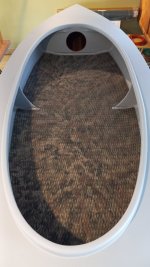
Keelsons are notched to accept the support rings. With the hatches, mine are 16x16 at that size they are getting to the size where plywood may not lay as flat as you would like with plywood being plywood (got a tiny bit of rocking pre upgrade described in second paragraph below). 12x12 would be plenty big or 8x16 might be better. There is a lot of benefit of the length fore and aft when removing debris and hosing out, not so much to the sides. Were strength not an issue, a removable 12" wide strip down the length would be ideal. I didn't screw them down and that was never an issue other than grit working in there, in this day and age of great cheap magnets, I might consider using them.
In the final version (later than this pic) I ripped the cover edges thinner (from 1/2 to 1/4) and 5200ed a hard rubber moulding along the edges. That has held up well. I used to get wear from grit getting into the junction.
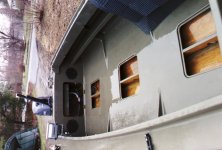
Thanks Tod. I'd been thinking about hold-downs as well as some type of "gasket"... appreciate the ideasKeelsons are notched to accept the support rings. With the hatches, mine are 16x16 at that size they are getting to the size where plywood may not lay as flat as you would like with plywood being plywood (got a tiny bit of rocking pre upgrade described in second paragraph below). 12x12 would be plenty big or 8x16 might be better. There is a lot of benefit of the length fore and aft when removing debris and hosing out, not so much to the sides. Were strength not an issue, a removable 12" wide strip down the length would be ideal. I didn't screw them down and that was never an issue other than grit working in there, in this day and age of great cheap magnets, I might consider using them.
In the final version (later than this pic) I ripped the cover edges thinner (from 1/2 to 1/4) and 5200ed a hard rubber moulding along the edges. That has held up well. I used to get wear from grit getting into the junction.
View attachment 71546
View attachment 71548
RM Anderson
Well-known member
Henry,
I love Tod's hatches, and given the complexity of a much bigger boat, may be the best solution. The reasoning behind my idea was to keep grit and sand from ever accumulating in the bilge in the first place but yet still be able to eliminate any water from condensation or leakage (God forbid). My solution was to thoroughly seal the sole to the hull and drill scuppers on the bottom of the bow bulkhead (flush with the bottom of the hull) that would allow water to drain to the bow section when the trailer jack is lowered. This would also allow some air circulation under the sole when the bow bulkhead hatch cover is removed. Just a thought, RM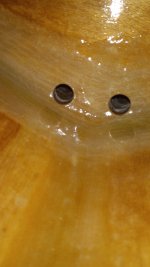
I love Tod's hatches, and given the complexity of a much bigger boat, may be the best solution. The reasoning behind my idea was to keep grit and sand from ever accumulating in the bilge in the first place but yet still be able to eliminate any water from condensation or leakage (God forbid). My solution was to thoroughly seal the sole to the hull and drill scuppers on the bottom of the bow bulkhead (flush with the bottom of the hull) that would allow water to drain to the bow section when the trailer jack is lowered. This would also allow some air circulation under the sole when the bow bulkhead hatch cover is removed. Just a thought, RM
Last edited:
Henry,
I love Tod's hatches, and given the complexity of a much bigger boat, may be the best solution. The reasoning behind my idea was to keep grit and sand from ever accumulating in the bilge in the first place but yet still be able to eliminate any water from condensation or leakage (God forbid). My solution was to thoroughly seal the sole to the hull and drill scuppers on the bottom of the bow bulkhead (flush with the bottom of the hull) that would allow water to drain to the bow section when the trailer jack is lowered. This would also allow some air circulation under the sole when the bow bulkhead hatch cover is removed. Just a thought, RMView attachment 71594View attachment 71596
With the high humidity he sees he might want maximum ability to air it out. Also he is going to use it in saltwater which will leave a hygroscopic film (and mud if he fishes in the marshes) everywhere that he will probably want to be able to readily rinse off so the boat doesn't sit wet 12 months of the year.
RM Anderson
Well-known member
Tod,With the high humidity he sees he might want maximum ability to air it out. Also he is going to use it in saltwater which will leave a hygroscopic film (and mud if he fishes in the marshes) everywhere that he will probably want to be able to readily rinse off so the boat doesn't sit wet 12 months of the year.
Very good point!
My count is at least 2 very good points!Tod,
Very good point!
RM Anderson
Well-known member
Honestly I don't even know how a stitch and glue boat builder would manage the humidity in some areas of the country so as not to encapsulate alot of moisture in the plywood itself. Henry, Is it much drier there in the winter months or do you run a dehumidifier?With the high humidity he sees he might want maximum ability to air it out. Also he is going to use it in saltwater which will leave a hygroscopic film (and mud if he fishes in the marshes) everywhere that he will probably want to be able to readily rinse off so the boat doesn't sit wet 12 months of the year.
RM
Last edited:
Honestly I don't even know how a stitch and glue boat builder would manage the humidity in some area of the country so as not to encapsulate alot of moisture in the plywood itself. Henry, Is it much drier there in the winter months or do you run a dehumidifier?
RM
I think a well-heeled fella like him with an air conditioned shop doesn't worry about humidity other than in his humidor.
If you ever get into the weeds on the epoxy discussions there are conversations about how it can be permeable to moisture vapor. I've never payed it much mind, since I know it works having trusted my life to it for years. There are also people that get worked up about condensation that occurs within voids in plywood contributing to rot. Again, not something I lose sleep over.
Even if the wood is wet it isn't going to rot very fast since there isn't much air in exchange.