2025 Devlin Snow Goose Thread

Henry,
Addendum to above post. I've given this a little more thought and can explain my reasoning a little better after a good night's sleep. Edge gluing plywood is difficult, even for epoxy. By adding carlins to both sides of all bulkheads you are increasing your epoxy mating surface at least ten fold. To my way of thinking, only taping the top surface guarantees that your sole is only as strong as the top layer of ply. Also, any movement will in time, wear the waterproofing layer of epoxy and subject the plywood to water intrusion. To put this another way, if you were able to access the underside of the sole, you would fillet the joints; no questions asked. Because you can't, builders use carlins. RM
 
Last edited:

Quick day trip with my bride today up to Lake Mattamuskeet. This is a place both of our dad's used to duck hunt (didn't know each other). A good bit of it is now wildlife refuge... definitely found the ducks and geese and tundra swans. An incredible variety. I wish I could upload a short video just so I could share the cacophony of voices.

IMG_20260117_213732.jpg

IMG_20260117_213945.jpg
 
Hi Henry, g’day from down under.

I stumbled upon your brilliant build through Google when trying to find build resources for my own build, which is Devlin’s Cackler 14.
I wish I had found your post months ago because it would have been extremely helpful following along as I worked through some of the aspects that I had no idea about and your work methodology seems textbook perfect.

I’m not a woodworker, this is my first boat build and I’m building on trestles and the work factory floor so some of methods are a bit unconventional. I’m roughly at the same stage of the build as you although I do not have the sides, front transom and rear transom faired and painted after glassing the hull with 200gsm cloth. The bottom though is done and coated with 3 layers of granite powder infused epoxy, but I will add another 2 layers before I glue and screw some HDPE strips onto the keels/runners.

At the moment I’m working on the sole and have just fitted the last floor sheet. I took a similar approach and made it in 3 pieces.
There is no glassing or fitting schedule in my plans for the sole, so at the moment I’m pondering whether the floor sheets need to be glass taped to the sides. Will you be taping your floor to the sides? Is it necessary for a boat of this style? As it stands I have epoxy glued and screwed the floor sheet to the stringers and run a fat bead of thickened epoxy along edges and underside of the sheet where it contacts with the sides, just above the chine.
0E6FA5BC-B59F-4873-9C83-E6581D60A9BA.jpeg
 
Hi Henry, g’day from down under.

I stumbled upon your brilliant build through Google when trying to find build resources for my own build, which is Devlin’s Cackler 14.
I wish I had found your post months ago because it would have been extremely helpful following along as I worked through some of the aspects that I had no idea about and your work methodology seems textbook perfect.

I’m not a woodworker, this is my first boat build and I’m building on trestles and the work factory floor so some of methods are a bit unconventional. I’m roughly at the same stage of the build as you although I do not have the sides, front transom and rear transom faired and painted after glassing the hull with 200gsm cloth. The bottom though is done and coated with 3 layers of granite powder infused epoxy, but I will add another 2 layers before I glue and screw some HDPE strips onto the keels/runners.

At the moment I’m working on the sole and have just fitted the last floor sheet. I took a similar approach and made it in 3 pieces.
There is no glassing or fitting schedule in my plans for the sole, so at the moment I’m pondering whether the floor sheets need to be glass taped to the sides. Will you be taping your floor to the sides? Is it necessary for a boat of this style? As it stands I have epoxy glued and screwed the floor sheet to the stringers and run a fat bead of thickened epoxy along edges and underside of the sheet where it contacts with the sides, just above the chine.
View attachment 72459
Looking really good Matthias! Stay tuned as others with more experience than I have will likely chime in (like you, this is my first boat build), but my inclination is that taping to the sides isn't a requirement. I'll be "bedding" the port and starboard tapered edges of the sole pieces to the hull bottom with thickened epoxy and plan to filet the top side of them to the bottom/sides to ensure water flows towards the center and can't find its way under. I don't think those outer edges will require the stiffening (as they'll be bedded) or abrasion resistance glass adds, but a little tape certainly wouldn't hurt. I do suspect I'll tape where the sole pieces meet the vertical rise of the bulkheads, after fileting those joints. My thinking there is simply spreading the load a touch more without needing huge filets.

You might search for Eric Patterson's build thread (can't remember offhand whether it was a Scaup or BB), some really good stuff there. In particular, he and others who built boats with the sponsons off the rear found that the lower unit of the motor could foul on the bottom corners of the sponsons when tilted for shallow water maneuvering. They took a bit off those inside corners to address the issue, and this would still be fairly easy for you to deal with at tour current stage.

Feel free to continue the discussion here - but starting a new thread for the remainder of your build might yield broader input and discussion.
 
Welcome to the DHBP!

As noted, I think you’ll get lots input if you start a new thread. Cool to see a boat build from down under!!
 
Looking really good Matthias! Stay tuned as others with more experience than I have will likely chime in (like you, this is my first boat build), but my inclination is that taping to the sides isn't a requirement. I'll be "bedding" the port and starboard tapered edges of the sole pieces to the hull bottom with thickened epoxy and plan to filet the top side of them to the bottom/sides to ensure water flows towards the center and can't find its way under. I don't think those outer edges will require the stiffening (as they'll be bedded) or abrasion resistance glass adds, but a little tape certainly wouldn't hurt. I do suspect I'll tape where the sole pieces meet the vertical rise of the bulkheads, after fileting those joints. My thinking there is simply spreading the load a touch more without needing huge filets.

You might search for Eric Patterson's build thread (can't remember offhand whether it was a Scaup or BB), some really good stuff there. In particular, he and others who built boats with the sponsons off the rear found that the lower unit of the motor could foul on the bottom corners of the sponsons when tilted for shallow water maneuvering. They took a bit off those inside corners to address the issue, and this would still be fairly easy for you to deal with at tour current stage.

Feel free to continue the discussion here - but starting a new thread for the remainder of your build might yield broader input and discussion.
Thanks for the reply Henry.

Yep, the inclination is not to tape the sides especially for the fore and middle pieces because those sheets have quite a taper sanded into them so they sit nicely where the hull bottom rises up to the chine. They were also the first floor boards I made, so the fit is quite loose. The starboard and port gaps between the sole and boat sides required a decent amount of epoxy to fill so I’m not really worried about strength there. But the aft sheet is a much tighter fit, so there’s not much epoxy along its sides.

I will start my own build thread and post clearer pictures there so that I don’t clutter your thread with all my questions.

Thanks for the heads up about the engine/prop clearance issue. I’ll be test fitting the engine in the next week or so and will cycle it to check if it hits.
 
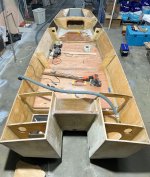
Everything fitted, then removed for final finishing below.

IMG_20260119_143305.jpg

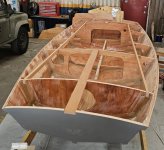
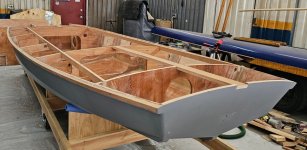
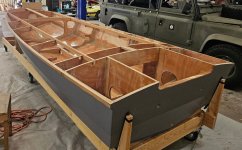
Decking longitudinals cut for length and dry fit, will need to be shaped a bit. I decided to "square up" the cockpit - doesn't look quite as nice as the version that follows the side lines, but will be easier for flapboards/blind and a cap, and the outer longitudinals give me something to tie the deck and coaming to.

IMG_20260119_143457.jpg

IMG_20260119_143608.jpg

IMG_20260119_143729.jpg
 
Everything fitted, then removed for final finishing below.

View attachment 72508

Decking longitudinals cut for length and dry fit, will need to be shaped a bit. I decided to "square up" the cockpit - doesn't look quite as nice as the version that follows the side lines, but will be easier for flapboards/blind and a cap, and the outer longitudinals give me something to tie the deck and coaming to.

View attachment 72509

View attachment 72510

View attachment 72511
That boat is a thing of beauty. Your workmanship is A-1.

Nothing to do with your boat, just in general with the Devlin boats...I could never get myself to sacrifice all that space in the designated flotation compartments. Sixty+ years messing around in boats roughly 1/2 the days of the year and never sunk/swamped one by accident. Been in some hairy situations, thought this might end badly but survived and won't do that again. It's a lot of sacrifice for a low probability event. Call me an old fool, but I'd enjoy the storage.
 
That boat is a thing of beauty. Your workmanship is A-1.

Nothing to do with your boat, just in general with the Devlin boats...I could never get myself to sacrifice all that space in the designated flotation compartments. Sixty+ years messing around in boats roughly 1/2 the days of the year and never sunk/swamped one by accident. Been in some hairy situations, thought this might end badly but survived and won't do that again. It's a lot of sacrifice for a low probability event. Call me an old fool, but I'd enjoy the storage.
Tempts me, as well.
 
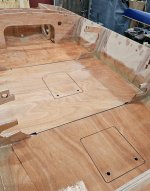
I have a better understanding now, Tod, of your completion % comments. The work definitely slows down working on the "little things". Hatch cover supports finished, fitted, and epoxied in place, including some RE magnets on the corners (matching magnets in the hatch covers). Keelsons notched and sole pieces dry fit. Will get a final coat of epoxy on the inside bottom and debating a coat of white gloss paint there and on the underside of the sole pieces, just to make it easier to keep clean and to spy any problems under there, before I do final install of the sole.

View attachment 72437

View attachment 72438

If you had slapped that floor in without hatches you would have been done in a day!

You have a really complex build and a lot of great features planned, they are going to go slow. That is one reason I've said that I wouldn't build a boat that size/complexity again with plywood and would use something like coosa that is waterproof without sealing. The thing that really slowed me down is breaking every edge with a router THEN sealing the entire thing THEN sealing any place I sanded too aggressively THEN sealing every screw hole THEN sealing...

I would go with a squared off smaller cockpit to do it again, so I approve.

Looks great!
 
Last edited:
The thing that really slowed me down is breaking every edge with a router THEN sealing the entire thing THEN sealing any place I sanded too aggressively THEN sealing every screw hole THEN sealing...
This exactly.

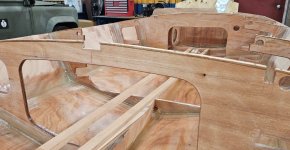
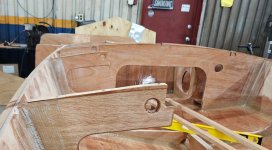
By moving my bulkheads around a little I changed finished heights a touch, which became visible once I dry-fitted my longitudinal deck supports. Squaring up the cockpit may also have contributed some variance. As a result, I needed to build up the bulkheads a little to get a consistent deck/coaming height fore to aft. May be difficult to see, but adding this just in case anyone does something similar so they can plan for it. The scraps I'd saved from cutting out the bulkheads proved valuable - I was able to use the curve on those cutouts to draw the curves I needed. Alternatively, as thin as these additions are, I could have just cut flat strips then sanded/planed the outer edges down towards the outer edges. These are temporarily screwed in place until the epoxy dries.

IMG_20260121_134832.jpg

IMG_20260121_134741.jpg
 
Back
Top