
Steve Sanford
Well-known member
All~
My earlier U-bolt post was an early step in the vessel I am building for the Tuckerton Show in late-September.
44th Old Time Barnegat Bay Decoy and Gunning Show - September 26 & 27
https://www.co.ocean.nj.us/cultural....aspx?ID=2e868c92-9761-4606-95c5-c3ea2650601a
As I intend this boat to be a bit of a surprise, I will not be divulging here the entire, step-by-step process until after the Show. So, I will be depicting only portions of the build without the overall context. In this post, I am beginning the internal framing by fabricating and installing blocks at both ends of the hull to hold the midline framing member of the decks.
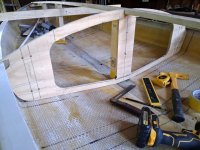
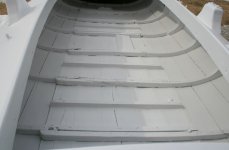
You may know that I commonly serve in the role of Commodore Stickler Fussbudget when it comes to boat terminology - self-appointed (and uncompensated) Keeper of the Language. So, I am a bit embarrassed and stumped when trying to give the right name to the central longitudinal framing member above the rails, i.e., for the decks. Whereas conventionally planked decks do not need a central framing member, they often use a heavy (thicker) plank known as the King Plank in this location. This supports deck hardware and may also serve as a support for the other deck planks. In any event, the first step in laying out the framing - bulkheads, purlins, carlins, et cetera - once the hull itself is done is to establish the centerline by fastening a full-length board from stem to stern. In this post I am showing my work only at the stem and stern. The hull is a production 'glass hull that I have stripped down as I convert it to a gunning boat. Without bigger "context" photos, I ask you to bear with me. I will focus on the "trees" without showing you the "forest".
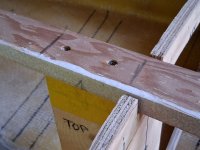
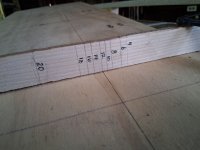
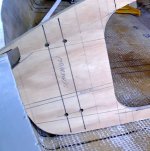
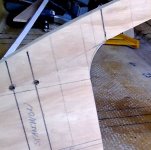
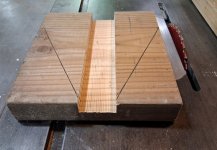
Here is the first step - laying the central frame on some heavy stock from which blocks will be fitted both forward and aft. I am using treated Southern Yellow Pine (SYP) - 2x8. Note the grain running athwartships to avoid splitting. I plowed the dado on the table saw with standard blade - to save the time needed for a dado blade/set and because the rough surface will help the 3M 5200 bedding that I will use as permanent fastening.
The central frame - which one source called a "central stringer" (but a stringer is down inside the hull in my experience and not part of the deck) - is 3/4" x 2" untreated SYP that I planed down. It once was part of the bleachers in the Cambridge Central School gym.... I am trying to make this boat as light as possible so avoided a denser wood.
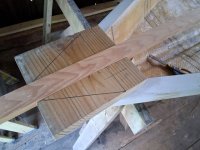
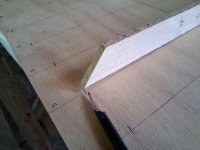
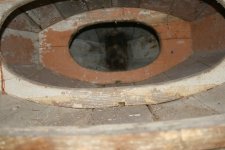
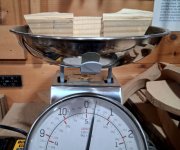
Lots of careful steps in fitting the bow block to the hull and deck "rim" (the latter left as a "shelf" to receive deck fasteners later in the build). This is NOT a conventional breast hook because it does not serve to tie the stem and gunwales together. It will add 5 ounces to the boat.
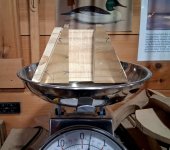
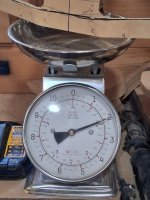
The stern block was cut from the same 2x8 - with the same dado. It, too, weighed in at 5 ounces.
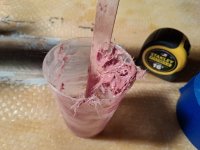
Both blocks are glued in with thickened epoxy. I added: milled fibers, 1/4-inch 'glass fibers, and some fairing compound. The first 2 ingredients add structural strength, the third just stiffens the mixture to prevent oozing and running during the cure. It is the colloidal silica in the fairing compound that provides the stiffening.
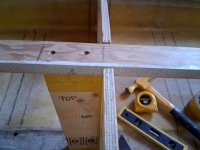
The stern block was clamped once I was certain that it was dead center - hence the measuring tape. The masking tape, of course, prevents the frame from sticking; it is not ready to be fastened permanently.
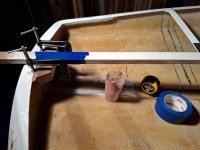
The excess epoxy mix is wiped below. Note how the block is proud of the existing deck. It will be faired to the deck contour later in the process.
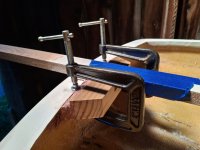
The bow block was self-centering. The clamping force here needed to be upward - to seat the rabbets on both upper edges of the block.
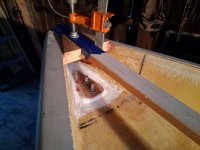
Progress will be slow (LOTS of family obligations) - but still plenty of time before Tuckerton.
All the best,
SJS
My earlier U-bolt post was an early step in the vessel I am building for the Tuckerton Show in late-September.
44th Old Time Barnegat Bay Decoy and Gunning Show - September 26 & 27
https://www.co.ocean.nj.us/cultural....aspx?ID=2e868c92-9761-4606-95c5-c3ea2650601a
As I intend this boat to be a bit of a surprise, I will not be divulging here the entire, step-by-step process until after the Show. So, I will be depicting only portions of the build without the overall context. In this post, I am beginning the internal framing by fabricating and installing blocks at both ends of the hull to hold the midline framing member of the decks.
You may know that I commonly serve in the role of Commodore Stickler Fussbudget when it comes to boat terminology - self-appointed (and uncompensated) Keeper of the Language. So, I am a bit embarrassed and stumped when trying to give the right name to the central longitudinal framing member above the rails, i.e., for the decks. Whereas conventionally planked decks do not need a central framing member, they often use a heavy (thicker) plank known as the King Plank in this location. This supports deck hardware and may also serve as a support for the other deck planks. In any event, the first step in laying out the framing - bulkheads, purlins, carlins, et cetera - once the hull itself is done is to establish the centerline by fastening a full-length board from stem to stern. In this post I am showing my work only at the stem and stern. The hull is a production 'glass hull that I have stripped down as I convert it to a gunning boat. Without bigger "context" photos, I ask you to bear with me. I will focus on the "trees" without showing you the "forest".
Here is the first step - laying the central frame on some heavy stock from which blocks will be fitted both forward and aft. I am using treated Southern Yellow Pine (SYP) - 2x8. Note the grain running athwartships to avoid splitting. I plowed the dado on the table saw with standard blade - to save the time needed for a dado blade/set and because the rough surface will help the 3M 5200 bedding that I will use as permanent fastening.
The central frame - which one source called a "central stringer" (but a stringer is down inside the hull in my experience and not part of the deck) - is 3/4" x 2" untreated SYP that I planed down. It once was part of the bleachers in the Cambridge Central School gym.... I am trying to make this boat as light as possible so avoided a denser wood.
Lots of careful steps in fitting the bow block to the hull and deck "rim" (the latter left as a "shelf" to receive deck fasteners later in the build). This is NOT a conventional breast hook because it does not serve to tie the stem and gunwales together. It will add 5 ounces to the boat.
The stern block was cut from the same 2x8 - with the same dado. It, too, weighed in at 5 ounces.
Both blocks are glued in with thickened epoxy. I added: milled fibers, 1/4-inch 'glass fibers, and some fairing compound. The first 2 ingredients add structural strength, the third just stiffens the mixture to prevent oozing and running during the cure. It is the colloidal silica in the fairing compound that provides the stiffening.
The stern block was clamped once I was certain that it was dead center - hence the measuring tape. The masking tape, of course, prevents the frame from sticking; it is not ready to be fastened permanently.
The excess epoxy mix is wiped below. Note how the block is proud of the existing deck. It will be faired to the deck contour later in the process.
The bow block was self-centering. The clamping force here needed to be upward - to seat the rabbets on both upper edges of the block.
Progress will be slow (LOTS of family obligations) - but still plenty of time before Tuckerton.
All the best,
SJS