All Things Flocking

This helps alot! I've been struggling to know when I'm done with a deke. Keep telling myself it's a duck decoy and it's fine - but inside I'm not happy yet. Redoing some mallard drake heads now. Having trouble with drake bodies and blending color to it. Mainly the flock brown to airbrush rusto brown and the flock black. Just can't seem to blend it. Just looks like 3 blocks of color. For hunting dekes keeping the flock black and white colors true seem to be priority so blending off of them is something I haven't done very good yet.
 
This helps alot! I've been struggling to know when I'm done with a deke. Keep telling myself it's a duck decoy and it's fine - but inside I'm not happy yet. Redoing some mallard drake heads now. Having trouble with drake bodies and blending color to it. Mainly the flock brown to airbrush rusto brown and the flock black. Just can't seem to blend it. Just looks like 3 blocks of color. For hunting dekes keeping the flock black and white colors true seem to be priority so blending off of them is something I haven't done very good yet.
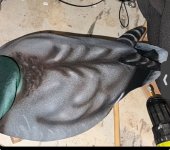
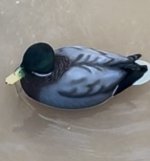
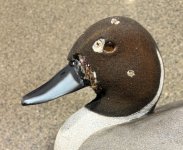
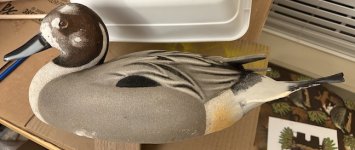
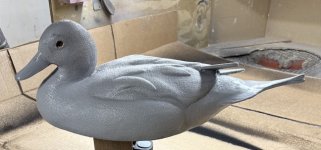
Dont be afraid to add some black and white into the gray. When im doing the front chest, I dont worry about a tad of over spray sometimes into the gray. It gives it a touch of blended between the gray and chest rusto brown when im doing mallard. Also, let some of the detail work in the chest overlap the line of the chest you laid down. That will also help blend, leaving some gray coming through but some of that detail work get into the gray. Don is a master at this, and I often envy his ability. But if you look closely you can see that. Also here are some birds I did last year and you can see how much white and black I put into the gray to work some of the detail into the top feathering. Again, I’m still playing around and working on my own airbrushing, and hopefully one day I’ll be as good as Don. I definitely didn’t start with a light enough gray flocking in my mallard this last year. Plan on fixing them this year and repainting. So I’ll get another shot at this. My line work still isn’t near as sharp as it needs to be but I get the contrast I want for decoying birds at a distance. End of the day, that’s my main goal.
 

Attachments

  • IMG_5769.jpeg
    IMG_5769.jpeg
    246.8 KB · Views: 9
  • IMG_5771.jpeg
    IMG_5771.jpeg
    430.7 KB · Views: 9
  • IMG_5770.jpeg
    IMG_5770.jpeg
    98.2 KB · Views: 9
It's looking pretty snazzy. The blend from brown to grey on the chest is perfect, It's all about decoying birds. I just think about what triggers a variety of waterfowl species , usually that means contrast and field markings.
 
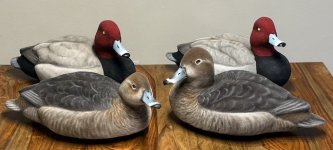
I've been doing some color mixing after talking to the folks at Flocking Unlimited. I used bisque tan flocking and brown flocking to get a little orange into the brown paint and I am fairly pleased with the color I got for a base on the redhead hens. The flocking unlimited people suggested mixing different colors of flocking. I was using Mark's photo to try and put me in the right direction and although it's really not all the way there, I'm much happier with the outcome.
IMG_5612.jpg
 
Mark, I printed that picture you posted with the redheads, especially the hen head and it kind of changed my approach to the hens. I'm not there yet, but getting closer. I want to try some rustoleum rusty metal primer under my buff/brown flocking mix and see if I can get closer on the base color.
 
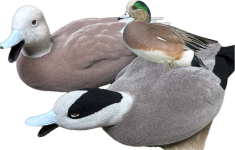
Another flocking color combo. I've been flocking wigeons with goose grey over leather brown for a long time and it's kind of semi close, but still takes a lot of airbrush blend to get the color where I want it to be, a little orangish toward the lower flank up to a more brownish chest and back, but getting that pink/beigh/orange color is always a challenge. I will still have to airbrush the color change on wigeon bodies, but I think this is going to be much closer to where I want to go.

The wigeon lower right is my old color combo, the wigeon upper left is light grey flocking over rusty metal primer. I got the rusty metal primer to get a more carmel look under brown for some of the diver heads and lighten up the flanks on the redhead hens. When I did the redhead flank, I wasn't especially happy with the outcome, but it's workable. However when I looked at it my first thought was wigeon drake body. I'll still have some airbrush blends, but at least the base will be leaning the right direction,


IMG_5693.png
 
I haven't ever done a lot of buffleheads, but since we added them to our line of decoys I decided I better figure that one out.


I do my initial flocking layer from head to tail with waste flock that I recover from a few sessions of flocking. It saves me some money and lessens the amount of loss I get from the process. This first photo is how I do the second coat on a drake. The only thing that is beyond routine is how I do the tail area. I do the the back, head, and tail/femoral tract with black right up to the end of the flank. The second flocking is light grey over grey rustoleum on the flanks and chest. At that point you have everything with a second flocking, but you have a black tail and rump and a black head. White/white is impossible to get without hand painting white over those areas. When I paint white over the flank, chest and now the tail and rump I get a fairly white coverage on the flank and chest, but the white paint over the black flocking ond the tail leaves it more light gray in contrast to the white/white of the chest. It's a pretty reasonable base color to airbrush over for the light grey tail section.
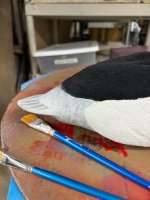
IMG_5839.jpg

Now I've got to paint white over that head patch too and it's going to be light grey when it dries when painting directly over black flocking. This is a good time to do the color on the head. I can paint straight through the white patch without concern. It takes a few passes to see any color and you've got to give it an hour or more to let the paint tack up or you won't get it to brighten.
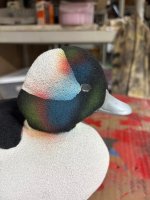
IMG_5838.jpg

Let the airbrush dry overnight before painting white over it again or you will have a kaleidoscope of pastel colors show up in that white patch.

IMG_5837.jpg

On the hen, once again I flocked on the first coat with waste flocking. The second coat is done by painting black over the back right to the tail tip, this time excluding the femoral tract, then painting grey over the chest and flank. I do a tiny bit of blend between the black and grey areas before flocking goose grey over the entire area, that gives a nice seamless transition between to contrasting colors. I get the grey I want on the flank and the dark grey on the back. Give it an overnight and come back and do black over black flocking on the head. I'm sure these would do great on the river regardless of any airbrush, but where would the fun be in that.
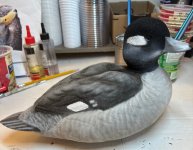
IMG_5840.jpg

I call this piece of cardboard my catchment. I was just losing so much flocking that I wanted a way to recover it better. The problem is there are a variety of colors in the mix after a session with bisque tan, light grey, dark grey, brown, black and redhead red. It's really not a suitable color for anything, however plenty good for a first coat. I flock hundreds of decoys every year and this really helps to recover waste flock. I do put the lid from the tub directly behind it and can put what falls on the lid right back in the original tub. This is my carving/airbrush/flocking booth with an exhaust in the back. When I'm carving or painting I just put the cardboard on the side of the booth.

you may notice the pair of tweezers on the lower right corner. I use it to pick hairs off when I'm flocking decoys,
I have a Nova Scotia Toller, nuff said
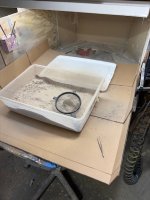
IMG_5804.jpg
 
Back
Top