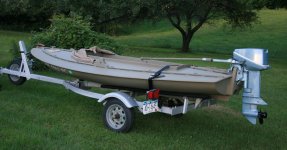
Cool Herters Model Goose Duck boat.. sneak box dreaming.

Jim Mandas

New member
Hey fellas,

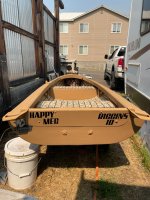
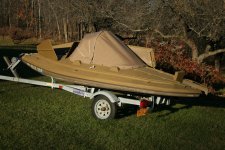
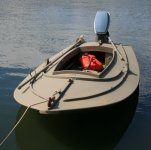
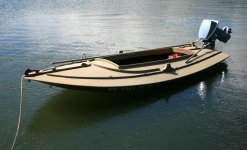
Here I have a Herters Model GOOSE DUCK. I've always wanted a smaller east coast style boat, we always used a big flat john with a kayak as our "dog" and man ducks flared those boats. I love the old school duck boats that you all have so much experience with, and I think I can get bit of a hybrid setup with this Herters. This boat will hunt me and my dog, and if two hunters are on board we won't hunt out of it. Should be a super fun boat to travel with here in Idaho and maybe some out-of-state slack water spots, so long as Oregon doesn't outlaw hunting and ranching and fishing and freedom.

Here is were I would like some help:
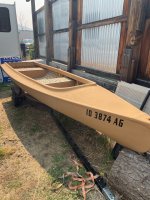
Mandas boat 2.jpg
Mandas Boat.jpg


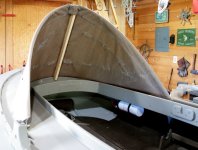
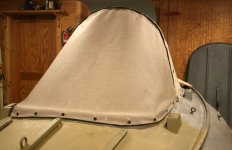
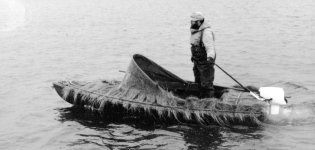
What is your preferred material for a dodger, maybe something I can paint?
What hardware would you use for a bimini style big dodger?
Looking at this boat, how would you add flap boards, or would you even add flap boards at all?
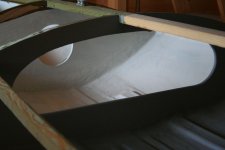
Lastly, I am thinking of removing both seats, and decking in the rear a few feet. Make it more of a cockpit. I'd reinforce it to retain structural integrity. Please let me know your thoughts, and thank you in advance!

-Jim
 
Years ago I rescued one of the Herters Boats from an Island owned by a friend. Had been there for years left in Phrags . At one time guessing owner used it for setting decoys in pond it was at. After discovering it and seeing potential I drug it home. It had some aluminum bracing scattered throughout and no seats. About 13' long. Boat builder buddy of mine put a new transom in it and redid it to use for making a mold for some he was going to sell. I got the boat back Ready to paint and title. Ran a 8 hp merc on it. Grassed up with dodger and lap curtain . Worked fine but lacked room for my retriever so after a few years I sold it. Quite a few of those little boats come off buddy's mold while he was making them. Occasionally see one up for sale in my area. He eventually sold mold.
 
Jim

I like the idea of removing both seats and decking the rear. There are some challenges ahead of you should you go this route. I suspect the boats flotation is in the seats so once removed you will need to install new flotation elsewhere. Where it me I'd put it in the nose and both back corners giving you stable three point flotation should she ever swamp.

The link below takes you to my build of a sneakbox dodger made from fiberglass, aka a hard dodger. I've used it for several seasons and wouldn't want the boat without it. It really opened up hunting open water vegetation on local WMAs. It hides so well and is extremely comfortable to gun from lying down with my back propped up by a board on the front bulkhead. I am fully protected from stiff winds. Further, I prefer to operate my boat while standing. The hard dodger is very rigid and gives me a good hold making driving standing up a safe means to operate the boat. Your boat is a bit longer than mine so if you want to go this route you'll have to make the dodger a bit longer so you can reach it and the tiller. Or you could have a separate grab handle akin to what surface drive operators use. In this case 'd want it easily removed so as not to be sticking you in the ribs as you move about the cockpit setting up or taking down.


Jim~

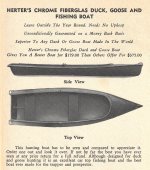
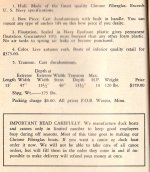
Here are some catalog images (mostly 1959-60) for your files:

View attachment 76858

View attachment 76859


View attachment 76860

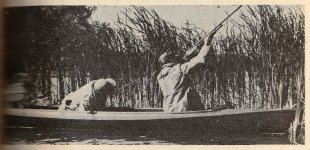
A real bit of 'fowling romance - especially with a sweet old Winchester Model 12 dropping birds left and right!

View attachment 76861

Enjoy!

SJS
I love the idea that circa 1959-60 "Chrome" was considered a desirable description of a drab, purely functional duck boat.

I like your concepts of removing the seats and adding some decking at the stern. It will get the hunter(s) lower and make the boat easier to grass. I'd also add grassing rails or cord/bungee. As Carl notes, you'll need to replace the structural function of the seats.
 
Thank you for the replies fellas, I plan to buildout my dream sneakbox in my near future. In the meantime, I'm brainstorming what I can do with this Herters to make her ideal to hunt with.
Jim

I like the idea of removing both seats and decking the rear. There are some challenges ahead of you should you go this route. I suspect the boats flotation is in the seats so once removed you will need to install new flotation elsewhere. Where it me I'd put it in the nose and both back corners giving you stable three point flotation should she ever swamp.

The link below takes you to my build of a sneakbox dodger made from fiberglass, aka a hard dodger. I've used it for several seasons and wouldn't want the boat without it. It really opened up hunting open water vegetation on local WMAs. It hides so well and is extremely comfortable to gun from lying down with my back propped up by a board on the front bulkhead. I am fully protected from stiff winds. Further, I prefer to operate my boat while standing. The hard dodger is very rigid and gives me a good hold making driving standing up a safe means to operate the boat. Your boat is a bit longer than mine so if you want to go this route you'll have to make the dodger a bit longer so you can reach it and the tiller. Or you could have a separate grab handle akin to what surface drive operators use. In this case 'd want it easily removed so as not to be sticking you in the ribs as you move about the cockpit setting up or taking down.


Eric that boat is killer. "Top Shelf" was my first thought too haha. Awesome setup. I will fab up a tiller handle extension and let you know how the boat runs while standing up, it might be too narrow to run standing...

Would you guys recommend just lumber framing to reinforce the boat after pulling the seats?
What foam would you use for flotation?
Any recommendations on hardware for dodger frame?
Do any of you hunt with the dog behind you in the dodger rather than by the outboard?

I will either deck more of the front of the boat, or make a larger, estuary type dodger. The larger dodger is what I'd been thinking, and I am fortunate to have a good connection with a canvas lady if I get over my head with it.

Thank you very much!
- Jim
 
I owned one years ago and the reason I sold it was because of the built in seats. I prefer an open floor plan, especially for a low profile boat where I want to grass it up to layout in it and for more room hauling decoys.
 
Would you guys recommend just lumber framing to reinforce the boat after pulling the seats?
What foam would you use for flotation?

I would use 3/4" marine ply and create bulkheads and then epoxy fillet and glass tape them into place. You will want to use some 1/4" luan to make a template to fit the hull and then use it to trace and cut your marine ply. Basically you are using the same type of interior structure that stitch-n-glue boats have.

Foam board insulation cut to shape and neatly stacked in flotation compartments is fine. You will need to make compartments and once again plywood glassed into place to form boxes will fit the bill.
 
I owned one years ago and the reason I sold it was because of the built in seats. I prefer an open floor plan, especially for a low profile boat where I want to grass it up to layout in it and for more room hauling decoys.
Mike that’s my thoughts exactly, I think I’m gonna pull the seats. Did you run it very much? Can you remember if you had to add a jack plate to get your outboard higher?
 
I would use 3/4" marine ply and create bulkheads and then epoxy fillet and glass tape them into place. You will want to use some 1/4" luan to make a template to fit the hull and then use it to trace and cut your marine ply. Basically you are using the same type of interior structure that stitch-n-glue boats have.

Foam board insulation cut to shape and neatly stacked in flotation compartments is fine. You will need to make compartments and once again plywood glassed into place to form boxes will fit the bill.
Thank you for the advise Eric🙏 Do you brad nail them or anything to tack them while they setup? Also, If I deck a few feet off the back to create a cockpit, would you use that same 3/4” marine ply for framing and the deck too, or can I get away with thinner ply for the decking?
 
Last edited:
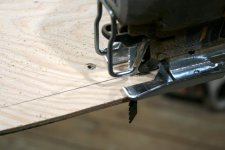
I have used brad nails plenty of times to hold things in place temporarily. For the deck I'd use 3/8". 3/4" will work if it saves you buying more marine ply but it is overkill. You will have to kerf bend it and it adds a bit more weight.
 
Jim~

I converted a Herter's car-topper many years ago - make a 2-man grassboat/Sneakbox.


Two-man Grassboat - SJS at speed - small.jpg

I forced the beam out to about 60 inches - and reinforced the entire hull from inside with a layer of Fab Mat (which was mat + roving - probably a precursor to 1708) - too long ago for me to recall the weights.

Two-man Sneakbox - SJS at helm.jpg

The dodger was cotton canvas and folded down whilst gunning; we shot over the bow. Most of the cockpit was concealed with a thatched-up lap cover.

Two-man Grassboat - TMS at-the-ready - small.jpg

It had been built very much like the Duck and Goose Boat. I removed the seats (and all the aluminum and flotation), added bulkheads fore and aft of the 6-foot long cockpit - and added a 'midships frame. I used 3/4-inch for the mid-frame but half-inch for the bulkheads. (No detail build photos from those pre-digital days....). I did use 3/8-inch for the decks but later felt it was too much.

On all later vessels I used 1/2-inch for the bulkheads and 1/4-inch for the decks. For the latter, I consider whether/how often I might stand on the decks. The answer is usually "almost never" - which I would anticipate on your vessel as it has much less beam.

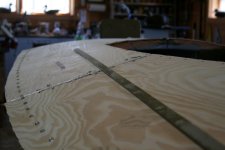
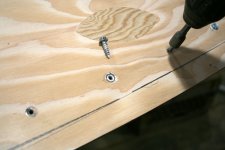
I usually secure my decks to the framing with 3M 5200 (although thickened epoxy would work as well). I secure it with panhead or cap screws (#10 x 3/4) set every 3 inches or so. I leave them in place for about 1 week to get a full cure (epoxy would cure overnight) then back them out and save them for the next project. I rough cut the decks with a Skilsaw and a shop-made depth gauge - the use a router with a round-over bit to trim the decks against the gunwales. After sealing the end-grain of the plywood, I lap the deck canvas over the gunwales about 2 inches down onto the sides.

sm Butt block a RED-LEG.jpg

sm 7 Decks 1b.jpg


sm 11 Decks 2b.jpg


sm 13 decks 9.jpg

Hope this helps!

SJS
 
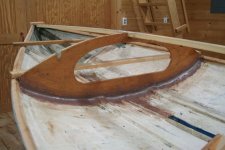
Steve that helps immensely, thank you sir 🫡 When you added your bulkheads, was there any storage in them, like open bulkheads, or were they sealed up with foam in them? Your Cartopper build is going to be wicked close to what I end up building my boat out to be. For the dodger, was that steel pipe and Bimini hardware? I’d like to do an overhead dodger, at least give me the option when the weather is fowl, but we will see. Thank you again Steve and thank you everyone for your help with this! 🙏
-Jim
 
Jim~

The bulkheads were open for storage. As I recall, the forward bulkhead had a "sill" - perhaps 3 inches above the floor - to keep bilge water out so the storage was dry. Here is one on a different vessel (2-man Scooter WHITE-WING) which also had a forward air chamber for flotation:

sm 6 - High sill on forward bulkhead allows for dry storage.jpg

I always paint such enclosed areas a pale grey gloss - to see better and clean more easily.


sm 3  - Forward hold is painted pale grey so stuff in there can be seen..jpg


The after bulkhead was open across its bottom - and allowed bilge water to drain freely aft to the transom drain. I stored the 3-gallon gas tank and a 1-gallon "emergency" tank there - and probably my toolbox (watertight box) as well.

Flotation was via insulation foam glued up under the decking 'twixt the framing.

The dodger above was framed with just a single bow bent from EMT conduit (half-inch) and supported with a single strut.

D 20.jpg

Here is a dodger that covers the gunner from above (on a South Bay Duckboat).

sm Abbate Dgr 21.JPG

I used tubing and hardware from SailRite.

sm Abbate Dgr 23.JPG

This vessel was kept at a dock during the gunning season so I added a full (zippered) cover to keep the whole cockpit dry 'twixt hunts.

sm Abbate Z 01.JPG

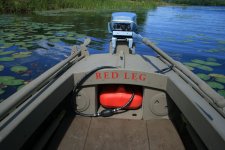
It may help you to read through my magnum opus - the 2016 renovation of my Sneakbox RED-LEG. As I recall, I posted over 3 or so months and included over 300 images. My attempts at searching failed - but perhaps Mr. Patterson could help.

All the best,

SJS
 
@Steve Sanford

Your writing here has been prolific, but I managed to find the Red Leg photo essay. It reads just as good today as the day you posted it.

https://duckboats.net/community/threads/sneakbox-renovation.280953/

@Jim Mandas

The first two pictures in Steve's latest post in this thread are worth more than 2000 words. They show what you should replicate in your hull when you remove the seats and add a deck. I hope you tackle this project. If you do, then we are here to help.
 
@Steve Sanford

Your writing here has been prolific, but I managed to find the Red Leg photo essay. It reads just as good today as the day you posted it.

https://duckboats.net/community/threads/sneakbox-renovation.280953/

@Jim Mandas

The first two pictures in Steve's latest post in this thread are worth more than 2000 words. They show what you should replicate in your hull when you remove the seats and add a deck. I hope you tackle this project. If you do, then we are here to help.
Thanks very much, Eric! I'll have to read through it again - just as soon as I have a spare day or two....

All the best,

SJS
 
@Jim Mandas

The first two pictures in Steve's latest post in this thread are worth more than 2000 words. They show what you should replicate in your hull when you remove the seats and add a deck. I hope you tackle this project. If you do, then we are here to help.
[/QUOTE]

Jim,
My father, who coincidentally was not a duck hunter, was fond of saying that you will wait a long time for roast duck to fly into one's mouth. If you follow the ideas in Steve Sanford's post, you will have saved yourself alot of time, money and study. This is a great opportunity to create your dream sneakboat.
RM
 
Eric, RM, Jim et al
In the middle of the night - rain falling on the tin roof here at our Lake Champlain camp - I read through my old posts (as retrieved by Eric).


https://duckboats.net/community/threads/sneakbox-renovation.280953/

It brought back many fine memories, including numerous duckboats.net members who are no longer with us. I noticed, though, that it does not include the last chapter - the sea trials. So, to provide the "closure" and to further whet Jim's appetite, here are a few shots from her maiden voyage as a rejuvenated vessel.

sm Rig 1.JPG
I included this photo way-back-when to show/teach how one's painter should never be able to reach the prop.
sm Painter 4.JPG
From the dock at the launch. I had not yet attached the dodger - nor stowed the gas tank.
sm Portrait 1a.JPG

Her official portrait - still at the dock.

sm RED-LEG Portrait 1.JPG

After crossing Cossayuna Lake - to my satisfaction.

sm Portrait 2.JPG

Home again - none the worse for wear. She later headed south to Tuckerton - from which she returned with a Best-in-Show for Restored Sneakbox.

sm Home Again 1.JPG

All the best,

SJS
 
Steve, Eric, and RM; I have looked at this site for years, and always dreamed of building out one of these historic and hyper practical duck boats. Thank you guys, for your time, encouragement and guidance.

While I plan to someday build one from the ground up, I'm going to get to demo today on the Happy Meg. I think I've got a decent handle on how to frame out the bulkheads and the deck now, at least enough to be dangerous. She'll be built out using these great posts as a guide, I am considering pulling the whole factory deck up and redecking the whole boat. If this were your project, bearing in mind the narrower beam, you guys would redeck the whole thing correct? I think that'll make for a better finished product. I live in a town of 400, getting material of any kind is a mission; getting parker duck boat paint and primer here was brutal, but it can be done!

Again, thank you dearly fellas, and stay tuned :cool:

-Jim
 
Last edited:
Back
Top