
Nails or screws in Barnegat Bay Sneakboxes

According to Google AI, it is in Chapter 8 under planking.

Rick Lathrop
Richard~

When I see today's technology allow one to "take the lines off a vessel" by simply walking along a hull holding a cell phone - I think of Mr. Chapelle measuring up scores and scores of near-derelict small craft in scores and scores of near-derelict boatyards - the "analog" way. I have often wondered if he might have towed a flat-bed trailer - with grid lines and leveling jacks - to make his task more manageable. In any event, I envy him his life's work!

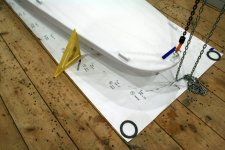
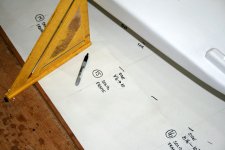
I have done only a few over the years. The pleasurable task is made quite a bit easier/accurate on a level floor and with a jig or two.

sm 1 Scooter lines 1 - Plan view.jpg


sm 2 - Scooter lines - Notes re side elevations.jpg

sm 3 - Scooter - Buttock line offsets.jpg

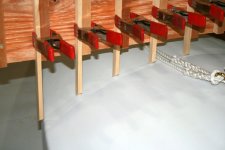
BTW: To get back to the topic of this post - the bottom planks were fastened to the sawn Hackmatack floor frames in this 1920s Scooter with copper roves and rivets. I believe the deck planking was nailed.

All the best,

SJS
 
Last edited:
Greg~

When I wrote the post, I had Mr. Keeney and Mr. Hillman in mind. Of course, you are no slouch when it comes to All Things Jersey! Thanks for the Sam Hunt observation.

All the best,

SJS
Steve, sorry been busy in the shop and in the field first time reading this post.

You are correct. The majority of traditional New Jersey boxes are nailed. The quality and constitution of these nails varies widely.

Some of the oldest use square cut nails, clenched over

Those built in the mid part of the 20th century by quality builders, generally have silicon bronze or galvanized ring shanks.

In any modern restoration, I prefer appropriate sized silicon bronze or stainless steel screws. However in a pinch an exterior coated deck screw will be used if needed, especially in longer length or larger sizes.
 
Steve, sorry been busy in the shop and in the field first time reading this post.

You are correct. The majority of traditional New Jersey boxes are nailed. The quality and constitution of these nails varies widely.

Some of the oldest use square cut nails, clenched over

Those built in the mid part of the 20th century by quality builders, generally have silicon bronze or galvanized ring shanks.

In any modern restoration, I prefer appropriate sized silicon bronze or stainless steel screws. However in a pinch an exterior coated deck screw will be used if needed, especially in longer length or larger sizes.
Thanks, Jode~

Sounds like you've been reading the Policy & Procedures Manual here at Pencil Brook Boatworks - except I also use bronze ringshanks (e.g., Anchorfast) - and even s/s staples (pneumatic gun) as I deem appropriate. And I'll bet Howard Chappelle would have loved 3M 5200.....

All the best!

SJS
 
I am compelled to add a few things I've learned over the years.

First, I avoid rolled thread screws if strength is important. Rolled thread screws are popular for sheetrock, decks, and fences. They typically don't require a pilot hole thus making them fast to install. They are great, but their big shortcoming is they are weak. I came to know this firsthand as my privacy fence boards began shearing heads off it's decking screws as the boards seasonal movement proved too stressful. Every year I have to replace sheared screws and refasten fence boards.

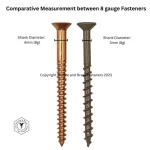
The below picture shows why rolled thread screws are weaker. Notice the shaft diameter on the rolled thread screw on the right, it's smaller. This is an artifact of the way they are manufactured. The cut thread screw on the left has a tapered and beefier diameter where it counts, just below the head.
8_mesurement_pic_480x480.webp

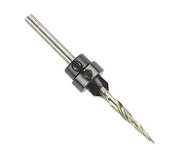
The second thing I've learned is the pilot hole needs to match the screw. Straight shank screws will get pilot holes drilled with a straight drill bit of the appropriate size (pilot hole charts are easily googled and posted on your shop wall). Traditional wood screws are tapered and need a tapered pilot hole. WL Fuller makes quality tapered drill bits with counterbores. These are my go-to bit. If you are stripping heads when installing wood screws you drilled the wrong pilot hole. If you are stripping the wood threads when installing the screw you are either overtightening or drilled the wrong pilot. It's not complicated. Match the pilot bit to the screw being installed. Details matter here.

wl-fuller-316in-drill-bit-hole-round-shank-taper-point-drill-bit-countersink-c9m.jpg

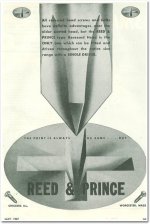
As for screw preference I started with traditional silicon bronze with a Frearson head, aka Reed & Prince, and have stuck with that head even though they are not very well known. These look like a Phillips head but won't drive with a Phillips head screw driver. A Frearson driver doesn't "cam-out" of the screw and strip the head like Phillips are notorious for when you really torque them. Screws also fit the driver snugly, meaning you can push the screw onto the driver and then orient it anyway and it won't fall off. Maybe the best part is there is only one driver size. Unlike Torx and Robertson you don't have to match the driver to the screw. One driver fits all. A really nice feature that simplifies life a bit when using them. It's all a matter of personal preference and typically what you start with is what you stick with, especially after you have a bunch of boxes on hand.

ReedPrince.jpg
 
Last edited:
Back
Top