Old Tool Video

I feel almost embarrassed of my electric tools after watching this video. Our ancestors were the real deal!
RM
 
I helped a friend move their parents last week and it turns out her grandfather built bi-planes. Nobody wanted his old tools so they gave them to me since they knew I would put them to use. Picked up a handful of saws, 2 saw sets, saw vice, a couple yankee screwdrivers a stanley #10 rabbet plane, 5 1/2 jack plane, couple braces and a full set of augers in great shape as well as other odds and ends. It was clear that these tool were well maintained. I have collected most of these tools already so now i have to go through them and figure out which ones to keep. I like them all! The hardest part about using hand tools is learning how to sharpen them and keeping them sharp. Once you learn that, they are pleasure to use. My belief is that most people who have tried hand tools used ones that were dull or not setup properly leaving them with a belief that they are difficult to use. Once I learned how to sharpen saws and planes it changed the way I do work in my shop dramatically.
 
Neal

I completely agree with you. Using hand tools is as much about sharpening as it is actually using the tool. My solution used to be to send everything out to get sharpened. Then I started acquiring the tools to sharpen and am finding the sharpening process to be quite interesting and rewarding. After years of dulling Forstner bits and setting them aside I finally taught myself to use a diamond file. The shearing noise they make cutting wood is music to my ears. I recently bought a drill grinder. Just last night I completed sharpening a batch of fifty twist drill bits (1/2" to 1 1/4") that I used to send out. Not only was it expensive but I had to box them up and go to the post office to mail them to a sharpening company in North Carolina. A hassle I no longer have to deal with. I'm finding it hard to find sharpening services near me so now I do it in-house or ship it elsewhere for stuff I don't have a means to do myself.
 
When I was first getting into woodworking (soon followed by decoy carving) in the days before the information overload of the internet and youtube, my two patron saints were Roy Underhill and Norm Abram, through their tv programs and then books. The problem was they were at polar ends of the spectrum. I was very drawn to Roy's use of 18th century and older tools. But Norm made me feel like I could build anything, with little skill and the right tool, as long as that tool had a power cord coming from it. I was caught in the middle, and am still fighting that battle. I gradually evolved into a hybrid approach. I only recently bought a DeWalt planer, after years of flattening the mating surfaces of my decoys with a handplane. But that and my bandsaw are the only power tools involved in my carving. I experimented with both Foredom and Dremel rotary tools but they just didn't feel right to me. I do use more power tools in my woodworking, but still apply beading, roundovers, dados, rabbets and grooves with hand or wooden molding planes. And for my retirement, I've purchased the tools for hand-cutting dovetails and am committed to learning that skill, attempting other handtool skills as well. For me, it's always been about enjoying the journey rather than arriving at the destination. I'm even considering a muzzleloading fowling piece next!

 
Fyi, all episodes of New Yankee Workshop have been posted on YouTube. Pure nostalgia.

@newyankeeworkshop

I remember the Normite and Luddite wars on the early internet woodworking forums in the 90s.

Rick Lathrop
 
Eric et al~

Thanks for posting! I enjoyed watching it just now - and have the same mixed reactions many of you have expresed.

I have most of the tools shown - but not the corn sheller nor the anvil. Growing up near Great South Bay - not much call for the sheller. Instead of an anvil, I have a nice big vise that came with my farm. It has enough mass and size and a large "horn" for most of my inexpert shaping and peening.

I fastened my first gunning vessel with the aid of our (my Dad's, now mine) Yankee screwdriver. It is the ratchet style that did a fine job of driving the slotted, hot-dipped galvanized wood screws I used. I am at my Mom's now - so cannot run out to the shop and photograph it. It has a pouch in the tool box I built circa 1975 - with White Pine sawn by my father-in-law and planed with his 3-phase planer. Nevertheless, I think cordless drills and keyless chucks are one of the game-changers I rely on every day. (I also have a couple of egg-beater style drills - with the shoulder pasd and hand crank - as well as the braces and bits of my youth.)

It seems most of us have a foot in both camps. I love my draw knife for shaping decoy bodies - and other curved pieces, e.g., canoe yokes - and have never taken to my Foredom. However, I have never mastered all the different kinds of sharpening needed for traditional tools. I can keep my draw knives and chisels nice and sharp - but never had much luck with drills or gouges. I need to look into the "diamond files" for my Forstner bits.

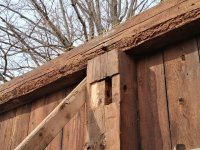
The other tool shown I have never owned is a broad axe. However, I do have lots of posts and beams built with them on my circa-1825 farm. One can readily see the marks from the broad axe and adzes - and have also learned than many posts and beams got re-used, especially in so-called out-buildings. In our Granary, the two "sumpter/summer" beams do not match. The West is higher than the East - and the East is rabbeted to receive the upper ends of the shiplap siding (full post once the restoration is complete - maybe June).

Tsm Granary - Mortise in West post.jpg

Lots to appreciate in the old work - as with some of my older vessels and firearms.

All the best,

SJS
 
Back
Top