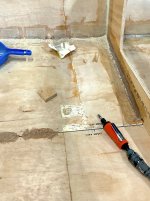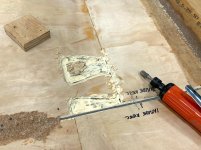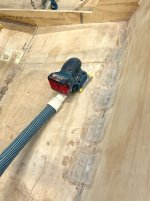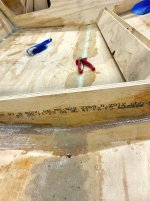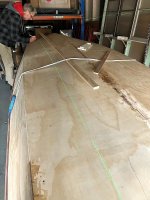
The Cackler 14 has three small keels, a centre keel, and either side a bilge keel. The plans specify: 18mm x 38mm softwood against hull, hardwood over. I couldn't get that size so I I'm using 19mm x 42mm instead.
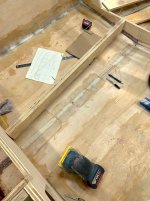
I couldn't figure out how to attach the softwood for the centre keel so that it sits nicely on the peak of the hull, so I chose to do the two side bilge keels first. I had my brother help me and we used a laser to project the bilge keel's position onto the hull.
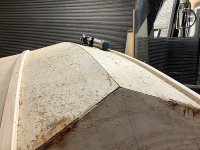
Some nice looking lines. Once we had the port-side bilge keel screwed down, we measured its position as a guide to fit the starboard bilge keel. I then chamfered the the edges to 45 degrees.
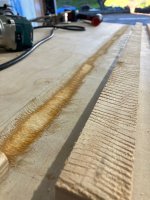
For ease of transport I bought the keel timber in 2.4 metre lengths (94.5") so another piece had to be added to reach the stern. After the dry fit, he hull and bottom side of the keel pieces were roughed up for extra tooth for glueing with thickened epoxy.

Once the keels were glued down I crawled underneath the boat to add more screws from inside.
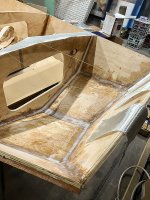
I was still at a loss of how the do the centre keel, so I worked on the rear transom instead. I cut out the hull panels to make the motor well, faired out the huge, rough transom fillets with a layer of smooth thickened epoxy and started to glass the edges/seams with the 400gsm biaxial tape.
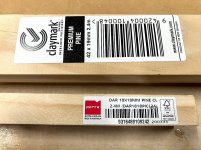
This is the timber I used for the keels. I finally came up with a solution for the centre keel, and that was to do it in two 18mm x 18mm (0.7"x 0.7") pieces side-by-side and fiil the gap with heaps of epoxy.

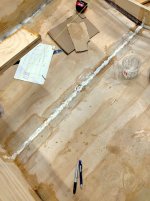
Here's the solution for the centre keel. Two square lengths of pine with a epoxy, sawdust filling.
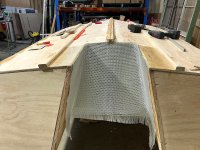
Centre keel gap is now filled. Back to work on the rear transom/motor mount. 800gsm fibreglass cloth ready for epoxy!
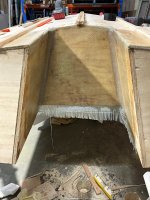
All glassed up. I had to peel and re-apply the heavy cloth twice before I got it to lay nicely over the radius of the fillets.
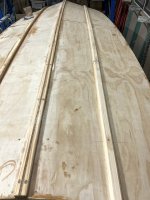
The keels looked OK, but the timber wasn't completely straight. Also because I was working by myself, and even though they were pre-drilled at the dry fit stage, I couldn't get the keels into their exact position during the glue up. As a result they are not 100% parallel and the spacing between them is slightly out.
The error is about ±3mm (±3/32") so I'm not going to stress about it.
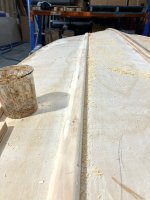
The 45º chamfer on the keels was sanded round so that glass cloth and tape would drape over them and apply nicely.

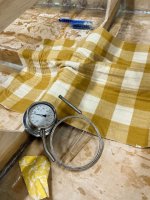
Mum wasn't happy about me stealing her nice silicone spatula to work on the boat!
The fillets on the keels required loads of epoxy, and in an effort to get them as even as possible I piped the mixture on using a ziplock bag. Wow, what a game changer -- from now on all fillets were piped!

I don't know why, but the centre keel has a sad face! It's all sanded smooth waiting for a covering of 400gsm biax tape.
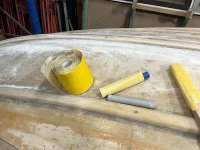
I mixed up too much resin when putting the biaxial tape over the bilge keels. Stupidly, rather than wasting it, I applied it over the centre keel to smooth out some of the bumps, but it had already started to go off and went on way too thick. My nicely sanded keel now needed extra sanding to bring it back to standard — gotta love doing things twice!
Lesson: if the epoxy starts heating up and going off don't panic apply it.

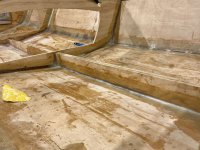
To prepare for the final hull sheathing I am using a carbide scraper to fair out the edges of the glass tape that was applied over bilge keel. Much better than sanding -- I can now work cleaner with minimal dust and more accuracy.