Aussie Cackler 14 build

Matthias,
Necessity is the mother of invention! I never would have thought to use moldings for side clamps but as long as the grain is straight with minimal runout, why not?
For years I also used an epoxy that was quite viscous and just recently tried one of the boutique boat building resins. What a difference in workability but as you mentioned, not near as flexible. I also used a penetrating epoxy on all interior hull surfaces as it was so much easier to apply and work into every nook and cranny. To ensure a truly waterproof sole, I used an industrial epoxy coating meant for coating the inside of storage tanks to create a sort of bathtub floor inside the boat. Aging the workability was so much easier than neat epoxy. Great write up! RM
 
Matthias,
Necessity is the mother of invention! I never would have thought to use moldings for side clamps but as long as the grain is straight with minimal runout, why not?
For years I also used an epoxy that was quite viscous and just recently tried one of the boutique boat building resins. What a difference in workability but as you mentioned, not near as flexible. I also used a penetrating epoxy on all interior hull surfaces as it was so much easier to apply and work into every nook and cranny. To ensure a truly waterproof sole, I used an industrial epoxy coating meant for coating the inside of storage tanks to create a sort of bathtub floor inside the boat. Aging the workability was so much easier than neat epoxy. Great write up! RM
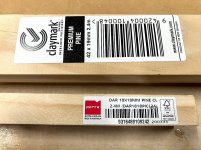
I went through the entire shelf of mouldings and chose the best ones.
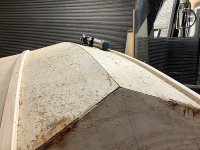
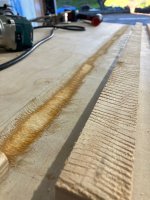
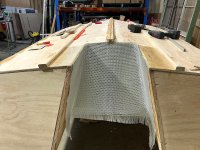
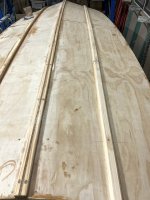
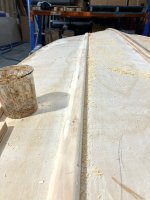
Initially when I first glued on the moulding I had planned on it being the first of two laminations, but now I reckon it will suffice on its own, covered with two layers of tape and then a strip of HDPE over the top as the rub rail.
 
Matthias,
HDPE for a rub rail is a great idea. UHMW, if available, is even better. Can be bonded with G-Flex epoxy or something similar if flame treated. UHMW has worked wonderfully for me on my Kara Hummer as wear strips on the bottom of the hull. I think you will really enjoy your new boat and nothing comes close to the satisfaction of building your own.
All the best, RM
 
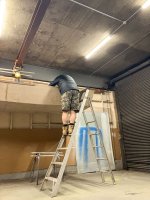
01 ladder work.jpg
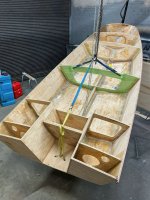
Never thought that building a boat would require working at heights. For little jobs such as removing the wire stitches it was more practical to leave the boat hanging because some stitches were more easily pulled out from underneath.

Had to redo the wire stitches along the chines between bulkhead 2 and 3 because after dropping to boat down to the floor again I noticed some of the stitch holes in the plywood had started to elongate and the chine joint started to loosen up getting out of shape. All this moving around was not good, so it was time to finish filleting and start laying some tape.
02 BowFloatCompartment.jpg
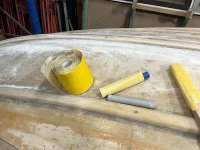
I'm using a combination of 100mm and 150mm 400gsm biaxial tape. (that's roughly 4" and 6". I bought a 328-foot-long roll of each)
Had to sand smooth these bow fillets then fair them with another thin layer of thickened epoxy -- the white stuff -- before laying down the boat's first section of tape.
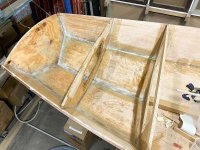
03 ForeSectionTaped.jpg
Front floatation compartment and storage compartment all taped up.
04 Bulk3and4.jpg
Taping the chine between bulkhead three and four.

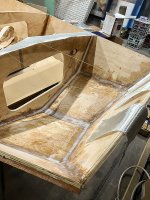
05 FuelCompartment.jpg
Working on the fuel/rear flotation compartment. These fillets were quite rough and required a decent amount of sanding to smooth out before they could be glass taped.

On the plus side, I'm enjoying the build process because just about all of the sanding so far has been done with 40 grit and it gets done quick! I'm not looking forward to fairing the hull with fine grit papers. In general progress is slow because the work is done after hours at work and I don't stay back more than 2hrs, and I'm only doing that a couple of nights per week.

06 ElectricBlanky.jpg
There's been some cold temperatures overnight and one batch of fillets took three days to completely set! The daytime temperature in the factory hovers around 14ºC and has been as low as 12. It's impossible to heat the space so I thought I could keep sections of fresh epoxy cosy with an old electric blanket! There's some waxed paper under the blanket to stop it sticking.
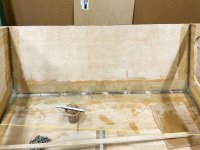
07 FuelCompartmentDone.jpg
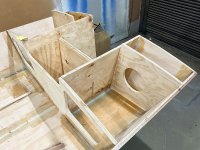
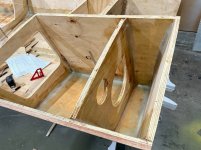
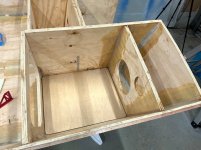
Finished taping the fuel/floatation compartment. The next job is to install the floatation bulkhead (the piece with the big hole in it) and build a light floor in front of it so that the fuel tank has a level surface to sit on.
 
Mattias,
I can't imagine working on a boat suspended in mid air! You are correct to worry about your chine joints. My Poleboat faced somewhat similar circumstances when the cheap folding sawhorses collapsed early in the build. Fortunately it only required minor tweaking to get the boat square again. For wetting out biaxial tape, I found it helpful to make a shallow rectangular box to wet out my strips before transferring them the short distance to the boat. Another great timesaver is to lay your biaxial strips on top of your uncured fillets. RM
 
Mattias,
I can't imagine working on a boat suspended in mid air! You are correct to worry about your chine joints. My Poleboat faced somewhat similar circumstances when the cheap folding sawhorses collapsed early in the build. Fortunately it only required minor tweaking to get the boat square again. For wetting out biaxial tape, I found it helpful to make a shallow rectangular box to wet out my strips before transferring them the short distance to the boat. Another great timesaver is to lay your biaxial strips on top of your uncured fillets. RM
Do you have pictures of your pole boat? Would be interested in seeing how you built your poling platform.

The laying of tape and making fillets was certainly a learning and evolution process. I now don't wet the tape in position any more. And do it more or less like you described.
I mark the area, cut the tape to size, paint the marked area with epoxy, wait about half an hour, wet out the tape on the workbench on a layer of waxed paper or plastic, then roll the strips into bundles that I carry to the boat and unroll into the correct position.

For filleting I now use a piping bag for all fillets and let the long sausage sit a while before spreading it out. So much easier than spooning uneven globs out a tub with a stick and trying to work that into a nice even fillet. I try to do wet on wet where I can, but working only for an hour here and there makes it difficult to coordinate.
 
Do you have pictures of your pole boat? Would be interested in seeing how you built your poling platform.
Mattias,
There is no platform since I absolutely suck at poling; a Poleboat in name only. To get around, I row with oars. Sorry about the photo, it seems that I can't access them since they were uploaded to the cloud.
RM
 
Last edited:
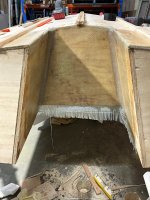
01 fuel and float_n.jpgThis is the port side fuel compartment and floatation chamber. I don't want the fuel tanks sitting on the slope of the hull panel so I'm making a level floor for them. The floatation chamber (between the bulkhead with two holes and the rear transom) will eventually be filled with expanding pouring foam.

02 fuel floor_n.jpg
Test fitting the fuel tank floor. It's 6mm hardwood marine ply and will be glassed in once I screw in the bilge keels, which need to be screwed through the hull panel from inside the boat..

03 fuel tank_n.jpg
Fuel tank sits nice and level now. Just gotta figure out a way to stop it jumping around when I'm pounding through the chop.

04 die grinder_n.jpg
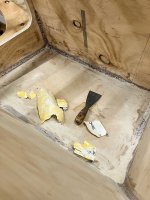
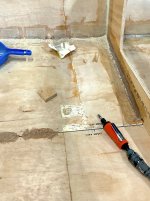
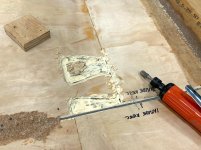
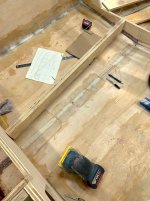
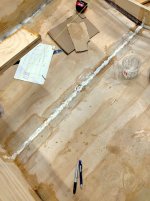
When the blind puzzle scarf joints were CNC machined, the plywood wasn't vacuumed down properly and the sheet moved during cutting. Basically after I glued the two pieces together to make the hull panel I was left with an open area full of exposed dry PVA. Because epoxy doesn't bond to PVA I grabbed the die grinder and carved out all of the surface PVA.

05 die grinder2_n.jpg
Close-up of the PVA removal.


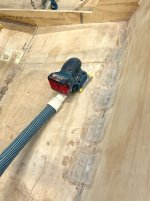
06 sanding_n.jpg
Port side chine. In a few areas where I thought I needed greater strength while filleting between the wires, I added tabs of biaxial tape. Quite some sanding was required to smooth these out in readiness for fully taping the seam.

07 taped and repaired.jpg
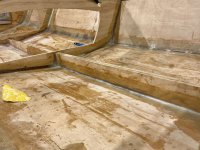
Overview of the taped seams. To fill the centre V where the hull panels meet at the keel I mixed some sawdust and fumed silica with the epoxy to make the filleting paste. Maybe this is wrong, maybe I'm over filling the seam? I just thought it was too deep and large an area to fill with solid thickened epoxy, hence I added the saw dust.

08 last stitches for snitches.jpg
Removing the last wires so I can sand and prepare for the centre stringer installation. The plans show a hardwood longitudinal for this, but I'm making it from plywood instead.

09 clamp town.jpg
Laminating two pieces of 19mm ply to make the aft centre stringer.

10 beached.jpg
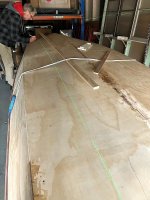
When the boat is sitting on the trestles I can not reach into the centre of the boat easily to do any work there. So for proper access to confidently do the stringer work, the boat had to be unceremoniously laid on the ground!

11 first time.jpg
First time in the boat!
🥳

I wasn't happy about getting into the boat with it lying on the concrete, but it was the only way I could have proper access to comfortably do the stringer install.

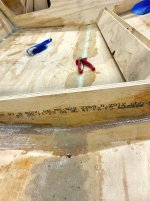
12 first stringer.jpg
Sanding and prepping for the stringer install. I didn't bother glassing over the tabs because the stringer would be glued and glassed over that entire area anyway.


13 stringer glue.jpg
Epoxy glue laid out, ready for the stringer to be set.

14 stringer in.jpg
Stringer is in, somewhat filleted and screwed for support while the epoxy cures. As soon as I had the stringer glued and screwed I placed the boat as true and level as possible back on the trestles so that it would not be distorted while the epoxy set.
 
Last edited:
Back
Top